TOTAL PAGEVIEWS

TRANSLATE

Tuesday, 14 December 2021

14-12-2021 EL PALMAR, ALBUFERA - EURASIAN HOOPOE (Upupa epops)


14-12-2021 EL PALMAR, ALBUFERA - SMALL WHITE BUTTERFLY (Pieris rapae)


Pieris rapae is a small-to-medium-sized butterfly species of the whites-and-yellows family Pieridae. It is known in Europe as the small white, in North America and the United Kingdom as the cabbage white or cabbage butterfly, on several continents as the small cabbage white, and in New Zealand as the white butterfly. The butterfly is recognizable by its white color with small black dots on its wings, and it can be distinguished from P. brassicae by the latter's larger size and black band at the tip of the forewings.

The caterpillar of this species, often referred to as the "imported cabbageworm", is a pest to crucifer crops such as cabbage, kale, bok choy and broccoli. Pieris rapae is widespread in Europe and Asia; it is believed to have originated in the Eastern Mediterranean region of Europe and to have spread across Eurasia thanks to the diversification of brassicaceous crops and the development of human trade routes. Over the past two centuries, it spread to North Africa (about 1800), North America (1860s), Hawaii (1897), New Zealand (1930), and Australia (1937), as a result of accidental introductions.

14-12-2021 EL PALMAR, ALBUFERA - COMMON SANDPIPER (Actitis hypoleucos)


The Common Sandpiper, Actitis hypoleucos, is a small wader of the Palearctic region, easily recognized by its greyish-brown upperparts and pristine white underparts. Adults typically measure between 18-20 cm in length, with a wingspan of 32-35 cm. They possess short, dark-yellowish legs and feet, and a bill that is pale at the base with a dark tip.

In the field, look for the Common Sandpiper's distinctive stiff-winged flight pattern, just above the water's surface. During the non-breeding season, they appear duller and exhibit more noticeable barring on the wings, which is most visible at close range. Juveniles display heavier barring above and buff edges to their wing feathers. The species can be differentiated from the similar Spotted Sandpiper by its darker legs and feet and the crisper wing pattern, especially in flight.

These birds are often found near freshwater sources, where they nest on the ground in close proximity to the water's edge.

The Common Sandpiper breeds across much of temperate and subtropical Europe and Asia. It is a migratory bird, wintering in Africa, southern Asia, and Australia. During migration, large numbers may congregate in stop-over locations such as Palau in Micronesia.

Common Sandpipers are typically solitary or found in small groups. They may form larger flocks during migration or at breeding season roosts but seldom join multispecies flocks.

When breeding, these birds nest on the ground near freshwater. A notable behavior is the young's ability to cling to a parent's body, being flown to safety when threatened.


14-12-2021 SOLLANA, ALBUFERA - EURASIAN KESTREL (Falco tinnunculus)


The common kestrel (Falco tinnunculus), also known as the European kestrel, Eurasian kestrel or Old World kestrel, is a species of predatory bird belonging to the kestrel group of the falcon family Falconidae. In the United Kingdom, where no other kestrel species commonly occurs, it is generally just called "kestrel".
This species occurs over a large native range. It is widespread in Europe, Asia and Africa, as well as occasionally reaching the east coast of North America. It has colonized a few oceanic islands, but vagrant individuals are generally rare; in the whole of Micronesia for example, the species was only recorded twice each on Guam and Saipan in the Marianas.


In the cool-temperate parts of its range, the common kestrel migrates south in winter; otherwise it is sedentary, though juveniles may wander around in search for a good place to settle down as they become mature. It is a diurnal animal of the lowlands and prefers open habitat such as fields, heaths, shrubland and marshland. It does not require woodland to be present as long as there are alternative perching and nesting sites like rocks or buildings. It will thrive in treeless steppe where there are abundant herbaceous plants and shrubs to support a population of prey animals. The common kestrel readily adapts to human settlement, as long as sufficient swathes of vegetation are available, and may even be found in wetlands, moorlands and arid savanna. It is found from the sea to the lower mountain ranges, reaching elevations up to 4,500 m (14,800 ft) ASL in the hottest tropical parts of its range but only to about 1,750 m (5,740 ft) in the subtropical climate of the Himalayan foothills.


The common kestrel, Falco tinnunculus, is a bird of prey from the kestrel group within the falcon family Falconidae. It is also known as the European kestrel, Eurasian kestrel, or Old World kestrel. In the United Kingdom, it is often simply referred to as the "kestrel." This raptor is small compared to other birds of prey but larger than most songbirds, with long wings and a distinctive long tail.

Males and females exhibit sexual dimorphism in their plumage. The male has a blue-grey cap and tail with a black tip bordered by a narrow white rim. Its back is chestnut with black spots, and the underside is buff with black streaks. The female is larger and lacks the blue-grey coloring, having a brown back with black bars and a similar underside to the male. Both sexes have a prominent black malar stripe, bright yellow cere, feet, and eye-ring, with dark toenails, bill, and iris.


The common kestrel favors open habitats such as fields, heaths, shrubland, and marshland. It does not require woodland but needs alternative perching and nesting sites like rocks or buildings. It thrives in treeless steppes and can adapt to human settlements and various landscapes, from wetlands to arid savannas.

This species has a vast range, being widespread in Europe, Asia, and Africa, and occasionally reaching the east coast of North America. It has colonized some oceanic islands, though vagrant individuals are generally rare.

The common kestrel is diurnal and can be sedentary or migratory, depending on the region. It is known for its characteristic hunting behavior, hovering 10-20 meters above the ground before diving steeply onto prey. It is also capable of seeing ultraviolet light, which aids in detecting the urine trails of small mammals.

Breeding occurs in spring or the start of the dry season, with the kestrel preferring cavity nests in cliffs, trees, or buildings. Clutches typically consist of 3-7 eggs, which are incubated by both parents. The young fledge after 4-5 weeks and stay with the family for a short period thereafter.


The lesser kestrel and American kestrel are similar but not closely related. The lesser kestrel lacks black on the upperside except for wing and tail tips, while the American kestrel has much grey in the wings of males.

The common kestrel's diet consists almost exclusively of mouse-sized mammals, such as voles, shrews, and true mice. It may also consume small birds, particularly during the summer when fledglings are abundant. Invertebrates and arthropods can be significant food sources seasonally.

The IUCN lists the common kestrel as Least Concern. Its population has fluctuated but remains generally stable, with an estimated 1-2 million pairs globally. Some subspecies, such as those in the Canary Islands, are rarer and number less than 1000 adult birds.

14-12-2021 SOLLANA, ALBUFERA - WOOD SANDPIPER (Tringa glareola)


The wood sandpiper (Tringa glareola) is a small wader belonging to the sandpiper family Scolopacidae. A Eurasian species, it is the smallest of the shanks, a genus of mid-sized, long-legged waders that largely inhabit freshwater and wetland environments, as opposed to the maritime or coastal habitats of other, similar species.

The wood sandpiper was formally described in 1758 by the Swedish naturalist Carl Linnaeus in the tenth edition of his Systema Naturae under the current binomial name Tringa glareola. Linnaeus cited his own Fauna Svecica that had been published in 1746. He specified the type locality as Europe but it is now restricted to Sweden. The species is considered to be monotypic: no subspecies are recognised. The genus name, Tringa, is the Neo-Latin name given to the green sandpiper (Tringa ochropus) in 1599 by Aldrovandus, based on the Ancient Greek trungas, a "thrush-sized, white-rumped, tail-bobbing" wading bird mentioned by Aristotle. The specific glareola is from the Latin glarea, meaning "gravel".


The wood sandpiper resembles a longer-legged, more delicate form of the aforementioned green sandpiper (T. ochropus), or a solitary sandpiper (T. solitaria), albeit with a shorter, finer bill, brown back and longer yellowish legs. The wood sandpiper differs from the green by having a smaller, less contrasting white rump-patch, while the solitary sandpiper has no rump-patch, at all. However, the wood sandpiper is not closely related to these two species; its closest relative is the common redshank (T. totanus), with which it shares a sister relationship with the marsh sandpiper (T. stagnatilis). These three species are a group of smallish shanks with red or yellowish legs, displaying a breeding plumage of subdued, light-brown above (with some darker mottling), and a pattern of somewhat smaller, diffuse, brownish spots on the breast and neck.


The wood sandpiper breeds in subarctic wetlands, from the Scottish Highlands in the west, east across Eurasia and the Palearctic. They will migrate to Africa, South Asia (particularly India) and Australia. Vagrant birds have been seen as far into the Pacific as the Hawaiian Islands. In Micronesia, it is a regular visitor to Palau and the Mariana Islands, where flocks of up to 32 birds have been reported; it is observed and recorded on Kwajalein, Marshall Islands, approximately once each decade. The wood sandpiper is also encountered in the Western Pacific region of East Asia and some Western Pacific islands between mid-October and mid-May. A slight westward-expansion saw the establishment of a small resident breeding population in Scotland, beginning in the 1950s. This species is usually found in and around freshwater habitats during migration and wintering.


Mature wood sandpipers moult all of their primary feathers between August and December, whilst juvenile birds shed a varying number of outer primaries between December and April, much closer to their departure from Africa. Immature birds are also much more flexible than older birds regarding the timing (and rate) of their moult and refueling. Adults and immatures which accumulate fuel loads of c.50% of their lean body mass can potentially cross distances of 2397–4490 km in one non-stop flight.


The wood sandpiper nests primarily on the ground, or will re-use an abandoned tree nest of another bird species, such as the fieldfare (Turdus pilaris). Four pale-green eggs are laid between March and May. These are incubated by both sexes beginning with the last egg. They hatch after 22 to 23 days. They are initially cared for by both parents but the female normally departs after a few days. The young can feed themselves. The young fledge when aged around 30 days.


They forage for invertebrates by probing their bills in shallow water or into wet mud, such as lakeshores or riverbanks, and mainly eat aquatic insects, crustaceans, arthropods, various worms, and other small prey.

The wood sandpiper is one of the species to which the Agreement on the Conservation of African-Eurasian Migratory Waterbirds (AEWA) applies. With an apparently stable, healthy global population, it is considered a Species of Least Concern, as per the IUCN.


Arboreal Nesting: While most sandpipers nest exclusively on the ground, the Wood Sandpiper often reuses abandoned tree nests of other birds, such as those of the Fieldfare.

Long-Distance Migration: They are "marathon" flyers, capable of traveling up to 4,490 km (approx. 2,790 miles) in a single non-stop flight after refueling.

Parental Roles: Both parents incubate the typically four pale-green eggs. However, the female often departs just a few days after the chicks hatch to regain energy, leaving the male to raise the young until they can fly at about 30 days old.

Defensive Tactics: When threatened, they may feign injury (pretending to have a broken wing) to lure predators away from their nest.


14-12-2021 SOLLANA, VALENCIA - EURASIAN KESTREL (Falco tinnunculus)


The common kestrel (Falco tinnunculus) is a bird of prey species belonging to the kestrel group of the falcon family Falconidae. It is also known as the European kestrel, Eurasian kestrel, or Old World kestrel. In the United Kingdom, where no other kestrel species commonly occurs, it is generally just called "kestrel".

This species occurs over a large range. It is widespread in Europe, Asia, and Africa, as well as occasionally reaching the east coast of North America. It has colonized a few oceanic islands, but vagrant individuals are generally rare; in the whole of Micronesia for example, the species was only recorded twice each on Guam and Saipan in the Marianas.

Monday, 13 December 2021

9-12-2021 CITY OF ARTS AND SCIENCES, VALENCIA - RED CRESTED POCHARD (MALE) (Netta rufina)


The Red-crested Pochard, Netta rufina, is a striking large diving duck. Its name is drawn from the Greek word for duck, 'Netta', and the Latin 'rufina', meaning 'golden-red', a nod to the male's vibrant plumage.

Males are resplendent with a rounded orange head, a red bill, and a contrasting black breast. Their sides are a crisp white, with a brown back and a black tail. Females, on the other hand, are clad in more subdued tones, primarily pale brown with a darker back and crown, and a whitish face. During eclipse, males resemble females but retain their red bills.


These ducks favor lowland marshes and lakes, thriving in the wetland habitats of southern Europe.

The Red-crested Pochard breeds from the steppe and semi-desert regions near the Black Sea to Central Asia and Mongolia. It is a somewhat migratory species, with northern populations wintering in the Indian Subcontinent and Africa.

Gregarious by nature, Red-crested Pochards form large flocks in the winter, often mingling with other diving ducks such as the Common Pochard. They are known to both dive and dabble for their food.


The red-crested pochard (Netta rufina) is a large diving duck. The scientific name is derived from Greek Netta "duck", and Latin rufina, "golden-red" (from rufus, "ruddy"). Its breeding habitat is lowland marshes and lakes in southern Europe and it extends from the steppe and semi-desert areas on the Black Sea to Central Asia and Mongolia, wintering in the Indian subcontinent and Africa. It is somewhat migratory, and northern birds winter further south into north Africa.


The adult male is unmistakable. It has a rounded orange head, red bill and black breast. The flanks are white, the back brown, and the tail black. The female is mainly a pale brown, with a darker back and crown and a whitish face. Eclipse males are like females but with red bills. They are gregarious birds, forming large flocks in winter, often mixed with other diving ducks, such as common pochards. They feed mainly by diving or dabbling. They eat aquatic plants, and typically upend for food more than most diving ducks.

9-12-2021 CITY OF ARTS AND SCIENCES, VALENCIA - COMMON POCHARD (FEMALE) (Aythya ferina)


9-12-2021 CITY OF ARTS AND SCIENCES, VALENCIA - COMMON POCHARD (MALE) (Aythya ferina)


The Common Pochard (Aythya ferina) is a medium-sized diving duck, belonging to the family Anatidae. It is a bird of robust build, with a sloping forehead and a relatively long bill. The male is distinguished by its chestnut head and neck, black breast and tail, and pale grey body with fine vermiculations. The female is more subdued in coloration, with a brownish body and a less vibrant head and neck.


Males can be identified by their striking chestnut head and neck, black breast, and pale grey body. They have a dark grey bill with a blue-grey band and yellow-orange to red irises, which intensify during the breeding season. Females and juveniles are less colorful, with brownish tones and grey legs and feet. The female's iris is brown, sometimes with a yellowish tinge, while juveniles have a yellow-olive iris that darkens with age.


Gregarious by nature, Red-crested Pochards form large flocks in the winter, often mingling with other diving ducks such as the Common Pochard. They are known to both dive and dabble for their food.

A wheezing veht call can be given by the male. Series of hoarse vrah-vrah-vrah calls can also be heard from females.

Red-crested pochards build nests by the lakeside among vegetation and lay 8–12 pale green eggs. The birds' status in the British Isles is much confused because there have been many escapes and deliberate releases over the years, as well as natural visitors from the continent. However, it is most likely that they are escapees that are now breeding wild and have built up a successful feral population.

13-12-2021 PEGO MARJAL, ALICANTE - LITTLE EGRET (Egretta garzetta)


13-12-2021 PEGO MARJAL, ALICANTE - BOOTED EAGLE (Hieraaetus pennatus)


9-12-2021 CITY OF ARTS AND SCIENCES, VALENCIA - LOGGERHEAD SEA TURTLE (Caretta caretta)


Sunday, 12 December 2021

9-12-2021 CITY OF ARTS AND SCIENCES, VALENCIA - YELLOW LEGGED GULL (Larus michahellis)

The Yellow-legged Gull (Larus michahellis) is a large, robust seabird with a commanding presence. Its size can be quite variable, with the smallest females being scarcely larger than a Common Gull, and the largest males approaching the heft of a Great Black-backed Gull. Adults typically exhibit a grey back, a shade lighter than that of the Lesser Black-backed Gull, and their heads are notably whiter in the autumn months. A distinctive feature is their yellow legs, which give this species its common name.

When observing the Yellow-legged Gull, look for the yellow legs that contrast with the grey back and the white head, which becomes even whiter during the autumn. The wing tips are black with limited white spots, and adults have a red spot on the bill. The eye is surrounded by a red ring. Juveniles can be identified by their paler head, rump, and underparts, dark bill and eyes, and a black band on the tail.

This gull favors a variety of coastal environments, often nesting on sea cliffs, islands, and occasionally on buildings within urban settings. It is also known to breed on trees in some regions.

The Yellow-legged Gull has a breeding range centered around the Mediterranean Sea, extending to the Atlantic islands and coasts as far north as Brittany and west to the Azores. Its presence is also noted on the western side of the Black Sea.

The species is known for its adaptability, with many individuals remaining in the same area year-round, while others migrate to milder regions of western Europe or head south to areas such as Senegal and the Red Sea. Post-breeding dispersal can lead to increased numbers in regions like southern England from July to October.

9-12-2021 CITY OF ARTS AND SCIENCES, VALENCIA - HARBOR SEAL (Phoca vitulina)


9-12-2021 CITY OF ARTS AND SCIENCES, VALENCIA - SOUTH AMERICAN SEA LION


12-12-2021 LLUTXENT, VALENCIA - EURASIAN BLACKCAP (MALE) (Sylvia atricapilla)


12-12-2021 LLUTXENT, VALENCIA - EUROPEAN STARLING (Sturnus vulgaris)


The Common starling (Sturnus vulgaris) is a medium-sized passerine bird in the starling family, Sturnidae. It is a noisy bird, especially in communal roosts and other gregarious situations, with an unmusical but varied song. Its gift for mimicry has been noted in literature including the Mabinogion and the works of Pliny the Elder and William Shakespeare.

The Сommon starling is a medium-sized bird. It has glossy black plumage with a metallic sheen, which is speckled with white at some times of the year. The legs are pink and the bill is black in winter and yellow in summer. Juveniles are grey-brown and by their first winter resemble adults though often retaining some brown juvenile feathering, especially on the head. They can usually be sexed by the color of the irises, rich brown in males, mouse-brown, or grey in females.


Common starlings are native to Eurasia and are found throughout Europe, northern Africa (from Morocco to Egypt), India (mainly in the north but regularly extending further south and extending into the Maldives) Nepal, the Middle East including Syria, Iran, and Iraq and north-western China. Common starlings in the south and west of Europe are mainly resident, although other populations migrate from regions where the winter is harsh. Most birds from northern Europe, Russia, and Ukraine migrate southwestwards or southeastwards. In the autumn, when immigrants are arriving from eastern Europe, many of Britain's common starlings are setting off for Iberia and North Africa. Common starlings prefer urban or suburban areas, reedbeds, grassy areas such as farmland, grazing pastures, playing fields, golf courses, and airfields where short grass makes foraging easy. They occasionally inhabit open forests and woodlands and are sometimes found in shrubby areas. These birds are also found in coastal areas, where they nest and roost on cliffs and forage amongst the seaweed.

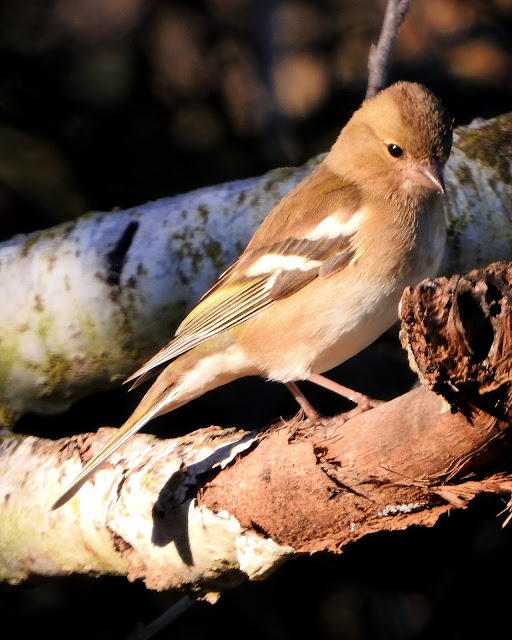
12-12-2021 LLUTXENT, VALENCIA - COMMON CHAFFINCH (FEMALE) (Fringilla coelebs)


12-12-2021 LLUTXENT, VALENCIA - EURASIAN BLACKCAP (FEMALE) (Sylvia atricapilla)


The Eurasian blackcap (Sylvia atricapilla) is a common and widespread warbler that breeds in much of Europe, western Asia, and northwestern Africa. Its rich and varied song has led to the blackcap being described as the "mock nightingale" and it has been featured in literature, films, and music.

The Eurasian blackcap is mainly grey in color with distinct male and female plumages. The adult male has olive-grey upperparts, other than a paler grey nape and a neat black cap on the head. The underparts are light grey, becoming silvery white on the chin, throat, and upper breast. The tail is dark grey, with an olive tint to the outer edge of each feather. The bill and long legs are grey, and the iris is reddish brown. The female resembles the male but has a reddish-brown cap and a slightly browner tone to the grey of the upperparts. Juveniles are similar to the female, but their upperparts have a slight rufous tinge, and the breast and flanks have a more olive tone; young males have darker brown cap than their female counterparts.


Eurasian blackcaps are very active birds. They are usually found singly but may form loose groups during migration. They feed by the day mainly picking prey off foliage and twigs, but may occasionally hover, flycatch or feed on the ground. Blackcaps eat a wide range of small fruit and squeeze out any seeds on a branch before consuming the pulp. They defend good winter food sources, and at garden feeding stations they don't hesitate to repel competitors as large as starlings and blackbirds. Eurasian blackcaps are known for their beautiful loud song. The males' song is a rich musical warbling, often ending in a loud high-pitched crescendo, which is given in bursts of up to 30 seconds. In some geographically isolated areas, such as islands, peninsulas, and valleys in the Alps, males sing a simpler fluting song. The main call of Eurasian blackcaps is a hard 'tac-tac', like stones knocking together, and other vocalizations include a squeaking sweet alarm, and a low-pitched trill. Blackcaps may sometimes mimic the song of other birds, especially preferring to copy the garden warbler and the common nightingale.