TOTAL PAGEVIEWS

TRANSLATE

Monday, 20 December 2021

1-6-2019 LINYANTI CAMP, BOTSWANA - SMITH'S BUSH SQUIRREL (Paraderus Cepapi)


Smith's bush squirrel (Paraxerus cepapi), also known as the yellow-footed squirrel or tree squirrel, is an African bush squirrel which is native to woodlands of the southern Afrotropics.

It is found in Angola, Botswana, the DRCongo, Malawi, Mozambique, Namibia, South Africa, Tanzania, Zambia, and Zimbabwe. It is a common rodent which is diurnal by nature.

Its total length is 350 mm (14 in), half of which is tail; weight 200 g (7.1 oz). The coat colour varies throughout the region. In the western and arid parts of its range, it is pale grey, and in the eastern localities, more brown. Its head and legs are a rusty colour. Colouration on the chest varies from yellowish to buff in the east, to white in the west. This squirrel's belly is white. These alert and ever busy creatures carry their long tails extended backwards.


Smith's bush squirrels are primarily vegetarian, but like most rodents, they take insect prey and use their front feet to manipulate food items when feeding. They scatter-hoard seeds next to tree trunks or grass tufts, thereby facilitating tree regeneration.

Essentially arboreal animals, they also spend a great deal of time on the ground, foraging for food. When disturbed, Smith's bush squirrels always seek the refuge of trees. At night, territorial family groups nest together in holes in trees. Offspring become sexually mature between six and nine months old, when they are forcibly evicted by the breeding pair. The males are mainly responsible for territorial defense, although females also chase intruders when they care for dependent pups. To promote group cohesion, a common scent is shared by mutual grooming, which is an important facet of the social fibre of this species. Smith's bush squirrels are diligent in their grooming and a mother tree squirrel holds her offspring down with her fore legs while grooming it with licks, nibbles, and scratches with her claws.

1-6-2019 LINYANTI CAMP, BOTSWANA - AFRICAN SAVANNA ELEPHANT (Loxodonta Africana)


The African bush elephant (Loxodonta africana), also known as the African savanna elephant, is a species of elephant native to sub-Saharan Africa. It is one of three extant elephant species and, along with the African forest elephant, one of two extant species of African elephant. It is the largest living terrestrial animal, with fully grown bulls reaching an average shoulder height of 3.04–3.36 metres (10.0–11.0 ft) and a body mass of 5.2–6.9 tonnes (5.7–7.6 short tons); the largest recorded specimen had a shoulder height of 3.96 metres (13.0 ft) and an estimated body mass of 10.4 tonnes (11.5 short tons). The African bush elephant is characterised by its long prehensile trunk with two finger-like processes; a convex back; large ears which help reduce body heat; and sturdy tusks that are noticeably curved. The skin is grey with scanty hairs, and bending cracks which support thermoregulation by retaining water.


The African bush elephant inhabits a variety of habitats such as forests, grasslands, woodlands, wetlands and agricultural land. It is a mixed herbivore feeding mostly on grasses, creepers, herbs, leaves, and bark. The average adult consumes about 150 kg (330 lb) of vegetation and 230 L (51 imp gal; 61 US gal) of water each day. A social animal, the African bush elephant often travels in herds composed of cows and their offspring. Adult bulls usually live alone or in small bachelor groups. During the mating season, males go through a process called musth, a period of high testosterone levels and heightened aggression. For females, the menstrual cycle lasts three to four months, and gestation around 22 months, the longest of any mammal.

Sunday, 19 December 2021

2-6-2019 LINYANTI, BOTSWANA - RED BILLED FRANCOLIN (Pternistis-adspersus)


The red-billed spurfowl (Pternistis adspersus), also known as the red-billed francolin, is a species of bird in the family Phasianidae. It is found in Southern Africa, including Angola, Botswana, Namibia, South Africa, Zambia, and Zimbabwe.

The species exhibits sexual dimorphism in size. Males are larger, measuring 38 cm (15 in) in length and weighing 340–635 g (12.0–22.4 oz), whereas females measure 33 cm (13 in) in length and weigh 340–549 g (12.0–19.4 oz). The species has barred underparts (in contrast to the related Natal spurfowl) and a conspicuous yellow eye-ring.

The red-billed spurfowl was described in 1838 by the English naturalist George Robert Waterhouse from specimens collected by James Edward Alexander on his expedition to Namaqualand and Damaraland. Waterhouse coined the binomial name Francolinus adspersus and noted that the specimens had come near the Fish River in what is now Namibia. The specific epithet adspersus is Latin for "sprinkling". The species is now placed in the genus Pternistis that was introduced by the German naturalist Johann Georg Wagler in 1832. The red-billed spurfowl is considered as monotypic: the proposed subspecies mesicus is not recognised.

2-6-2019 LINYANTI, BOTSWANA - AFRICAN SACRED IBIS (Threskiornis aethiopicus ssp. aethiopicus)


The African sacred ibis (Threskiornis aethiopicus ) is a wading bird native to Africa and the Middle East. It is especially known for its role in the religion of the Ancient Egyptians, where it was linked to the god Thoth; despite this, the species is currently extirpated from Egypt.
African sacred ibises have all-white body plumage apart from dark plumes on the rump. Males are generally slightly larger than females.

The bald head and neck, thick curved bill, and legs of these birds are black. The white wings show a black rear border in flight. The eyes are brown with a dark red orbital ring. Sexes are similar, but juveniles have dirty white plumage, a smaller bill and some feathering on the neck, greenish-brown scapular, and more black on the primary coverts.

6-12-2021 MONTE CORONA, VALENCIA - TRUE CRICKET (Genus Petaloptila)


Petaloptila is a genus of true crickets (family Gryllidae) in the subfamily Gryllomorphinae, commonly known as glandular crickets. Erected by José Pantel in 1890, this genus is predominantly found on the European mainland, with a high concentration of endemic species in the Iberian Peninsula (Spain and Portugal) and parts of Italy.

Key Biological FeaturesGlandular 

Structures: A defining characteristic of the genus is the presence of a specialized abdominal tubercle or gland. This features prominently in reproductive interactions, earning them the common name "glandular crickets".

Reduced Wings (Micropterous): These crickets have highly reduced wings (tegmina). In males, the tegmina are modified into tiny, rectangular lobes with variable veins, and they lack a functional stridulatory (chirping) apparatus. In females, the wings are practically invisible, remaining hidden beneath the pronotum.


Physical Appearance: They generally feature pale straw-to-brown coloration, elongated legs, long antennae, and females possess a long, straight ovipositor for laying eggs in soil or crevices.

Habitat and Ecology

Cave and Subterranean Bias: Many species are troglobitic or troglophilic, meaning they live in limestone caves, rocky chasms, and subterranean environments.

Microclimate Preferences: They thrive in environments with total darkness, low temperatures, and exceptionally high humidity levels (often exceeding 95%).

Aseasonal Reproduction: Because cave environments lack strict seasonal signals, adult and nymph populations frequently coexist throughout the year, suggesting continuous, aseasonal reproductive cycles.

Saturday, 18 December 2021

9-12-2021 CITY OF ARTS AND SCIENCES, VALENCIA - FLORIDA RED BELLY TURTLE (Pseudemys nelsoni)


The Florida Red-Bellied Cooter (Pseudemys nelsoni) is a large, herbivorous freshwater turtle in Florida, known for its reddish-orange belly, yellow-striped dark skin, and preference for basking in sunny spots on logs in lakes, rivers, and marshes, often sharing habitats with alligators, whose nests they sometimes use for laying eggs, growing large (females up to 14+ inches) and living for decades. 

Appearance & Size
Shell: Brown/olive carapace (top) with light streaks; reddish-orange plastron (bottom) that fades with age.

Head/Limbs: Olive to black skin with bright yellow stripes; males have longer foreclaws and tails.

Size: Females are larger, reaching up to 35-40 cm (14-15 inches) long, while males are smaller. 


Habitat & Behavior

Home: Permanent fresh waters like ponds, swamps, canals, and slow rivers across Florida.

Basking: Loves to sunbathe on logs/rocks to regulate body temperature, quickly diving when disturbed.

Diet: Primarily aquatic plants (waterweed, duckweed), but juveniles eat insects; adults may eat algae and carrion.

Nesting: Females nest spring-fall, sometimes laying eggs in alligator nests for protection. 

9-12-2021 CITY OF ARTS AND SCIENCES, VALENCIA - RED CRESTED POCHARD (FEMALE) (Netta rufina)


The Red-crested Pochard, Netta rufina, is a striking large diving duck. Its name is drawn from the Greek word for duck, 'Netta', and the Latin 'rufina', meaning 'golden-red', a nod to the male's vibrant plumage.

Males are resplendent with a rounded orange head, a red bill, and a contrasting black breast. Their sides are a crisp white, with a brown back and a black tail. Females, on the other hand, are clad in more subdued tones, primarily pale brown with a darker back and crown, and a whitish face. During eclipse, males resemble females but retain their red bills.


These ducks favor lowland marshes and lakes, thriving in the wetland habitats of southern Europe.

The Red-crested Pochard breeds from the steppe and semi-desert regions near the Black Sea to Central Asia and Mongolia. It is a somewhat migratory species, with northern populations wintering in the Indian Subcontinent and Africa.

Gregarious by nature, Red-crested Pochards form large flocks in the winter, often mingling with other diving ducks such as the Common Pochard. They are known to both dive and dabble for their food.


The red-crested pochard (Netta rufina) is a large diving duck. The scientific name is derived from Greek Netta "duck", and Latin rufina, "golden-red" (from rufus, "ruddy"). Its breeding habitat is lowland marshes and lakes in southern Europe and it extends from the steppe and semi-desert areas on the Black Sea to Central Asia and Mongolia, wintering in the Indian subcontinent and Africa. It is somewhat migratory, and northern birds winter further south into north Africa.


The adult male is unmistakable. It has a rounded orange head, red bill and black breast. The flanks are white, the back brown, and the tail black. The female is mainly a pale brown, with a darker back and crown and a whitish face. Eclipse males are like females but with red bills. They are gregarious birds, forming large flocks in winter, often mixed with other diving ducks, such as common pochards. They feed mainly by diving or dabbling. They eat aquatic plants, and typically upend for food more than most diving ducks.

9-12-2021 CITY OF ARTS AND SCIENCES, VALENCIA - PIED AVOCET (Recurvirostra avosetta)


9-12-2021 CITY OF ARTS AND SCIENCES, VALENCIA - RED CRESTED POCHARD (FEMALE) (Netta rufina)


The Red-crested Pochard, Netta rufina, is a striking large diving duck. Its name is drawn from the Greek word for duck, 'Netta', and the Latin 'rufina', meaning 'golden-red', a nod to the male's vibrant plumage.

Males are resplendent with a rounded orange head, a red bill, and a contrasting black breast. Their sides are a crisp white, with a brown back and a black tail. Females, on the other hand, are clad in more subdued tones, primarily pale brown with a darker back and crown, and a whitish face. During eclipse, males resemble females but retain their red bills.

These ducks favor lowland marshes and lakes, thriving in the wetland habitats of southern Europe.

The Red-crested Pochard breeds from the steppe and semi-desert regions near the Black Sea to Central Asia and Mongolia. It is a somewhat migratory species, with northern populations wintering in the Indian Subcontinent and Africa.

Gregarious by nature, Red-crested Pochards form large flocks in the winter, often mingling with other diving ducks such as the Common Pochard. They are known to both dive and dabble for their food.

9-12-2021 CITY OF ARTS AND SCIENCES, VALENCIA - BLACK NECKED SWAN (Cygnus melancoryphus)


An unmistakable bird with bold patterns, Black-necked swans are characteristic and majestic inhabitants of southern South Americas wetlands. They are easily distinguished by their immaculate white body feathers that contrast sharply with their velvety black head and neck. The bill is blue-gray in color and has a noticeable, double-lobed scarlet-colored knob, called a caruncle, at its base. The eyes are surrounded by a thin white line which goes along the sides of the head to the rear. Males and females are similar in appearance, though females are generally slightly smaller. The juvenile does not have a caruncle, and has a head and neck that is more brownish-black, with varying amounts of brownish-tipped and grayish-flecked feathers.


The Black-necked swan inhabits southern South America, from Tierra del Fuego and the Falkland Islands northwards to Paraguay, central Chile, and southern Brazil. It lives in a wide variety of freshwater and saline habitats such as shallow coastal regions along the Pacific Ocean, estuaries, inland lakes, lagoons, and marshes. Particularly important are places that are rich with submerged aquatic vegetation.


These swans are highly social birds, and are gregarious outside of the time of the breeding season. They become territorial during the breeding season and divide up into mated pairs, nesting in small colonies or as solitary pairs, but they regroup once the young have hatched, each flock numbering thousands of birds. 

These flocks may move around, dependent on the climate and resources, but usually stay in the south of South America until migrating north. 


The black-necked swan (Cygnus melancoryphus ) is the largest waterfowl native to South America.

Black-necked swans are diurnal and most of their time is spent in water. If males need to defend their territory, they display aggressive behavior such as lowering their neck and thrusting the head forward. After fighting with beating its wings, the male returns to the female in triumph, continuously lifting its chin and calling.

9-12-2021 CITY OF ARTS AND SCIENCES, VALENCIA - RED KNOBBED COOT (Fulica cristata)


9-12-2021 CITY OF ARTS AND SCIENCES, VALENCIA - NORTHERN SHOVELER (MALE) (Spatula clypeata)


The Northern shoveler (Spatula clypeata) is a widespread species of duck unmistakable in the northern hemisphere due to its large spatulate bill. In Britain, it is known simply as the shoveler. One part of its scientific name Spatula is the Latin for a "spoon" or "spatula"; the other part is derived from the Latin clypeata and can be translated as "shield-bearing".

During the breeding season, the male of this species has an iridescent dark green head, white breast, and chestnut belly and flanks. In flight, pale blue forewing feathers are revealed, separated from the green speculum by a white border. In early fall the male will have a white crescent on each side of the face. In non-breeding (eclipse) plumage, the male resembles the female. The female is a drab mottled brown like other dabblers, with plumage much like a female mallard, but easily distinguished by the long broad bill, which is gray-tinged with orange on the cutting edge and lower mandible. The female's forewing is gray.


Northern shovelers breed in wide areas across Eurasia, western North America, and the Great Lakes region of the United States. They are strongly migratory and winter in southern Europe, Africa, the Indian Subcontinent, the Caribbean, northern South America, the Malay Archipelago, Japan, and other areas. In North America, they winter south of a line from Washington to Idaho, from New Mexico east to Kentucky, and along the Eastern Seaboard as far north as Massachusetts. Northern shovelers are birds of open wetlands, such as wet grassland or marshes with some emergent vegetation. Preferred feeding areas include lakes, estuaries, coastal shorelines, salt marshes, flooded fields, and agricultural ponds.


Northern shovelers are social ducks that live in small flocks and coexist peacefully with many other species. They feed during the day by dabbling for plant food, often by swinging their bill from side to side and using the bill to strain food from the water. Their wide-flat bill is equipped with well-developed lamellae; these are small, comb-like structures on the edge of the bill that act like sieves, allowing the birds to skim crustaceans and plankton from the water's surface. This adaptation gives them an advantage over other puddle ducks, with which they do not have to compete for food resources during most of the year. Thus, mud-bottomed marshes rich in invertebrate life are their habitat of choice. During the midday heat, the birds usually rest on land near the water. Northern shovelers are fairly quiet and communicate with each other only in certain situations; males have a low clunking call, whereas females have a light Mallard-like quack.

Friday, 17 December 2021

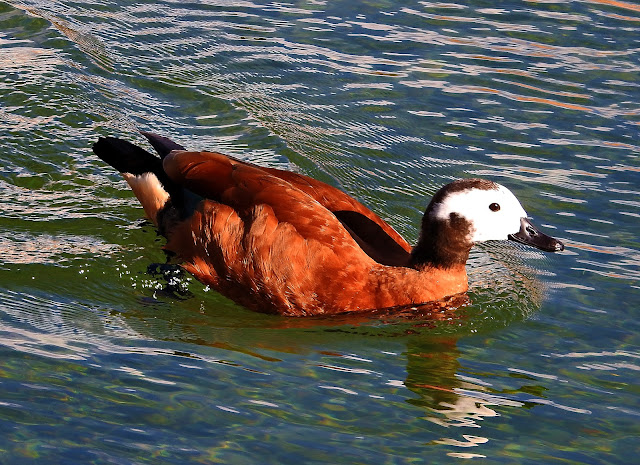
9-12-2021 CITY OF ARTS AND SCIENCES, VALENCIA - SOUTH AFRICAN SHELDUCK (MALE) (Tadorna cana)


9-12-2021 CITY OF ARTS AND SCIENCES, VALENCIA - SOUTH AFRICAN SHELDUCK (FEMALE) (Tadorna cana)


9-12-2021 CITY OF ARTS AND SCIENCES, VALENCIA - COMMON BOTTLENOSE DOLPHIN (Tursiops truncatus)


The common bottlenose dolphin or Atlantic bottlenose dolphin (Tursiops truncatus) is a wide-ranging marine mammal of the family Delphinidae. The common bottlenose dolphin is a very familiar dolphin due to the wide exposure it gets in captivity in marine parks and dolphinariums, and in movies and television programs. It is the largest species of the beaked dolphins. It inhabits temperate and tropical oceans throughout the world, and is absent only from polar waters. While formerly known simply as the bottlenose dolphin, this term is now applied to the genus Tursiops as a whole. As considerable genetic variation has been described within this species, even between neighboring populations, many experts think additional species may be recognized.

9-12-2021 CITY OF ARTS AND SCIENCES, VALENCIA - EURASIAN GREAT CORMORANT (Phalacrocorax carbo)


Great cormorants are monogamous, with pairs sometimes reuniting in subsequent years. The male chooses the nest site, displaying to attract the female by waving his wings up and down and flashing his white rump patch. He will also swing his head from side to side while holding his tail erect and calling loudly. The female responds by swinging her head slightly and “purring”. This species breeds at any time, depending on food resources. Breeding takes place in colonies of as many as 2,000 pairs, although colonies of a smaller size are typical. Colonies are often located close to other species, like darters, herons, and spoonbills. The parents build their nest with reeds, sticks, and seaweeds on a cliff, in a tree, or in a bush, according to the region. Often a nest is reused. 2 to 6 eggs are laid, with an average of 3-4. The parents share the incubation for 27 to 31 days. The altricial chicks hatch at intervals and fledge at about 50 days old. They remain with their parents for 50 or more days, relying on them for food. The young start to breed between 2 and 4 years old, typically when 3 years old.


Great cormorants have large populations and are widespread, although surveys are not complete across their range. Being an important fish competitor, in the past, they were almost extinct in Europe. However, in recent years increases have been observed, thanks to intensive protection. But in some countries, expanding conflicts with fish farms and fisheries lead to new persecution. Another threat is that hatchlings may be eaten by raptors before fledging.


The IUCN Red List reports that the global population of Great cormorants is about 1,400,000-2,100,000 individuals. The European population is estimated at 401,000-512,000 pairs, which equates to 803,000-1,020,000 mature individuals. Overall, currently, Great cormorants are classified as Least Concern (LC) on the IUCN Red List and their numbers today are increasing.