TOTAL PAGEVIEWS

TRANSLATE

Tuesday, 23 November 2021

22-11-2021 VILLALONGA, VALENCIA - HOUSE SPARROW (FEMALE) (Passer domesticus)


The house sparrow (Passer domesticus) is a member of the sparrow family Passeridae. This small bird typically measures around 16 cm (6.3 in) in length and weighs between 24–39.5 g (0.85–1.39 oz). The species exhibits sexual dimorphism, with females and young birds displaying pale brown and grey plumage, while males are characterized by more vibrant black, white, and brown markings.

Males can be identified by their bright black, white, and brown markings, with a distinctive black bib, white cheeks, and a grey crown. Females lack the striking head patterns of males and are predominantly buffish with softer coloration. Juveniles resemble adult females but are generally paler with less defined markings.


The house sparrow is highly adaptable and can thrive in both urban and rural environments. It is commonly found in close association with human habitation and avoids dense forests, grasslands, polar regions, and deserts far from human development.

Native to Europe, the Mediterranean Basin, and much of Asia, the house sparrow has been introduced to various regions worldwide, including parts of Australasia, Africa, and the Americas, making it one of the most widely distributed wild birds.

House sparrows are social birds, often seen in flocks. They exhibit a range of behaviors, including dust or water bathing and communal roosting. Males are known to be territorial around their nesting sites.


The house sparrow's vocalizations are predominantly variations of a simple chirping call. Males may sing or give an "ecstatic call" during the breeding season, and the species uses a variety of calls for different social interactions.

House sparrows are generally monogamous and may mate for life. They can breed in the season following their hatching and often produce multiple clutches per year, with each clutch containing up to five eggs. Nest sites are varied, with a preference for cavities.

The house sparrow can be confused with other seed-eating birds, such as the Eurasian tree sparrow, which has a chestnut crown and a black cheek patch.

An opportunistic feeder, the house sparrow's diet consists mainly of seeds from grains and weeds, but it also consumes insects and other invertebrates, especially during the breeding season when feeding young.

23-11-2021 MONTE CORONA, VALENCIA - STINK BUG (Acrosternum heegeri)


23-11-2021 MONTE CORONA, VALENCIA - RUSTY DOT PEARL MOTH (Udea ferrugalis)


23-11-2021 MONTE CORONA, VALENCIA - COMMON HAIRY FIELD SPIDER (Neoscona subfusca)

https://www.inaturalist.org/taxa/320611-Neoscona-subfusca


23-11-2021 MONTE CORONA, VALENCIA - BLACK REDSTART (MALE) (Phoenicurus ochruros)


Monday, 22 November 2021

6-6-2019 MOREMI CAMP, BOTSWANA -BLACK HERON (Egretta ardesiaca)


The black heron is a medium-sized wading bird known for its striking black plumage and unique "canopy feeding" behavior, where it uses its wings to create shade to attract fish. It primarily inhabits wetlands across Africa, south of the Sahara, and other regions like Madagascar, nesting in colonies and feeding on fish, insects, and crustaceans. During breeding season, adults develop long, wispy plumes on their heads. 

Appearance
Size: Approximately 42.5 to 66 cm (16.7 to 26.0 in) long, with a weight between 270 and 390 g (9.5–13.8 oz).
Plumage: Dark grey to black overall, with a slaty or bluish sheen.
Beak: Black.
Legs and Feet: Black legs, with yellow feet in adults.
Breeding Plumage: Adults grow long, black, shaggy crests on their heads. 

Sunday, 21 November 2021

20-11-2021 MONTE CORONA, VALENCIA - CUTWORM MOTH (Polymixis dubia)


21-11-2021 MONTE CORONA, VALENCIA - SPOTTED MONAESES CRAB SPIDER (Monaeses paradoxus)

https://www.inaturalist.org/taxa/676207-Monaeses-paradoxus


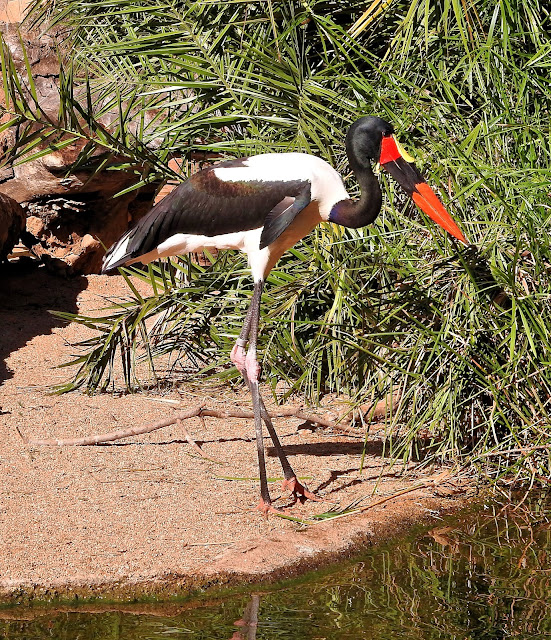
3-11-2021 BIOPARC, VALENCIA - SADDLE BILLED STORK (Ephippiorhynchus senegalensis)


The Saddle-billed Stork, known scientifically as Ephippiorhynchus senegalensis, is a magnificent and large wading bird belonging to the stork family, Ciconiidae. It stands tall, reaching heights of 145 to 150 cm (4 ft 9 in to 4 ft 11 in), with a wingspan stretching an impressive 2.4 to 2.7 m (7 ft 10 in to 8 ft 10 in). The male of the species is typically larger and heavier than the female, with weights ranging from 5.1 to 7.52 kg (11.2 to 16.6 lb).

Distinguishing between the sexes is straightforward; the female boasts golden yellow irises, while the male has brown irises complemented by dangling yellow wattles. Both sexes share a striking plumage, with iridescent black covering the head, neck, back, wings, and tail, and the rest of the body along with primary flight feathers being white. The juvenile birds wear a more subdued brownish-grey attire. The stork's bill is a vivid red adorned with a black band and a distinctive yellow frontal shield, the namesake "saddle." Their legs and feet are black with pink hocks, and a bare red patch of skin can be found on the chest, which intensifies in color during the breeding season.


Saddle-billed Storks have a preference for protected areas abundant in open water, such as national parks and protected swamps, which provide safer environments for both the birds and ornithologists.

This species is a resident breeder in sub-Saharan Africa, with its range extending from Sudan, Ethiopia, and Kenya in the east, down to South Africa, and also found in The Gambia, Senegal, Côte d'Ivoire, and Chad in West Africa.

In flight, the Saddle-billed Stork is a sight to behold, with its neck outstretched and its large bill drooping below the belly. They are generally silent, save for the bill-clattering sounds made at their nests. The species is known for its solitary nesting habits and lifelong pair bonds, often seen in pairs even outside the breeding season.


The Saddle-billed Stork builds large, deep stick nests in trees, where it lays one to five white eggs, with incubation lasting 30–35 days. After hatching, the chicks fledge in another 70–100 days, often staying within the parents' territory until the next breeding season.

These storks are adept hunters, stabbing their bills into water, mud, and vegetation to catch a variety of prey. They primarily feed on aquatic creatures like lungfish and catfish, which can weigh up to 1.3 kg (2.9 lb). They also consume frogs, snails, small mammals, birds, snakes, and various insects.

The Saddle-billed Stork is currently listed as Least Concern on the IUCN Red List, although it is considered endangered in South Africa.

The Saddle-billed Stork is closely related to the Black-necked Stork, the only other member of the genus Ephippiorhynchus, which is widespread across Asia and Australia.

Saturday, 20 November 2021

20-11-2021 MONTE CORONA, VALENCIA - GERMAN YELLOWJACKET (Vespula germanica)


20-11-2021 MONTE CORONA, VALENCIA - BOX BUG (Gonocerus acuteangulatus)


The box bug (Gonocerus acuteangulatus) is a 11 to 14 mm long reddish-brown squash bug found across the Mediterranean, Europe, and parts of Asia. It feeds on plant juices from shrubs and tree fruits, and can act as a pest on crops like hazelnuts.

Appearance and ID

Adults: Speckled reddish-brown with a narrow body and sharp, pointed shoulder edges on the thorax.

Nymphs: Bright green abdomens that may turn dull red later in the year.


Similar species: Looks like the dock bug, but has a slimmer body and sharper points on the sides.

Habitat and Diet

Warm areas: Prefers dry, sunny spots, hedges, and forest edges.Host plants: Lives on box trees, hawthorn, buckthorn, and various berry shrubs.

Pest potential: Can damage hazelnuts and pistachios by causing kernel loss or deformities.

Friday, 19 November 2021

16-11-2021 MONTE CORONA, VALENCIA - TRUE CRICKET (Gryllomorpha dalmatina)

https://www.inaturalist.org/taxa/1304989-Petaloptila-bolivari


22-8-2021 SPACE MUSEUM, CUENCA - GREEN VEINED WHITE BUTTERFLY (Pieris napi)


22-8-2021 SPACE MUSEUM, CUENCA - BRUSH FOOTED BUTTERFLY (Family Nymphalidae)


The Nymphalidae are the largest family of butterflies, with more than 6,000 species distributed throughout most of the world. Belonging to the superfamily Papilionoidea, they are usually medium-sized to large butterflies. Most species have a reduced pair of forelegs and many hold their colourful wings flat when resting. They are also called brush-footed butterflies or four-footed butterflies, because they are known to stand on only four legs while the other two are curled up; in some species, these forelegs have a brush-like set of hairs, which gives this family its other common name. 

Many species are brightly coloured and include popular species such as the emperors, monarch butterfly, admirals, tortoiseshells, and fritillaries. However, the under wings are, in contrast, often dull and in some species look remarkably like dead leaves, or are much paler, producing a cryptic effect that helps the butterflies blend into their surroundings.

17-11-2021 DEVESES, VALENCIA - BLACK REDSTART (FEMALE) (Phoenicurus ochruros)


Thursday, 18 November 2021

17-11-2021 RACO DE OLLA, VALENCIA - BLACK WINGED STILT (Himantopus himantopus)


15-11-2021 LORCA, VALENCIA - EUROPEAN WOOD MOUSE (Apodemus sylvaticus)


The wood mouse (Apodemus sylvaticus) is a murid rodent native to Europe and northwestern Africa. It is closely related to the yellow-necked mouse (Apodemus flavicollis) but differs in that it has no band of yellow fur around the neck, has slightly smaller ears, and is usually slightly smaller overall: around 90 mm (3.54 in) in length and 23 g in weight.ope and is a very common and widespread species, is commensal with people and is sometimes considered a pest. Other common names are long-tailed field mouse, field mouse, common field mouse, and European wood mouse. This species is a known potential carrier of the Dobrava sequence of hantavirus which affects humans and may pose serious risks to human health.


Wood mice inhabit forests, grasslands, and cultivated fields, tending to seek out more wooded areas in winter. Almost entirely nocturnal and terrestrial, wood mice burrow extensively, build nests of plants and live in buildings during harsh seasons. It is one of the most intensively studied species in the genus. In Europe, it ranges north to Scandinavia and east to Ukraine. The wood mouse is also found in northwestern Africa and on many Mediterranean islands.

Wood mice are primarily seed eaters, particularly seeds of trees such as oak, beech, ash, lime, hawthorn, and sycamore. If seeds are plentiful on the ground, they carry them back to their nests/burrows for storage. They may eat small invertebrates such as snails and insects, particularly in late spring and early summer when seeds are least available. Later in the season they will eat berries, fruits, fungi and roots. In winter, they may prey on hibernating bats, but this is still debatable.

Wood mice are mainly active during the dark, probably having evolved so to avoid predation, employing several anti-predatory strategies, though breeding females may be more active in daylight in order to collect sufficient food. While foraging, wood mice pick up and distribute visually conspicuous objects, such as leaves and twigs, which they then use as landmarks during exploration. If a wood mouse is caught by its tail, it can quickly shed the end of it, which may never regrow. Despite its name, it prefers hedgerows to woodland. During the colder months, wood mice do not hibernate; however, during severe winter seasons they can fall into a torpid state, a decrease in physiological activity.

17-11-2021 RACO DE OLLA, VALENCIA - LITTLE GREBE (JUVENILE) (Tachybaptus ruficollis)


17-11-2021 EL PALMAR, VALENCIA - BLACK REDSTART (FEMALE) (Phoenicurus ochruros)


The black redstart (Phoenicurus ochruros) is a small passerine bird in the genus Phoenicurus. Like its relatives, it was formerly classed as a member of the thrush family (Turdidae), but is now known to be an Old World flycatcher (Muscicapidae). Obsolete common names include Tithys redstart, blackstart (not to be confused with the species currently known as blackstart) and black redtail.


The black redstart is 13–14.5 cm (5.1–5.7 in) in length and 12–20 g (0.42–0.71 oz) in weight, similar to the common redstart. The adult male is overall dark grey to black on the upperparts and with a black breast; the lower rump and tail are orange-red, with the two central tail feathers dark red-brown. The belly and undertail are either blackish-grey (western subspecies; see Taxonomy and systematics, above) or orange-red (eastern subspecies); the wings are blackish-grey with pale fringes on the secondaries forming a whitish panel (western subspecies) or all blackish (eastern subspecies). 


The female is grey (western subspecies) to grey-brown (eastern subspecies) overall except for the orange-red lower rump and tail, greyer than the common redstart; at any age the grey axillaries and underwing coverts are also distinctive (in the Common Redstart these are buff to orange-red). There are two distinct forms in first calendar year males at least in western subspecies, with the first ('carei') being similar to females and the second ('paradoxus') approaching adult males but lacking the whitish wing panel that does only develop during post-breeding moult of wing feathers in the second calendar year. This second form is much rarer than the first. 

17-11-2021 EL PALMAR, VALENCIA - BLACK HEADED GULL (Chroicocephalus ridibundus)


17-11-2021 EL PALMAR, VALENCIA - WHITE WAGTAIL (Motacilla alba)

The White Wagtail (Motacilla alba) is a small, elegant passerine bird, a member of the family Motacillidae, which includes pipits and longclaws. This slender bird measures between 16.5 to 19 cm in length, with East Asian subspecies reaching up to 21 cm. It is characterized by its long, constantly wagging tail, a behavior that has become synonymous with the genus. Weighing an average of 25 g, the White Wagtail can live up to 12 years in the wild.

Adult White Wagtails exhibit a distinctive plumage with a combination of grey, black, and white. The bird's upper parts are generally grey, with a white face, belly, and breast. Males during the breeding season may show a darker back, and the species is known for its sharp, brisk call and more melodious song during courtship.

The White Wagtail is commonly found in open country, often in close proximity to human habitation and water sources. It shows a preference for bare areas which facilitate the sighting and pursuit of prey. This bird has adapted well to urban environments, utilizing paved areas such as parking lots for foraging.


17-11-2021 CREU DE LONGA, VALENCIA - LITTLE EGRET (Egretta garzetta)


17-11-2021 MUNTANYETA DEL SANS, VALENCIA - EUROPEAN STONECHAT (MALE) (Saxicola rubicola)


The European stonechat, Saxicola rubicola, is a small, charming passerine bird, once thought to be a member of the thrush family but now placed within the Old World flycatcher family, Muscicapidae. This species exhibits a striking sexual dimorphism, with males donning a black plumage with vibrant orange throats and females wearing a more subdued brown.

Males in their summer plumage are unmistakable with their black heads, orange throats, and white bellies. They also sport a distinctive white half-collar and small white patches on the wings and rump. Females, on the other hand, are predominantly brown with less pronounced white wing patches. Both sexes have notably short wings, which are shorter than those of their migratory relatives.

The European stonechat favors heathlands, coastal dunes, and open grasslands dotted with shrubs, brambles, and heather. These habitats provide the perfect backdrop for their active foraging and breeding behaviors.

This species is widely distributed across Europe, reaching as far east as Ukraine and the South Caucasus, and can also be found in parts of North Africa.


Stonechats are known for their lively presence, often perching conspicuously as they keep a vigilant eye on their surroundings. They exhibit a partial migratory pattern, with some populations moving southward to escape the colder winters.

The male stonechat's song is a delightful, high-pitched twitter, reminiscent of a dunnock's melody. Both sexes communicate with a distinctive call that evokes the sound of two stones being tapped together.

European stonechats are monogamous during the breeding season and commence their reproductive efforts at one year of age. They raise two to three broods per season, with the female constructing the nest and both parents tending to the young.

The European stonechat can be confused with the Siberian stonechat and the African stonechat, but genetic evidence supports their distinction as separate species.

These birds are adept insectivores, gleaning a variety of invertebrates from their environment to sustain themselves and their offspring.

17-11-2021 CREU DE LONGA, VALENCIA - EUROPEAN STARLING (Sturnus vulgaris)


17-11-2021 CREU DE LONGA, VALENCIA - SPOTLESS STARLING (Sturnus unicolor)