TOTAL PAGEVIEWS

TRANSLATE

Showing posts with label IBERIAN GREEN FROG (Pelophylax perezi). Show all posts

Sunday, 23 August 2026

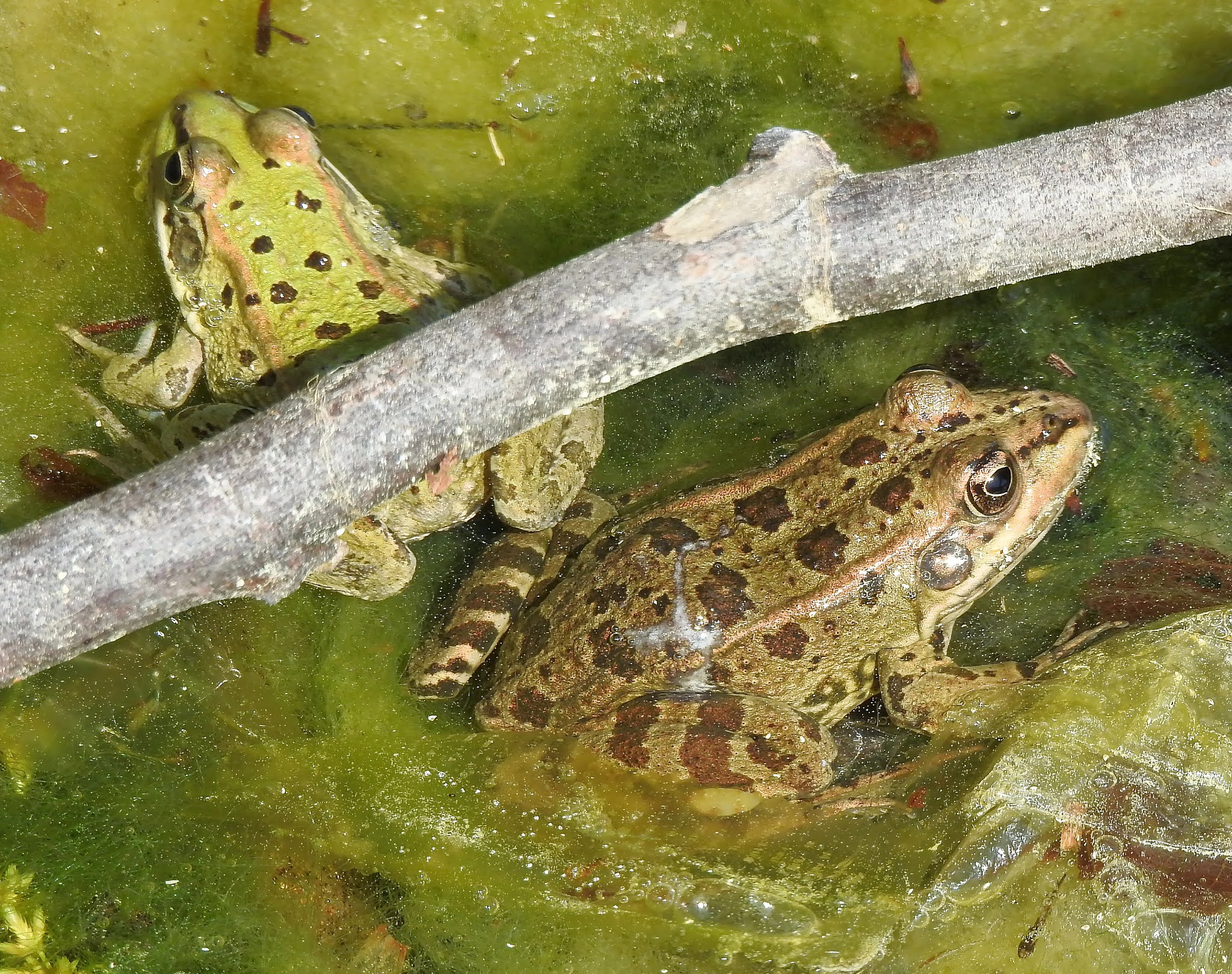
22-8-2026 RIO SERPIS, GANDIA - IBERIAN GREEN FROG (Pelophylax perezi)


The Perez's frog (Pelophylax perezi), also known as Iberian waterfrog, Iberian green frog or Coruna frog, is a species of frog in the family Ranidae. It is native to southern France, Portugal, Spain, and has been introduced to the Canary and Balearic Islands, Madeira, the United Kingdom, and the Azores. In the Iberian Peninsula it is widespread and common.

Its natural habitats are temperate forests, temperate shrubland, Mediterranean-type shrubby vegetation, rivers, intermittent rivers, swamps, freshwater lakes, intermittent freshwater lakes, freshwater marshes, intermittent freshwater marshes, sandy shores, arable land, and urban areas. It is not considered threatened by the IUCN.


A medium-sized, stout frog; snout-vent length is usually from 40 to 70 mm, but sometimes is longer than 10 cm (Docampo and Milagrosa-Vega 1988; González de la Vega 1988). The head is as long as wide, with prominent eyes located in dorsal position very close to each other. The tympanum is well marked, about 1/2 to 3/4 the eye diameter (Salvador and García-París 2001). Toes have well developed webbing. Skin is either smooth or slightly rough, with well-formed dorsolateral folds.

The dorsal coloration is very variable, usually green but also brown or grayish to dark gray. They usually show a vertebral stripe, mostly yellow or green. Two irregular rows of dark, rectangular spots are present on both sides of the vertebral stripe. These spots are also present on the rear limbs, sometimes forming a banded pattern. Some individuals lack both the spots and the vertebral stripe. Ventrally they are white with a variable number of dark spots. Males are smaller than females and have stronger forelimbs. They have gray vocal sacs than can be appreciated even when they are not in use.

Thursday, 16 July 2026

16-7-2026 RIO SERPIS GANDIA, VALENCIA - IBERIAN GREEN FROG (Pelophylax perezi)


The Perez's frog (Pelophylax perezi), also known as Iberian waterfrog, Iberian green frog or Coruna frog, is a species of frog in the family Ranidae. It is native to southern France, Portugal, Spain, and has been introduced to the Canary and Balearic Islands, Madeira, the United Kingdom, and the Azores. In the Iberian Peninsula it is widespread and common.

Its natural habitats are temperate forests, temperate shrubland, Mediterranean-type shrubby vegetation, rivers, intermittent rivers, swamps, freshwater lakes, intermittent freshwater lakes, freshwater marshes, intermittent freshwater marshes, sandy shores, arable land, and urban areas. It is not considered threatened by the IUCN.


A medium-sized, stout frog; snout-vent length is usually from 40 to 70 mm, but sometimes is longer than 10 cm (Docampo and Milagrosa-Vega 1988; González de la Vega 1988). The head is as long as wide, with prominent eyes located in dorsal position very close to each other. The tympanum is well marked, about 1/2 to 3/4 the eye diameter (Salvador and García-París 2001). Toes have well developed webbing. Skin is either smooth or slightly rough, with well-formed dorsolateral folds.

The dorsal coloration is very variable, usually green but also brown or grayish to dark gray. They usually show a vertebral stripe, mostly yellow or green. Two irregular rows of dark, rectangular spots are present on both sides of the vertebral stripe. These spots are also present on the rear limbs, sometimes forming a banded pattern. Some individuals lack both the spots and the vertebral stripe. Ventrally they are white with a variable number of dark spots. Males are smaller than females and have stronger forelimbs. They have gray vocal sacs than can be appreciated even when they are not in use.

Tadpoles grow up to 111 mm total length (Salvador 1985), but usually measure between 60-70 mm (Barbadillo et al. 1999). The spiracle is sinistral and the anus open on the right side of the base of the tail. Marginal papillae are absent from the upper side of the mouth. Denticles are arranged in a variable number of single rows (Llorente et al. 1994), but the most common formula is 2(2)/3. The dorsal fin is low, starting at the level of the spiracle. The tip of the tail is pointed. Ground coloration is green or light brown, with small, dark dots. These dots are denser and larger in the tail fin. The tail presents a typical pattern with three longitudinal dark stripes. The ventral coloration is white. 

Monday, 15 June 2026

15-6-2026 RIO SERPIS GANDIA, VALENCIA - IBERIAN GREEN FROG (Pelophylax perezi)

The Perez's frog (Pelophylax perezi), also known as Iberian waterfrog, Iberian green frog or Coruna frog, is a species of frog in the family Ranidae. It is native to southern France, Portugal, Spain, and has been introduced to the Canary and Balearic Islands, Madeira, the United Kingdom, and the Azores. In the Iberian Peninsula it is widespread and common.

Its natural habitats are temperate forests, temperate shrubland, Mediterranean-type shrubby vegetation, rivers, intermittent rivers, swamps, freshwater lakes, intermittent freshwater lakes, freshwater marshes, intermittent freshwater marshes, sandy shores, arable land, and urban areas. It is not considered threatened by the IUCN. A medium-sized, stout frog; snout-vent length is usually from 40 to 70 mm, but sometimes is longer than 10 cm (Docampo and Milagrosa-Vega 1988; González de la Vega 1988). The head is as long as wide, with prominent eyes located in dorsal position very close to each other. The tympanum is well marked, about 1/2 to 3/4 the eye diameter (Salvador and García-París 2001). Toes have well developed webbing. Skin is either smooth or slightly rough, with well-formed dorsolateral folds.

The dorsal coloration is very variable, usually green but also brown or grayish to dark gray. They usually show a vertebral stripe, mostly yellow or green. Two irregular rows of dark, rectangular spots are present on both sides of the vertebral stripe. These spots are also present on the rear limbs, sometimes forming a banded pattern. Some individuals lack both the spots and the vertebral stripe. Ventrally they are white with a variable number of dark spots. Males are smaller than females and have stronger forelimbs. They have gray vocal sacs than can be appreciated even when they are not in use.

Tadpoles grow up to 111 mm total length (Salvador 1985), but usually measure between 60-70 mm (Barbadillo et al. 1999). The spiracle is sinistral and the anus open on the right side of the base of the tail. Marginal papillae are absent from the upper side of the mouth. Denticles are arranged in a variable number of single rows (Llorente et al. 1994), but the most common formula is 2(2)/3. The dorsal fin is low, starting at the level of the spiracle. The tip of the tail is pointed. Ground coloration is green or light brown, with small, dark dots. These dots are denser and larger in the tail fin. The tail presents a typical pattern with three longitudinal dark stripes. The ventral coloration is white.

Saturday, 27 September 2025

27-9-2025 RIO SERPIS GANDIA, VALENCIA - IBERIAN GREEN FROG (Pelophylax perezi)

The Perez's frog (Pelophylax perezi), also known as Iberian waterfrog, Iberian green frog or Coruna frog, is a species of frog in the family Ranidae. It is native to southern France, Portugal, Spain, and has been introduced to the Canary and Balearic Islands, Madeira, the United Kingdom, and the Azores. In the Iberian Peninsula it is widespread and common.

Its natural habitats are temperate forests, temperate shrubland, Mediterranean-type shrubby vegetation, rivers, intermittent rivers, swamps, freshwater lakes, intermittent freshwater lakes, freshwater marshes, intermittent freshwater marshes, sandy shores, arable land, and urban areas. It is not considered threatened by the IUCN. A medium-sized, stout frog; snout-vent length is usually from 40 to 70 mm, but sometimes is longer than 10 cm (Docampo and Milagrosa-Vega 1988; González de la Vega 1988). The head is as long as wide, with prominent eyes located in dorsal position very close to each other. The tympanum is well marked, about 1/2 to 3/4 the eye diameter (Salvador and García-París 2001). Toes have well developed webbing. Skin is either smooth or slightly rough, with well-formed dorsolateral folds.

The dorsal coloration is very variable, usually green but also brown or grayish to dark gray. They usually show a vertebral stripe, mostly yellow or green. Two irregular rows of dark, rectangular spots are present on both sides of the vertebral stripe. These spots are also present on the rear limbs, sometimes forming a banded pattern. Some individuals lack both the spots and the vertebral stripe. Ventrally they are white with a variable number of dark spots. Males are smaller than females and have stronger forelimbs. They have gray vocal sacs than can be appreciated even when they are not in use.

Tadpoles grow up to 111 mm total length (Salvador 1985), but usually measure between 60-70 mm (Barbadillo et al. 1999). The spiracle is sinistral and the anus open on the right side of the base of the tail. Marginal papillae are absent from the upper side of the mouth. Denticles are arranged in a variable number of single rows (Llorente et al. 1994), but the most common formula is 2(2)/3. The dorsal fin is low, starting at the level of the spiracle. The tip of the tail is pointed. Ground coloration is green or light brown, with small, dark dots. These dots are denser and larger in the tail fin. The tail presents a typical pattern with three longitudinal dark stripes. The ventral coloration is white.

Sunday, 23 July 2023

23-7-2023 MONTE CORONA, VALENCIA - IBERIAN GREEN FROG (Pelophylax perezi)

The Perez's frog (Pelophylax perezi), also known as Iberian waterfrog, Iberian green frog or Coruna frog, is a species of frog in the family Ranidae. It is native to southern France, Portugal, Spain, and has been introduced to the Canary and Balearic Islands,[ Madeira, the United Kingdom, and the Azores. In the Iberian Peninsula it is widespread and common.

Its natural habitats are temperate forests, temperate shrubland, Mediterranean-type shrubby vegetation, rivers, intermittent rivers, swamps, freshwater lakes, intermittent freshwater lakes, freshwater marshes, intermittent freshwater marshes, sandy shores, arable land, and urban areas. It is not considered threatened by the IUCN.


Tuesday, 27 June 2023

27-6-2023 VIVEROS GARDENS, VALENCIA - IBERIAN GREEN FROG (Pelophylax perezi)


The Perez's frog (Pelophylax perezi), also known as Iberian waterfrog, Iberian green frog or Coruna frog, is a species of frog in the family Ranidae. It is native to southern France, Portugal, Spain, and has been introduced to the Canary and Balearic Islands, Madeira, the United Kingdom, and the Azores. In the Iberian Peninsula it is widespread and common.

Its natural habitats are temperate forests, temperate shrubland, Mediterranean-type shrubby vegetation, rivers, intermittent rivers, swamps, freshwater lakes, intermittent freshwater lakes, freshwater marshes, intermittent freshwater marshes, sandy shores, arable land, and urban areas.

Wednesday, 26 April 2023

26-4-2023 BICORP, VALENCIA - IBERIAN GREEN FROG (Pelophylax perezi)


The Perez's frog (Pelophylax perezi), also known as Iberian waterfrog, Iberian green frog or Coruna frog, is a species of frog in the family Ranidae. It is native to southern France, Portugal, Spain, and has been introduced to the Canary and Balearic Islands, Madeira, the United Kingdom, and the Azores. In the Iberian Peninsula it is widespread and common.

Its natural habitats are temperate forests, temperate shrubland, Mediterranean-type shrubby vegetation, rivers, intermittent rivers, swamps, freshwater lakes, intermittent freshwater lakes, freshwater marshes, intermittent freshwater marshes, sandy shores, arable land, and urban areas.

Friday, 29 October 2021

29-10-2021 MONTE CORONA, VALENCIA - IBERIAN GREEN FROG (Pelophylax perezi)


The Perez's frog (Pelophylax perezi), also known as Iberian waterfrog, Iberian green frog or Coruna frog, is a species of frog in the family Ranidae. It is native to southern France, Portugal, Spain, and has been introduced to the Canary and Balearic Islands, Madeira, the United Kingdom, and the Azores. In the Iberian Peninsula it is widespread and common.

Its natural habitats are temperate forests, temperate shrubland, Mediterranean-type shrubby vegetation, rivers, intermittent rivers, swamps, freshwater lakes, intermittent freshwater lakes, freshwater marshes, intermittent freshwater marshes, sandy shores, arable land, and urban areas. It is not considered threatened by the IUCN.


A medium-sized, stout frog; snout-vent length is usually from 40 to 70 mm, but sometimes is longer than 10 cm (Docampo and Milagrosa-Vega 1988; González de la Vega 1988). The head is as long as wide, with prominent eyes located in dorsal position very close to each other. The tympanum is well marked, about 1/2 to 3/4 the eye diameter (Salvador and García-París 2001). Toes have well developed webbing. Skin is either smooth or slightly rough, with well-formed dorsolateral folds.


The dorsal coloration is very variable, usually green but also brown or grayish to dark gray. They usually show a vertebral stripe, mostly yellow or green. Two irregular rows of dark, rectangular spots are present on both sides of the vertebral stripe. These spots are also present on the rear limbs, sometimes forming a banded pattern. Some individuals lack both the spots and the vertebral stripe. Ventrally they are white with a variable number of dark spots. Males are smaller than females and have stronger forelimbs. They have gray vocal sacs than can be appreciated even when they are not in use.


Tadpoles grow up to 111 mm total length (Salvador 1985), but usually measure between 60-70 mm (Barbadillo et al. 1999). The spiracle is sinistral and the anus open on the right side of the base of the tail. Marginal papillae are absent from the upper side of the mouth. Denticles are arranged in a variable number of single rows (Llorente et al. 1994), but the most common formula is 2(2)/3(1). The dorsal fin is low, starting at the level of the spiracle. The tip of the tail is pointed. Ground coloration is green or light brown, with small, dark dots. These dots are denser and larger in the tail fin. The tail presents a typical pattern with three longitudinal dark stripes. The ventral coloration is white.

Friday, 9 July 2021

7-7-2021 ALPERA, LA MANCHA - IBERIAN GREEN FROG (Pelophylax perezi)


The Perez's frog (Pelophylax perezi), also known as Iberian waterfrog, Iberian green frog or Coruna frog, is a species of frog in the family Ranidae. It is native to southern France, Portugal, Spain, and has been introduced to the Canary and Balearic Islands, Madeira, the United Kingdom, and the Azores. In the Iberian Peninsula it is widespread and common.

Its natural habitats are temperate forests, temperate shrubland, Mediterranean-type shrubby vegetation, rivers, intermittent rivers, swamps, freshwater lakes, intermittent freshwater lakes, freshwater marshes, intermittent freshwater marshes, sandy shores, arable land, and urban areas. It is not considered threatened by the IUCN. A medium-sized, stout frog; snout-vent length is usually from 40 to 70 mm, but sometimes is longer than 10 cm (Docampo and Milagrosa-Vega 1988; González de la Vega 1988). The head is as long as wide, with prominent eyes located in dorsal position very close to each other. The tympanum is well marked, about 1/2 to 3/4 the eye diameter (Salvador and García-París 2001). Toes have well developed webbing. Skin is either smooth or slightly rough, with well-formed dorsolateral folds.


 The dorsal coloration is very variable, usually green but also brown or grayish to dark gray. They usually show a vertebral stripe, mostly yellow or green. Two irregular rows of dark, rectangular spots are present on both sides of the vertebral stripe. These spots are also present on the rear limbs, sometimes forming a banded pattern. Some individuals lack both the spots and the vertebral stripe. Ventrally they are white with a variable number of dark spots. Males are smaller than females and have stronger forelimbs. They have gray vocal sacs than can be appreciated even when they are not in use.

Tadpoles grow up to 111 mm total length (Salvador 1985), but usually measure between 60-70 mm (Barbadillo et al. 1999). The spiracle is sinistral and the anus open on the right side of the base of the tail. Marginal papillae are absent from the upper side of the mouth. Denticles are arranged in a variable number of single rows (Llorente et al. 1994), but the most common formula is 2(2)/3. The dorsal fin is low, starting at the level of the spiracle. The tip of the tail is pointed. Ground coloration is green or light brown, with small, dark dots. These dots are denser and larger in the tail fin. The tail presents a typical pattern with three longitudinal dark stripes. The ventral coloration is white.

Monday, 21 September 2020

21-9-2020 CASTELLONET DE CONQUESTA , VALENCIA - IBERIAN GREEN FROG (Pelophylax perezi)

The Perez's frog (Pelophylax perezi), also known as Iberian waterfrog, Iberian green frog or Coruna frog, is a species of frog in the family Ranidae. It is native to southern France, Portugal, Spain, and has been introduced to the Canary and Balearic Islands, Madeira, the United Kingdom, and the Azores. In the Iberian Peninsula it is widespread and common.

Its natural habitats are temperate forests, temperate shrubland, Mediterranean-type shrubby vegetation, rivers, intermittent rivers, swamps, freshwater lakes, intermittent freshwater lakes, freshwater marshes, intermittent freshwater marshes, sandy shores, arable land, and urban areas. It is not considered threatened by the IUCN. A medium-sized, stout frog; snout-vent length is usually from 40 to 70 mm, but sometimes is longer than 10 cm (Docampo and Milagrosa-Vega 1988; González de la Vega 1988). The head is as long as wide, with prominent eyes located in dorsal position very close to each other. The tympanum is well marked, about 1/2 to 3/4 the eye diameter (Salvador and García-París 2001). Toes have well developed webbing. Skin is either smooth or slightly rough, with well-formed dorsolateral folds.

Sunday, 30 August 2020

30-8-2020 LA LLACUNA, VALENCIA - IBERIAN GREEN FROG (Pelophylax perezi)

The Perez's frog (Pelophylax perezi), also known as Iberian waterfrog, Iberian green frog or Coruna frog, is a species of frog in the family Ranidae. It is native to southern France, Portugal, Spain, and has been introduced to the Canary and Balearic Islands,[ Madeira, the United Kingdom, and the Azores. In the Iberian Peninsula it is widespread and common.

Its natural habitats are temperate forests, temperate shrubland, Mediterranean-type shrubby vegetation, rivers, intermittent rivers, swamps, freshwater lakes, intermittent freshwater lakes, freshwater marshes, intermittent freshwater marshes, sandy shores, arable land, and urban areas. It is not considered threatened by the IUCN.

Thursday, 30 July 2020

29-7-2020 EL BERRO, MURCIA - IBERIAN GREEN FROG (Pelophylax perezi)


The Perez's frog (Pelophylax perezi), also known as Iberian waterfrog, Iberian green frog or Coruna frog, is a species of frog in the family Ranidae. It is native to southern France, Portugal, Spain, and has been introduced to the Canary and Balearic Islands, Madeira, the United Kingdom, and the Azores. In the Iberian Peninsula it is widespread and common.

Its natural habitats are temperate forests, temperate shrubland, Mediterranean-type shrubby vegetation, rivers, intermittent rivers, swamps, freshwater lakes, intermittent freshwater lakes, freshwater marshes, intermittent freshwater marshes, sandy shores, arable land, and urban areas. It is not considered threatened by the IUCN. A medium-sized, stout frog; snout-vent length is usually from 40 to 70 mm, but sometimes is longer than 10 cm (Docampo and Milagrosa-Vega 1988; González de la Vega 1988). The head is as long as wide, with prominent eyes located in dorsal position very close to each other. The tympanum is well marked, about 1/2 to 3/4 the eye diameter (Salvador and García-París 2001). Toes have well developed webbing. Skin is either smooth or slightly rough, with well-formed dorsolateral folds.


The dorsal coloration is very variable, usually green but also brown or grayish to dark gray. They usually show a vertebral stripe, mostly yellow or green. Two irregular rows of dark, rectangular spots are present on both sides of the vertebral stripe. These spots are also present on the rear limbs, sometimes forming a banded pattern. Some individuals lack both the spots and the vertebral stripe. Ventrally they are white with a variable number of dark spots. Males are smaller than females and have stronger forelimbs. They have gray vocal sacs than can be appreciated even when they are not in use.


Tadpoles grow up to 111 mm total length (Salvador 1985), but usually measure between 60-70 mm (Barbadillo et al. 1999). The spiracle is sinistral and the anus open on the right side of the base of the tail. Marginal papillae are absent from the upper side of the mouth. Denticles are arranged in a variable number of single rows (Llorente et al. 1994), but the most common formula is 2(2)/3(1). The dorsal fin is low, starting at the level of the spiracle. The tip of the tail is pointed. Ground coloration is green or light brown, with small, dark dots. These dots are denser and larger in the tail fin. The tail presents a typical pattern with three longitudinal dark stripes. The ventral coloration is white.

Sunday, 28 June 2020

28-6-2020 POTRIES, VALENCIA - IBERIAN GREEN FROG (Pelophylax perezi)


The Perez's frog (Pelophylax perezi), also known as Iberian waterfrog, Iberian green frog or Coruna frog, is a species of frog in the family Ranidae. It is native to southern France, Portugal, Spain, and has been introduced to the Canary and Balearic Islands, Madeira, the United Kingdom, and the Azores. In the Iberian Peninsula it is widespread and common.

Its natural habitats are temperate forests, temperate shrubland, Mediterranean-type shrubby vegetation, rivers, intermittent rivers, swamps, freshwater lakes, intermittent freshwater lakes, freshwater marshes, intermittent freshwater marshes, sandy shores, arable land, and urban areas. It is not considered threatened by the IUCN. A medium-sized, stout frog; snout-vent length is usually from 40 to 70 mm, but sometimes is longer than 10 cm (Docampo and Milagrosa-Vega 1988; González de la Vega 1988). The head is as long as wide, with prominent eyes located in dorsal position very close to each other. The tympanum is well marked, about 1/2 to 3/4 the eye diameter (Salvador and García-París 2001). Toes have well developed webbing. Skin is either smooth or slightly rough, with well-formed dorsolateral folds.

The dorsal coloration is very variable, usually green but also brown or grayish to dark gray. They usually show a vertebral stripe, mostly yellow or green. Two irregular rows of dark, rectangular spots are present on both sides of the vertebral stripe. These spots are also present on the rear limbs, sometimes forming a banded pattern. Some individuals lack both the spots and the vertebral stripe. Ventrally they are white with a variable number of dark spots. Males are smaller than females and have stronger forelimbs. They have gray vocal sacs than can be appreciated even when they are not in use.

Tadpoles grow up to 111 mm total length (Salvador 1985), but usually measure between 60-70 mm (Barbadillo et al. 1999). The spiracle is sinistral and the anus open on the right side of the base of the tail. Marginal papillae are absent from the upper side of the mouth. Denticles are arranged in a variable number of single rows (Llorente et al. 1994), but the most common formula is 2(2)/3. The dorsal fin is low, starting at the level of the spiracle. The tip of the tail is pointed. Ground coloration is green or light brown, with small, dark dots. These dots are denser and larger in the tail fin. The tail presents a typical pattern with three longitudinal dark stripes. The ventral coloration is white.

Tuesday, 26 May 2020

25-5-2020 VILLALONGA TUNNELS, VALENCIA - IBERIAN GREEN FROG (Pelophylax perezi)


The Perez's frog (Pelophylax perezi), also known as Iberian waterfrog, Iberian green frog or Coruna frog, is a species of frog in the family Ranidae. It is native to southern France, Portugal, Spain, and has been introduced to the Canary and Balearic Islands, Madeira, the United Kingdom, and the Azores. In the Iberian Peninsula it is widespread and common.

Its natural habitats are temperate forests, temperate shrubland, Mediterranean-type shrubby vegetation, rivers, intermittent rivers, swamps, freshwater lakes, intermittent freshwater lakes, freshwater marshes, intermittent freshwater marshes, sandy shores, arable land, and urban areas. It is not considered threatened by the IUCN. A medium-sized, stout frog; snout-vent length is usually from 40 to 70 mm, but sometimes is longer than 10 cm (Docampo and Milagrosa-Vega 1988; González de la Vega 1988). The head is as long as wide, with prominent eyes located in dorsal position very close to each other. The tympanum is well marked, about 1/2 to 3/4 the eye diameter (Salvador and García-París 2001). Toes have well developed webbing. Skin is either smooth or slightly rough, with well-formed dorsolateral folds.

Saturday, 16 May 2020

15-5-2020 VILLALONGA CAMPO, VALENCIA - IBERIAN GREEN FROG (Pelophylax perezi)


Spain, and southern France, often found in waterbodies like ponds, reservoirs, and rivers. Known for their vocal, noisy rattling croaks, these green or brown, 35–100 mm frogs are active both day and night, breeding in both natural and artificial aquatic habitats. 

Key Facts about the Iberian Green Frog:

Appearance: They are usually shades of green or brown, sometimes blueish, with yellowish lines down their backs and small warts on their skin. They are quite agile and have long hind limbs designed for swimming and jumping.

Vocalization: Only males sing to attract females, often creating loud choruses that sound like rattling, croaks, and groans.


Diet: As opportunistic predators, they feed on insects like Diptera, Coleoptera, and Hymenoptera, but they can also be cannibalistic.

Habitat: While they prefer aquatic environments, they can be found in a wide variety of habitats, including temperate forests, Mediterranean shrubland, and even urban areas.

Reproduction: They reproduce in many types of water bodies, including lakes, rivers, ponds, and even temporary water tanks, often during the spring and summer.


Conservation Status: The species is listed as "Least Concern" by the IUCN, but its populations are decreasing and it is vulnerable to habitat changes and the introduction of exotic predators like the red swamp crawfish. 

Iberian Green Frogs can live at altitudes up to 2,400 meters.

They can be identified by a pale, central dorsal stripe dividing their back.

They can be seen during the day but are most vocal in the evening.


They are highly aquatic and will rapidly jump into the water to escape danger.
The Perez's frog (Pelophylax perezi), also known as Iberian waterfrog, Iberian green frog or Coruna frog, is a species of frog in the family Ranidae. It is native to southern France, Portugal, Spain, and has been introduced to the Canary and Balearic Islands, Madeira, the United Kingdom, and the Azores. In the Iberian Peninsula it is widespread and common.

Its natural habitats are temperate forests, temperate shrubland, Mediterranean-type shrubby vegetation, rivers, intermittent rivers, swamps, freshwater lakes, intermittent freshwater lakes, freshwater marshes, intermittent freshwater marshes, sandy shores, arable land, and urban areas. It is not considered threatened by the IUCN.

Monday, 10 February 2020

10-2-2020 XALO, ALICANTE - IBERIAN GREEN FROG (Pelophylax perezi)

The Perez's frog (Pelophylax perezi), also known as Iberian waterfrog, Iberian green frog or Coruna frog, is a species of frog in the family Ranidae. It is native to southern France, Portugal, Spain, and has been introduced to the Canary and Balearic Islands, Madeira, the United Kingdom, and the Azores. In the Iberian Peninsula it is widespread and common.

Its natural habitats are temperate forests, temperate shrubland, Mediterranean-type shrubby vegetation, rivers, intermittent rivers, swamps, freshwater lakes, intermittent freshwater lakes, freshwater marshes, intermittent freshwater marshes, sandy shores, arable land, and urban areas. It is not considered threatened by the IUCN. A medium-sized, stout frog; snout-vent length is usually from 40 to 70 mm, but sometimes is longer than 10 cm (Docampo and Milagrosa-Vega 1988; González de la Vega 1988). The head is as long as wide, with prominent eyes located in dorsal position very close to each other. The tympanum is well marked, about 1/2 to 3/4 the eye diameter (Salvador and García-París 2001). Toes have well developed webbing. Skin is either smooth or slightly rough, with well-formed dorsolateral folds.