TOTAL PAGEVIEWS

TRANSLATE

Sunday, 2 October 2016

1-10-2016 CHELMSFORD, ESSEX - SONG THRUSH (Turdus philomelos)


The song thrush (Turdus philomelos) is a thrush that breeds across the West Palearctic. It has brown upper-parts and black-spotted cream or buff underparts and has three recognised subspecies. Its distinctive song, which has repeated musical phrases, has frequently been referred to in poetry.

The song thrush breeds in forests, gardens and parks, and is partially migratory with many birds wintering in southern Europe, North Africa and the Middle East; it has also been introduced into New Zealand and Australia. Although it is not threatened globally, there have been serious population declines in parts of Europe, possibly due to changes in farming practices.

The song thrush builds a neat mud-lined cup nest in a bush or tree and lays four to five dark-spotted blue eggs. It is omnivorous and has the habit of using a favourite stone as an "anvil" on which to break open the shells of snails. Like other perching birds (passerines), it is affected by external and internal parasites and is vulnerable to predation by cats and birds of prey.


The song thrush breeds in most of Europe (although not in the greater part of Iberia, lowland Italy or southern Greece), and across Ukraine and Russia almost to Lake Baikal. It reaches to 75°N in Norway, but only to about 60°N in Siberia. Birds from Scandinavia, Eastern Europe and Russia winter around the Mediterranean, North Africa and the Middle East, but only some of the birds in the milder west of the breeding range leave their breeding areas.

In Great Britain song thrushes are commonly found where there are trees and bushes. Such areas include parks, gardens, coniferous and deciduous woodland and hedgerows.

Birds of the nominate subspecies were introduced to New Zealand and Australia by acclimatisation societies between 1860 and 1880, apparently for purely sentimental reasons. In New Zealand, where it was introduced on both the main islands, the song thrush quickly established itself and spread to surrounding islands such as the Kermadecs, Chatham and Auckland Islands. Although it is common and widespread in New Zealand, in Australia only a small population survives around Melbourne. In New Zealand, there appears to be a limited detrimental effect on some invertebrates due to predation by introduced bird species, and the song thrush also damages commercial fruit crops in that country. As an introduced species it has no legal protection in New Zealand, and can be killed at any time.


The song thrush is not usually gregarious, although several birds may roost together in winter or be loosely associated in suitable feeding habitats, perhaps with other thrushes such as the blackbird, fieldfare, redwing and dark-throated thrush. Unlike the more nomadic fieldfare and redwing, the song thrush tends to return regularly to the same wintering areas.

This is a monogamous territorial species, and in areas where it is fully migratory, the male re-establishes its breeding territory and starts singing as soon as he returns. In the milder areas where some birds stay year round, the resident male remains in his breeding territory, singing intermittently, but the female may establish a separate individual wintering range until pair formation begins in the early spring.

During migration, the song thrush travels mainly at night with a strong and direct flight action. It flies in loose flocks which cross the sea on a broad front rather than concentrating at short crossings (as occurs in the migration of large soaring birds), and calls frequently to maintain contact. Migration may start as early as late August in the most easterly and northerly parts of the range, but the majority of birds, with shorter distances to cover, head south from September to mid-December. However, hard weather may force further movement. Return migration varies between mid-February around the Mediterranean to May in northern Sweden and central Siberia. Vagrants have been recorded in Greenland, various Atlantic islands, and West Africa.

1-10-2016 CHELMSFORD, ESSEX - EUROPEAN ROBIN (Erithacus rubecula)


The European robin (Erithacus rubecula) is a small insectivorous passerine bird. The term robin is also applied to some birds in other families with red or orange breasts. These include the American robin (Turdus migratorius ), a thrush, and the Australasian robins of the family Petroicidae.

The male and female European robins are similar in coloration, with an orange breast and face lined with grey, brown upperparts, and a whitish belly. The bill and eyes are black. Juveniles are spotted brown and white in coloration, with patches of orange gradually appearing.

European robins occur in Eurasia east to Western Siberia, south to Algeria, and on the Atlantic islands as far west as the Central Group of the Azores and Madeira. Irish and British robins are largely resident but a small minority, usually female, migrate to southern Europe during winter, a few as far as Spain. Scandinavian and Russian robins migrate to Britain and western Europe to escape the harsher winters. European robins prefer spruce woods in northern Europe, contrasting with their preference for parks and gardens in Ireland and Great Britain. These may also be found in grasslands, shrubby vegetation, hedgerows with some tall trees, orchards, and farmlands.


European robins are active during the day, however, they may also hunt insects on moonlit nights or near artificial light at night. These are generally solitary and territorial birds, and males are noted for their highly aggressive territorial behavior. They will fiercely attack other males and competitors that stray into their territories and may even attack other small birds without apparent provocation. European robins communicate using a variety of calls, including a ticking note that usually indicates anxiety or mild alarm. During the breeding season, robins produce a fluting, warbling song. Both the male and female sing during the winter, when they hold separate territories; the song then sounds more plaintive than the summer version. The female typically moves a short distance from the summer nesting territory to a nearby area that is more suitable for winter feeding. The male keeps the same territory throughout the year. During the breeding season, males usually initiate their morning song an hour before civil sunrise and usually terminate their daily singing around thirty minutes after sunset. They may also sing at night, especially in urban areas that are artificially lit during the night.

Saturday, 1 October 2016

1-10-2016 CHELMSFORD, ESSEX - EURASIAN WREN (Troglodytes troglodytes)


The Eurasian wren is a plump, sturdy bird with rounded wings and a short tail, which is usually held cocked up. The adult bird is 9 to 10 cm (3.5 to 3.9 in) in length and has a wingspan of 13–17 cm (5.1–6.7 in).[18] It weighs around 10 g (0.35 oz). It is rufous brown above, greyer beneath, and indistinctly barred with darker brown and grey, even on the wings and tail. The bill is dark brown and the legs are pale brown, the feet having strong claws and a large hind toe. Young birds are less distinctly barred and have mottled underparts. The plumage is subject to considerable variation, and where populations have been isolated, the variation has become fixed in one minor form or another.

Wednesday, 28 September 2016

20-9-2014 MONTE CORONA, VALENCIA - EGYPTIAN LOCUST (Anacridium aegyptium)


5-3-2014 SEVILLE, ANDALUCIA - EURASIAN BLACKBIRD (FEMALE) (Turdus merula)


17-7-2014 MONTE CORONA, VALENCIA - EURASIAN RED SQUIRREL (Sciurus vulgaris)


15-9-2014 OCEANOGRAPHIC, VALENCIA - COMMON SHELDUCK (Tadorna tadorna)


9-6-2014 PEGO MARSHES, VALENCIA - PURPLE HERON (Ardea purpurea)


15-9-2014 OCEANOGRAPHIC, VALENCIA - EURASIAN GREAT CORMORANT (Phalacrocorax carbo)


15-9-2014 OCEANOGRAPHIC, VALENCIA - ROSEATE SPOONBILL (Platalea ajaja)


15-9-2014 OCEANOGRAPHIC, VALENCIA - FERRUGINOUS DUCK (Aythya nyroca)


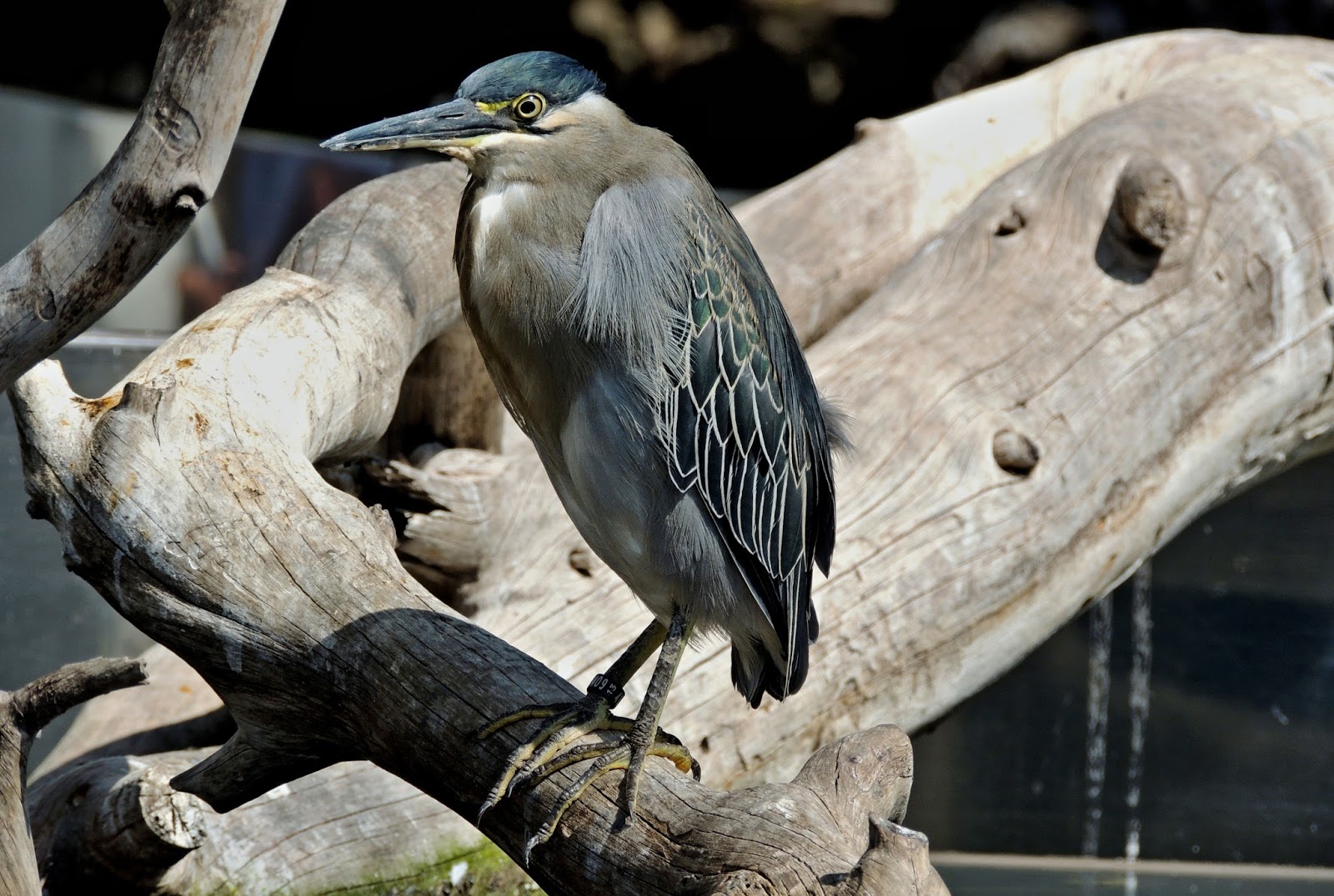
15-9-2014 OCEANOGRAPHIC, VALENCIA - STRIATED HERON (Butorides striata)


Tuesday, 27 September 2016

26-9-2016 MONTE CORONA, VALENCIA - EUROPEAN BEE WOLF (Philanthus triangulum)


The European beewolf (Philanthus triangulum), also known as the bee-killer wasp or the bee-eating philanthus (from the now obsolete synonym Philanthus apivorus), is a solitary wasp that lives in the Western Palearctic and Afrotropics. Although the adults of the species are herbivores (feeding on nectar and pollen), the species derives its name from the behaviour of the inseminated females, who hunt Western honey bees. The female places several of its paralysed prey together with an egg in a small underground chamber, to serve as food for the wasp larvae. All members of the genus Philanthus hunt various species of bees, but P. triangulum is apparently the only one that specialises in Western honey bees.


The European beewolf is a species of solitary wasp with bold yellow and black markings on the abdomen, males have trident-shaped markings between their bluish eyes while the larger females have a reddish stripe behind the eyes and a pale face.
 
The European beewolf is found mainly in areas of open sandy ground in areas such as lowland heathland and coastal dunes. They are infrequently found in clay areas and in Britain have been recorded digging burrows in coal dust and ash and have been found on spoil heaps from coal mining.

This wasp was previously considered to be one of the great aculeate rarities in Britain, with colonies only in sandy habitats on the Isle of Wight and Suffolk. It has undergone an expansion in range, with the wasp now locally common in a steadily increasing number of sites as far north as Yorkshire (2002). The species has RDB2 status (vulnerable) but, if revised, it is now likely that this status will be removed because of its increase in range and population.

26-9-2016 MONTE CORONA, VALENCIA - HOUSE CENTIPEDE (Scutigera coleoptrata)


Scutigera coleoptrata, also known as the house centipede, is a species of centipede that is typically yellowish-grey and has up to 15 pairs of long legs. Originating in the Mediterranean region, it has spread to other parts of the world, where it can live in human homes. It is an insectivore; it kills and eats other arthropods, such as insects and arachnids.

In 1758, Carl Linnaeus described the species in the tenth edition of his Systema Naturae, giving the name Scolopendra coleoptrata, writing that it has a "coleopterated thorax" (similar to a coleopter). In 1801, Jean-Baptiste Lamarck separated scutigera from scolopendra, calling this species Scutigera coleoptrata. The word scutigera comes from Latin gerere 'to bear' and scutum 'shield', because of the shape of the plates in the back of the chilopod.


The body of an adult Scutigera coleoptrata is typically 25 to 35 mm (1.0 to 1.4 in) in length, although larger specimens are sometimes encountered. Up to 15 pairs of long legs are attached to the rigid body. Together with the antennae they give the centipede an appearance of being 75 to 100 mm (3 to 4 in) in length. The delicate legs enable it to reach surprising speeds of up to 0.4 meters per second (1.3 ft/s)[citation needed] running across floors, up walls and along ceilings. Its body is yellowish-grey and has three dark dorsal stripes running down its length; the legs also have dark stripes. S. coleoptrata has developed automimicry in that its tail-like hind legs present the appearance of antennae. When the centipede is at rest, it is not easy to tell its cranial end from its caudal end.

Unlike most other centipedes, house centipedes and their close relatives have well-developed faceted eyes.


House centipedes lay their eggs in spring. In a laboratory observation of 24 house centipedes, an average of 63 and a maximum of 151 eggs were laid. As with many other arthropods, the larvae look like miniature versions of the adult, albeit with fewer legs. Young centipedes have four pairs of legs when they are hatched. They gain a new pair with the first molting, and two pairs with each of their five subsequent moltings. Adults with 15 pairs of legs retain that number through three more molting stages (sequence 4-5-7-9-11-13-15-15-15-15 pairs).

House centipedes live anywhere from three to seven years, depending on the environment. They can start breeding in their third year. To begin mating, the male and female circle around each other. They initiate contact with their antennae. The male deposits his sperm on the ground and the female then uses it to fertilize her eggs.

House centipedes feed on spiders, bed bugs, termites, cockroaches, silverfish, ants, and other household arthropods. They administer venom through forcipules. These are not part of their mandibles, so strictly speaking they sting rather than bite. They are mostly nocturnal hunters. Despite their developed eyes, they seem to rely mostly on their antennae when hunting. Their antennae are sensitive to both smells and tactile information. They use both their mandibles and their legs for holding prey. This way they can deal with several small insects at the same time. To capture prey they either jump onto it or use their legs in a technique described as "lassoing". Using their legs to beat prey has also been described. Like other centipedes they can stridulate.

Monday, 26 September 2016

25-9-2016 VILLALONGA CAMPO, VALENCIA - BARN SWALLOW


The Barn swallow (Hirundo rustica) is the most widespread species of swallow in the world. In fact, it has the largest natural distribution of any of the world's passerines, ranging over 251 million square kilometers globally. In Anglophone Europe it is just called the swallow; in northern Europe, it is the only common species called a "swallow" rather than a "martin".

The Barn swallow is a distinctive songbird with blue upperparts and a long, deeply forked tail. There is a line of white spots across the outer end of the upper tail. The female is similar in appearance to the male, but the tail streamers are shorter, the blue of the upperparts and breast band is less glossy, and the underparts paler. The juvenile is browner and has a paler rufous face and whiter underparts. It also lacks the long tail streamers of the adult.

Barn swallows are found in Europe, Asia, Africa, and the Americas. These birds are long-distance migrants and their wintering grounds cover much of the Southern Hemisphere as far south as central Argentina, the Cape Province of South Africa, and northern Australia. The preferred habitat of Barn swallows is open country with low vegetation, such as pasture, meadows, and farmland, preferably with nearby water. These birds avoid heavily wooded or precipitous areas and densely built-up locations. On their wintering grounds, Barn swallows avoid only dense forests and deserts. They are most common in open, low vegetation habitats, such as savanna and ranch land, and in Venezuela, South Africa, and Trinidad and Tobago the birds are particularly attracted to burnt or harvested sugarcane fields and the waste from the cane.


Barn swallows are gregarious birds and in the absence of suitable roost sites, they sometimes roost on wires where they are more exposed to predators. Individual birds tend to return to the same wintering locality each year and congregate from a large area to roost in reed beds. These roosts can be extremely large and are thought to be a protection from predators. Barn swallows typically feed by day in open areas 7-8 m (23-26 ft) above shallow water or the ground often following animals, humans, or farm machinery to catch disturbed insects; they may also pick prey items from the water surface, walls, and plants. During the breeding, season Barn swallows hunt in pairs, but otherwise form often large flocks. These birds are usually fairly quiet on the wintering grounds. At other times they communicate with constant twittering and chattering. The song of the male Barn swallow is a cheerful warble, often ending with 'su-seer'. Other calls include 'witt' or 'witt-witt' and a loud 'splee-plink' when excited (or trying to chase intruders away from the nest). The alarm calls include a sharp 'siflitt' for predators like cats and a 'flitt-flitt' for birds of prey like the hobby.

25-9-2016 VILLALONGA RESERVOIR, VALENCIA - GREY WAGTAIL (Motacilla cinerea)


This slim wagtail has a narrow white supercilium and a broken eye ring. The upperparts are grey and the yellow vent contrasting with whitish underparts makes it distinctive. The breeding male has a black throat that is edged by whitish moustachial stripes. They forage singly or in pairs on meadows or on shallow water marshes. They also use rocks in water and will often perch on trees. They have a clear sharp call note and the song consists of trills.

The breeding season is April to July and the nest is placed near fast running streams or rivers on an embankment between stones and roots. The male in display, makes short flights up into the air and descends slowly with fluttering flight accompanied by a rapid series of chipping high notes. In Europe the nests are often made in holes in manmade structures. The clutch consists of 3–6 speckled eggs and multiple broods may be raised with declining numbers in the clutch in subsequent broods. The usual clutch size is five in Ireland and the breeding success is about 80% with predation of eggs or chicks being the main cause of breeding failure. The Canary Islands population typically have smaller clutches and the breeding season is not as short and well marked as in populations at higher latitudes. The incubation period is about two weeks with chicks fledging within a fortnight. They live for a maximum of 8 years in the wild.

25-9-2016 VILLALONGA RESERVOIR, VALENCIA - GREEN SANDPIPER (Tringa ochropus)


The green sandpiper represents an ancient lineage of the genus Tringa; its only close living relative is the solitary sandpiper (T. solitaria). They both have brown wings with little light dots and a delicate but contrasting neck and chest pattern. In addition, both species nest in trees, unlike most other scolopacids.

Given its basal position in Tringa, it is fairly unsurprising that suspected cases of hybridisation between this species and the common sandpiper (A. hypoleucos) of the sister genus Actitis have been reported.

The green sandpiper (Tringa ochropus) is a small wader (shorebird) of the Old World.

This species is a somewhat plump wader with a dark greenish-brown back and wings, greyish head and breast and otherwise white underparts. The back is spotted white to varying extents, being maximal in the breeding adult, and less in winter and young birds. The legs and short bill are both dark green.

It is conspicuous and characteristically patterned in flight, with the wings dark above and below and a brilliant white rump. The latter feature reliably distinguishes it from the slightly smaller but otherwise very similar solitary sandpiper (T. solitaria) of North America.

In flight it has a characteristic three-note whistle.

Sunday, 25 September 2016

25-9-2015 VILLALONGA RESERVOIR, VALENCIA - LITTLE BITTERN (JUVENILE) (Ixobrychus minutus)


The little bittern or common little bittern (Ixobrychus minutus ) is a wading bird in the heron family, Ardeidae. Ixobrychus is from Ancient Greek ixias, a reed-like plant and brukhomai, to bellow, and minutus is Latin for "small".

The little bittern has a length of 33–38 centimetres (13–15 in) and a wing span of 52–58 centimetres (20–23 in). It is the smallest of the breeding herons of Europe and is characterised by its tiny size, long and sharp bill and thick neck. The males are distinctively patterned and both sexes show pale forewing panels. The males have black with a faint green sheen on the crown, nape, back, tail and scapulars. The underparts are pale buff and the wing has a pinkish buff oval shaped panel which contrasts with the otherwise black wings and is formed by the inner wing coverts. The underwing is completely whiteish in colour. The female is duller than the male and has brownish black upperparts with paler feather margins visible at close range. The underparts of the female are not as clean as those of the male and are streaked with dark buff and brown. The female's wing panel is less obvious than the male's. The juveniles are duller and more rufous than the females and are more heavily streaked on both their upperparts and underparts, including their wing coverts.


The little bittern is native to the Old World, breeding in Africa, central and southern Europe, western and southern Asia, and Madagascar. Birds from temperate regions in Europe and western Asia are migratory, wintering in Africa and further south in Asia, while those nesting in the tropics are sedentary. It is rare north of its breeding range.

The little bittern is crepuscular, skulking and normally solitary. It feeds on fishes, amphibians and insects which are caught within reedbeds or at their edges by the bird slowly stalking the prey. The male claims a territory in the Spring, advertising his presence with a deep barking or croaking call and the monogamous pair remain together for at least one breeding season. Eggs are laid in a nest situated in dense reedbeds, rushes or bushes above the water from the middle of May and there is a single brood which is normally 5-6 eggs. These are incubated for 17–19 days and the chicks are fledged after 25–30 days.


Little Bitterns were once widespread in Central Europe. In the meantime it is a poorly distributed breeding bird of the lowlands, sporadically up to low mountain ranges. It occurs from Europe (without regular breeding in Great Britain, Ireland or Scandinavia) to West Siberia up to 56° N. It also occurs in North Africa and southern Iran and south of the Sahara to southern Africa. Isolated populations also exist in Madagascar and Australia. The total population of Europe is about 60,000-120,000 breeding pairs, with occurrences of> 5000 breeding pairs in Russia, Ukraine, Romania and Turkey. In Central Europe (around 2000) about 5300-7800 pairs are breeding, most of it in Hungary. The formerly large population in Germany has decreased to just over 100 breeding pairs. However, inventory information is particularly unreliable for this very secret species.

14-7-2015 VILLALONGA RESERVOIR, VALENCIA - EPAULET SKIMMER DRAGONFLY (MALE) (Orthetrum chrysostigma)


Orthetrum chrysostigma, the epaulet skimmer, is a species of dragonfly in the family Libellulidae. It is found in Algeria, Angola, Benin, Botswana, Burkina Faso, Cameroon, Central African Republic, Chad, the Democratic Republic of the Congo, Ivory Coast, Egypt, Equatorial Guinea, Ethiopia, Gambia, Ghana, Guinea, Kenya, Liberia, Libya, Malawi, Mali, Mauritania, Morocco, Mozambique, Namibia, Niger, Nigeria, Senegal, Sierra Leone, Somalia, South Africa, Sudan, Tanzania, Togo, Uganda, Zambia, Zimbabwe, and possibly Burundi as well as Canary Islands, Israel, and Portugal. It was recorded in the Maltese Islands in 2010. One was also spotted in Tel Aviv, Israel in August 2022.


Its natural habitats are subtropical or tropical moist lowland forests, dry savanna, moist savanna, subtropical or tropical dry shrubland, subtropical or tropical moist shrubland, rivers, intermittent rivers, shrub-dominated wetlands, swamps, freshwater lakes, intermittent freshwater lakes, freshwater marshes, intermittent freshwater marshes, and freshwater springs. The adults prey on various flying insects. The bodies of adult males are blue, and those of young and females are yellow and brown.


Makes use of a wide range of freshwater habitats, including Rivers, streams, lakes, pans, dams and water-holes. Favours sites that are fairly open with exposed rocks, sand or gravel. Most common along rivers in the savanna regions.

Often perches on the ground, but also on rocks and exposed stems and twigs. Hunts from a perch with a rapid, darting flight. Frequently returns to the same perch. Both sexes can be found in the same area.


29-7-2015 VILLALONGA RESERVOIR, VALENCIA - EURASIAN REED WARBLER (Acrocephalus scirpaceus)


Rather plain medium-sized warbler: warm brown above with narrow pale spectacles, pale buffy below. Can be very difficult to separate from other reed warbler species. Most populations breed in reed or sedge beds, both pure and mixed with bushes, often wandering to adjacent scrub and thickets. “Mangrove” Reed Warbler is a resident in mangroves along the Red Sea. Non-breeding migratory birds may wind up in a wide range of habitats, from marshes to mangroves, to acacia scrub and cultivation. Often heard but can be hard to see: prolonged song much like Sedge Warbler but more even-paced and melodic, without rough and jerky phrases. Calls include a low “chuk” and rattled “chrrt.”