TOTAL PAGEVIEWS

TRANSLATE

Friday, 2 March 2018

1-12-2015 ANGKOR WAT, CAMBODIA - COMMON BIRDWING BUTTERFLY (Troides helena)


Troides helena, the common birdwing, is a butterfly belonging to the family Papilionidae. It is often found in the wildlife trade due to its popularity with butterfly collectors. The butterfly has seventeen subspecies.

The description of the commonest subspecies of the butterfly in India, T. h. cerberus Felder, is given below:[3]

Male
Upperside of forewings are rich velvety black with adnervular pale streaks on either side of the veins beyond the cell. The cilia is short, black, alternated with pale buffy white in the middle of the interspaces.

Hindwing: the abdominal fold, the apical half obliquely of interspace 1, the termen broadly, the base of the cell and the costal area up to and including the basal half of interspace 7 velvety black, the rest of the wing rich silky yellow; the veins prominently but narrowly black; the inner margin of the terminal black border produced inwards into prominent cone-shaped markings in the interspaces.

All specimens have one or more postdiscal black spots in the interspaces, but never a complete series; in interspace 2 and sometimes also in interspace 3 these spots coalesce with the cone-shaped projections of the terminal black border. Underneath the abdominal fold is a dense mass of buffy-white scented cottony pubescence. Underside similar, the adnervular pale streaks on the forewing broader and more prominent.

Hindwing: dorsal margin broadly black, with an edging of long soft black hairs; interspace 1 with a large oval postdiscal and a terminal black spot; interspace 2 with the postdiscal black spot generally separate from the cone-shaped projection of the black terminal border; the apical and lateral margins of interspaces 2-6 pale yellow irrorated (sprinkled) with black scales.

Antenna, head and thorax black, the collar narrowly crimson; abdomen yellow, shaded above with black; beneath: the thorax with a large lateral patch of crimson, the anal segment prominently buff coloured.

Female
Upper and under sides of the female is similar to those in the male, but with the following differences:

Forewing: the adnervular pale streaks broader and more prominent.
Hindwing: the black at base and along the costal margin broader, occupying fully one-third of the cell, the area above it and above vein 7, interrupted however, in interspace 7 near the apex of wing, by a transverse yellow mark which is sometimes subobsolete; a postdiscal series of large oval black spots, those in interspaces 2 and 3 often joined on the upperside to the cone-shaped terminal black marks; dorsal margin also more broadly black, without the fringe of black hairs and or course of the abdominal fold. Antenna, head and thorax as in the male; abdomen dark brownish black above.

30-11-2015 ANGKOR WAT, CAMBODIA - REEVE'S LEAF LITTER SKINK (Scincella reevesii)


Scincella reevesii (common name: Reeves's smooth skink) is a species of skink, a lizard in the family Scincidae. The species is endemic to Asia.

The specific name, reevesii, is in honor of English naturalist John Reeves.

S. reevesii is found in southern China (Guangxi, Guangdong, Hainan, Hong Kong), Indochina (Thailand, Cambodia, Vietnam) and south to Western Malaysia, Myanmar, India, and Nepal. There is also a questionable record from Korea. Reports from Bangladesh represent Sphenomorphus maculatus.


Total length up to 13 cm; snout-vent length 6 cm.
Body slim and bronze brown in colour, with a black dorsolateral stripe, extending from eye to tail;the stripe heavily speckled with tan along its entire length.
Males have a red patch on lower flanks, behind the forelegs, with a greenish tinge behind it.
Head rather small, with a somewhat pointed snout.
Labials and side of neck pale, with a few black speckles and flecks.
Underside of belly bright yellow in males; white in females.
Tail long and slim. Tail underside orange-yellow in males; greyish blue in females. Scales smooth.


Occurs in a wide variety of habitats such as cultivation, suburban gardens, grassland, shrubland, plantation woodland and edges of secondary forest.
Often very abundant in cultivated lowlands and shrubby hillsides.

Diurnal. Usually seen scampering through leaf litter or found underneath debris such as old boards, where several individuals may be found at one time. Darts swiftly away when approached.

Feeds mainly on tiny crickets, termites, beetle larvae, woodlice and other small arthropods.

Ovoviviparous. Breeds in spring. Gravid females frequently found in May.Bearing 2-3 young, which are approximately 2.5 cm in total length.

Very widely distributed throughout the New Territories and all major islands.
Recorded from southern China and Southeast Asia.

1-12-2015 TON LE SAP, CAMBODIA - COMMON IMPERIAL BUTTERFLY (Cheritra freja)


Cheritra freja, the common imperial, is a small butterfly found in India, Myanmar, Malaysia and Sri Lanka that belongs to the gossamer-winged butterflies family (Lycaenidae).

The butterfly has a brown upperside with white bands. The hindwings consist of a tail. It is coloured from pale yellow to white on the lower side with black margins.


Above, the male is purplish brown and the female is dark brown. Both sexes have large quadrate tornal spots in spaces 1b and 2 of the hindwing. These spots are outlined in white, more broadly so in the female than in the male. Underneath, both sexes are mostly white and have orange brown shadings on nearly the entire forewing and just the apical area of the hindwing. There is a narrow, indistinct ochreous brown post-discal line on the forewing. On the hindwing, the post-discal line occurs in short stripes and becomes darker and bolder towards the lower half of the wing. In addition, there is an interrupted dark submarginal line, a series of tornal spots on the tornal lobe and spaces 1b, 2 and 3. Metallic bluish green scalings overlay these spots. A long filamentous tail, up to 25mm, occurs at the end of vein 2. In contrast, a much shorter tail occurs at the end of vein 1b.

Thursday, 1 March 2018

30-11-2015 ANGKOR WAT - SACRED LOTUS (Nelumbo nucifera)

Nelumbo nucifera, also known as sacred lotus, Indian lotus, or simply lotus, is one of two extant species of aquatic plant in the family Nelumbonaceae. It is sometimes colloquially called a water lily, though this more often refers to members of the family Nymphaeaceae.

Lotus plants are adapted to grow in the flood plains of slow-moving rivers and delta areas. Stands of lotus drop hundreds of thousands of seeds every year to the bottom of the pond. While some sprout immediately and most are eaten by wildlife, the remaining seeds can remain dormant for an extensive period of time as the pond silts in and dries out. During flood conditions, sediments containing these seeds are broken open, and the dormant seeds rehydrate and begin a new lotus colony.

Under favorable circumstances, the seeds of this aquatic perennial may remain viable for many years, with the oldest recorded lotus germination being from seeds 1,300 years old recovered from a dry lakebed in northeastern China. Therefore, the Chinese regard the plant as a symbol of longevity.

It has a very wide native distribution, ranging from central and northern India (at altitudes up to 1,400 m or 4,600 ft in the southern Himalayas), through northern Indochina and East Asia (north to the Amur region; the Russian populations have sometimes been referred to as "Nelumbo komarovii"), with isolated locations at the Caspian Sea. Today, the species also occurs in southern India, Sri Lanka, virtually all of Southeast Asia, New Guinea, and northern and eastern Australia, but this is probably the result of human translocations. It has a very long history (c. 3,000 years) of being cultivated for its edible seeds and is commonly cultivated in water gardens. It is the national flower of India and Vietnam.

30-11-2015 ANGKOR WAT - COMMON MYNA (Acridotheres tristis)


The common myna or Indian myna (Acridotheres tristis), sometimes spelled mynah, is a bird in the family Sturnidae, native to Asia. An omnivorous open woodland bird with a strong territorial instinct, the common myna has adapted extremely well to urban environments.

The range of the common myna is increasing at such a rapid rate that in 2000 the IUCN Species Survival Commission declared it one of the world's most invasive species and one of only three birds listed among "100 of the World's Worst Invasive Species" that pose a threat to biodiversity, agriculture and human interests. In particular, the species poses a serious threat to the ecosystems of Australia, where it was named "The Most Important Pest/Problem" in 2008.

25-11-2015 SINGAPORE - ASIAN WEAVER ANT (Oecophylla smaragdina)


Oecophylla smaragdina (common names include Asian weaver ant, weaver ant, green ant, green tree ant, semut rangrang, semut kerangga, and orange gaster) is a species of arboreal ant found in tropical Asia and Australia. These ants form colonies with multiple nests in trees, each nest being made of leaves stitched together using the silk produced by the ant larvae: hence the name 'oecophylla' [Greek for 'leaf-house'].

Workers and major workers are mostly coloured orange. Workers are 5–7 millimetres (0.20–0.28 in) long; they look after larvae and farm scale bugs for honeydew. Major workers are 8–10 millimetres (0.3–0.4 in) long, with long strong legs and large mandibles. They forage, assemble and expand the nest. Queens are typically 20–25 millimetres (0.8–1.0 in) long, and normally greenish-brown, giving the species its name smaragdina (Latin: emerald).


Oecophylla smaragdina has a widespread distribution in tropical Asia and Australia, its range extending from India through Indonesia and the Philippines to Northern Territory and Queensland in Australia. It is an arboreal species, making its nests among the foliage of trees. Nests are constructed during the night, with major workers weaving towards the exterior and minor workers completing the interior structure. The ant colony may have several nests in one tree, or the nests may be spread over several adjacent trees; colonies can reach up to half a million individuals. In one instance, a colony occupied 151 nests distributed among twelve trees. Each colony has a single queen, in one of these nests, and her progeny are carried to other nests of the colony. The average life of a mature colony may be eight years.

25-11-2015 JURONG, SINGAPORE - CALLIANDRA (Calliandra tergemina ssp. emarginata)


This is a slow growing, dwarf variety producing coppery pink new foliage that matures to dark green; showy red powderpuff blooms in fall and winter, with some blooming year round; a great selection for containers.

The Dwarf Pink (or Red) Powderpuff Tree produces showy red Mimosa like flowers continuously throughout the year. This small to medium sized naturally evergreen tropical shrub makes a wonderful container plant where not hardy and may also be used for a continuous flowering Bonsai specimen. Where hardy it can be used as a hedge that the hummingbirds are sure to fight over! Provide good drainage and a partial to full sun location for the best results. Caterpillar host: Statire Sulphur

26-11-2015 BOTANICAL GARDENS, SINGAPORE - ZEBRA DOVE (Geopelia striata)


The zebra dove (Geopelia striata), also known as the barred ground dove, or barred dove, is a species of bird of the dove family, Columbidae, native to Southeast Asia. They are small birds with a long tail, predominantly brownish-grey in colour with black-and-white barring. The species is known for its pleasant, soft, staccato cooing calls.

The zebra dove feeds on small grass and weed seeds. They will also eat insects and other small invertebrates. They prefer to forage on bare ground, short grass or on roads, scurrying about with rodent-like movement. Unlike other doves, they forage alone, or in pairs. Their colouration camouflages them well when on the ground.


The native range of the species extends from Southern Thailand, Tenasserim, Peninsular Malaysia, and Singapore to the Indonesian islands of Sumatra and Java. It may also be native to Borneo, Bali, Lombok, Sumbawa, and the Philippine islands.

The zebra dove is popular in captivity and many populations have appeared outside its native range due to birds escaping or being deliberately released. It can now be found in central Thailand, Laos, Borneo, Sulawesi, Hawaii (introduced in 1922), Tahiti (1950), New Caledonia, the Seychelles, the Chagos Archipelago (1960), Mauritius (before 1768), Réunion, and Saint Helena.

It inhabits scrub, farmland, and open country in lowland areas and is commonly seen in parks and gardens. Trapping for the cagebird industry has led to them becoming rare in parts of Indonesia but in most parts of its range it is common. Zebra doves are among the most abundant birds in some places such as Hawaii and the Seychelles.

In its native range the breeding season is from September to June. The males perform a courtship display where they bow and coo while raising and spreading the tail. Upon selection of a nesting site, the female will place herself there and will make guttural sounds to attract males to help build the nest. The nest is a simple platform of leaves and grass blades. It is built in a bush or tree or sometimes on the ground and sometimes on window ledges. One or two white eggs are laid and are incubated by both parents for 13 to 18 days. The young leave the nest within two weeks and can fly well after three weeks.

26-11-2015 BOTANIC GARDENS, SINGAPORE - FERAL PIGEON (Columba livia var. domestica)


The domestic pigeon (Columba livia domestica or Columba livia forma domestica) is a pigeon subspecies that was derived from the rock dove or rock pigeon. The rock pigeon is the world's oldest domesticated bird. Mesopotamian cuneiform tablets mention the domestication of pigeons more than 5,000 years ago, as do Egyptian hieroglyphics. Research suggests that domestication of pigeons occurred as early as 10,000 years ago.

Pigeons have held historical importance to humans as food, pets, holy animals, and messengers. Due to their homing ability, pigeons have been used to deliver messages, including during the world wars. Despite this, city pigeons, which are feral birds released for one reason or another, are generally seen as pests, mainly due to their droppings. Feral pigeons are considered invasive in many parts of the world, though they have a positive impact on wild bird populations, serving as an important prey species for birds of prey.

26-11-2015 JURONG, SINGAPORE - BUFFON'S TURACO (Tauraco persa)


The Guinea Turaco (Tauraco persa), also known as the Green Turaco, is a species of turaco, a group of near-passerines birds. It is found in forests of West and Central Africa, ranging from Senegal east to DR Congo and south to northern Angola. It lays two eggs in a tree platform nest.

The Guinea Turaco, often inconspicuous in the treetops, is approximately 43 cm long, including a long tail. The plumage is largely green and the tail and wings are dark purplish, except for the crimson primary feathers that are very distinct in flight. In the westernmost subspecies buffoni, which sometimes is known as the Buffon’s Turaco, there is a white line above and in front of the eye and a black line below the eye. In the nominate subspecies of the central part of its range and zenkeri of the southeastern part there also is a second white line below the black line. Unlike similar turacos with red bills, even adult Guinea Turacos lack a white rear edge to the crest.

26-11-2015 JURONG, SINGAPORE - AFRICAN COLLARED DOVE (Streptopelia roseogrisea)


The African collared dove (Streptopelia roseogrisea) is a small dove found in the Sahel, northern parts of the Horn of Africa and southwestern Arabia. Although it lives in arid lands, it is found around water sources.

This bird is typically around 26 cm (10 in) in length. Its upper body, from shoulders to tail, is a pale grayish brown, though the wing edge has a bluish tinge. Flight feathers are darker, and nearly black. Head, neck and breast are pinkish shading to white on the chin and belly. There is little sexual dimorphism.

The African collared dove is the species thought to be the wild ancestor of the domestic Barbary dove, though some suggest the Eurasian collared dove (Streptopelia decaocto) may also have been involved. The African collared dove is able to hybridise with the Barbary dove, and it is thought that the increase in the range of colours of Barbary doves available that occurred in the later 20th century was the result of the importation of African collared doves into the United States for interbreeding.

Streptopelia roseogrisea has a diet of grass seeds and other plants. They would also eat berries, insects, and snails.

26-11-2015 JURONG, SINGAPORE - WATTLED STARLING (Creatophora cinerea)


The wattled starling is 21 cm long, with a short tail and pointed wings. It has mainly grey plumage except for a white rump, and black flight feathers and tail. The breeding male has a white shoulder patch and a distinctive head pattern, with unfeathered yellow skin, and black forehead and throat wattles. The extent to which these seasonal features develop increases with the age of the bird and some old females may show a weaker version of this plumage.

The non-breeding male has a feathered head except for a small yellow patch behind the eye. There are no wattles, but there is a black moustachial stripe. The white shoulder patch is much reduced. The female and juvenile plumages are similar to the non-breeding male, but the flight feathers and tail are brown.

The black flight and tail feathers and white rump make this species unmistakable in flight.

This species has a range of wheezing or grating calls comparable to those of the common starling, but the most familiar is a wheezing ssreeeeo.


Like other starlings, the wattled starling is an omnivore, taking a wide range of invertebrates seeds and berries, but its diet is mainly insects including many locusts, leading to the local name "locust bird".

It will scavenge at rubbish heaps, and frequently perches on livestock, feeding on insects disturbed by the animals and also removing ectoparasites.

The wattled starling is a colonial breeder, and may share its colonies with the Cape weaver. It always nests in trees or bushes, including acacias and eucalyptus at between 1 and 10 m above the ground. The globular nest is made from twigs and lined with grass or feathers. The two to five, usually three or four, eggs are pale blue, immaculate or with some brown spots, and are laid before the dome of the nest is completed. Both sexes build the nest, incubate the eggs and feed the young.

The eggs hatch after 11 days, and the chicks leave the nest in another 13–16 days. They cannot fly, and suffer heavy predation from large birds of prey.


Breeding is linked to an abundant insect supply, and colonies will be abandoned, even with chicks in the nest, if, for example, locust swarms are destroyed by control measures.

The wattled starling is highly gregarious and will form large flocks, often with other starlings. Its reedbed roosts, which can be huge, may also be shared.


1-3-2018 VILLALONGA, VALENCIA - BLACK REDSTART (FEMALE) (Phoenicurus ochruros)


The Black Redstart (Phoenicurus ochruros) is a small, charismatic passerine bird, exhibiting a blend of dark and vibrant plumage. Males are distinguished by their dark grey to black upperparts and breast, with a striking orange-red rump and tail. Females and juveniles are more subdued in color, with grey to grey-brown feathers and the same vivid tail coloration that is the hallmark of the species.

Adult males are easily identified by their dark upperparts and black breast, contrasting with the orange-red lower rump and tail. The belly and undertail may vary from blackish-grey to orange-red, depending on the subspecies. Females and juveniles are less conspicuous, with overall greyer tones and a distinctive orange-red rump and tail. The presence of pale fringes on the secondaries forms a whitish wing panel in some subspecies.

The Black Redstart has adapted remarkably to urban environments, often found nesting in crevices or holes within buildings. Originally a dweller of stony mountainous regions, it now thrives in industrial areas with similar structural features.

This species is widely distributed across south and central Europe, Asia, and north-west Africa. It is a resident in milder regions, while populations in the northeast migrate to warmer areas during winter.

1-3-2018 MONTE CORONA, VALENCIA - SARDINIAN WARBLER (MALE) (Sylvia melanocephala)


The Sardinian warbler, Curruca melanocephala, presents itself as a charming and distinctive bird of the Mediterranean. The males are adorned with a sleek grey back and pristine whitish underparts, crowned with a striking black head, a pure white throat, and captivating red eyes. The females, on the other hand, exhibit a more subdued palette, with brown upperparts and buff underparts, complemented by a subtle grey head.

When attempting to identify the Sardinian warbler, look for the male's black head and red eyes, which contrast with the white throat and grey back. Females can be recognized by their brown and buff coloration with a greyish head. The variability in plumage, including the presence or absence of a reddish hue, can be a helpful clue in distinguishing between subspecies.


This typical warbler favors open landscapes and cultivated areas, where it can find bushes suitable for nesting. Its preference for such environments makes it a familiar sight in the Mediterranean countryside.

The Sardinian warbler is a resident of the southernmost regions of Europe, extending its range into Asia in Turkey and the eastern Mediterranean. While not extensively migratory, some individuals do venture to North Africa for the winter, and the species has been known to appear as a vagrant as far as Great Britain.


This species is known for its affinity for open and cultivated areas with ample shrubbery for nesting. The Sardinian warbler constructs its nest in low shrubs or brambles, where it lays a clutch of 3-6 eggs. Its diet is primarily insectivorous, but it will not shy away from indulging in berries and other soft fruits.

The Sardinian warbler's song is a rapid and rattling melody, a sound that has become synonymous with the Mediterranean landscapes where it thrives.

The breeding habits of the Sardinian warbler involve the construction of nests in low shrubbery, where the female lays a clutch of eggs that both parents will tend to.


The Sardinian warbler is part of a superspecies complex, which includes Menetries's warbler and the eastern subalpine warbler. These species share certain characteristics, such as white malar areas and light throats in males, but can be differentiated by other plumage features and their distinct calls.

Primarily insectivorous, the Sardinian warbler supplements its diet with berries and other soft fruits, particularly when insects are less abundant.

The Sardinian warbler is currently listed as Least Concern by the IUCN, indicating that, for now, this species does not face any imminent threats to its survival.

26-11-2015 JURONG, SINGAPORE - VICTORIA CROWNED PIGEON (Goura victoria)


Sclater's crowned pigeon (Goura sclaterii) is a large, terrestrial pigeon confined to the southern lowland forests of New Guinea. This pigeon was previously considered as conspecific with Scheepmaker's crowned pigeon (Goura scheepmakeri) with the English name "southern crowned pigeon".

It has a bluish-grey plumage with elaborate blue lacy crests, red iris and very deep maroon breast. Both sexes have a similar appearance. It is 66–73 cm (26–29 in) in length and weighs 2.00–2.24 kg (4.41–4.94 lb).


Sclater's crowned pigeon was originally described by the Italian zoologist Tommaso Salvadori in 1876. He introduced the current binomial name Goura sclaterii. The specific epithet sclaterii was chosen to honour the English ornithologist Philip Sclater (1829–1913). A molecular phylogenetic study published in 2018 found that Sclater's crowned pigeon was most closely related to the western crowned pigeon (Goura cristata).

26-11-2015 JURONG, SINGAPORE - GREATER BLUE EARED STARLING (Lamprotornis chalybaeus)


26-11-2015 JURONG, SINGAPORE - EASTERN CATTLE EGRET (Bubulcus ibis ssp. coromandus)


The eastern cattle egret (Bubulcus coromandus) is a species of heron (family Ardeidae) found in the tropics, subtropics and warm temperate zones. Most taxonomic authorities lump this species and the western cattle egret together as subspecies of the cattle egret, but some (including the International Ornithologists' Union) separate them. Despite the similarities in plumage to the egrets of the genus Egretta, it is more closely related to the herons of Ardea. It is native to southern and eastern Asia, and Australasia.

It is a white bird adorned with buff plumes in the breeding season. It nests in colonies, usually near bodies of water and often with other wading birds. The nest is a platform of sticks in trees or shrubs. Eastern cattle egrets exploit drier and open habitats more than other heron species. Their feeding habitats include seasonally inundated grasslands, pastures, farmlands, wetlands and rice paddies. They often accompany cattle or other large mammals, catching insect and small vertebrate prey disturbed by these animals. Some populations of the cattle egret are migratory and others show post-breeding dispersal.

The adult eastern cattle egret has few predators, but birds or mammals may raid its nests, and chicks may be lost to starvation, calcium deficiency or disturbance from other large birds. This species maintains a special relationship with cattle, which extends to other large grazing mammals; wider human farming is believed to be a major cause of their suddenly expanded range. The cattle egret removes ticks and flies from cattle and consumes them. This benefits both species, but it has been implicated in the spread of tick-borne animal diseases.

26-11-2015 JURONG, SINGAPORE - PAINTED STORK (Mycteria leucocephala)


The painted stork (Mycteria leucocephala) is a large wader in the stork family. It is found in the wetlands of the plains of tropical Asia south of the Himalayas in the Indian Subcontinent and extending into Southeast Asia. Their distinctive pink tertial feathers of the adults give them their name. They forage in flocks in shallow waters along rivers or lakes. They immerse their half open beaks in water and sweep them from side to side and snap up their prey of small fish that are sensed by touch. As they wade along they also stir the water with their feet to flush hiding fish. They nest colonially in trees, often along with other waterbirds. The only sounds they produce are weak moans or bill clattering at the nest. They are not migratory and only make short-distance movements in some parts of their range in response to changes in weather or food availability or for breeding. Like other storks, they are often seen soaring on thermals.


The painted stork is widely distributed over the plains of Asia. They are found south of the Himalayan ranges and are bounded on the west by the Indus River system where they are rare and extend eastwards into Southeast Asia. They are absent from very dry or desert regions, dense forests and the higher hill regions. They are rare in most of Kerala and the species appears to have expanded into that region only in the 1990s. They prefer freshwater wetlands in all seasons, but also use irrigation canals and crop fields, particularly flooded rice fields during the monsoon. They are resident in most regions but make seasonal movements. Young birds may disperse far from their breeding sites as demonstrated by a juvenile ringed at a nest in Keoladeo National Park that was recovered 800 kilometres away at Chilka in eastern India. Breeding is always on large trees, usually in areas where nesting trees are secured over long periods of time, including in wetland reserves, along community-managed village ponds and lakes, inside villages when protection is also afforded to nesting birds like in Kokrebellur, protected tree patches in urban locations such as zoos, and on islands in urban wetlands.

Wednesday, 28 February 2018

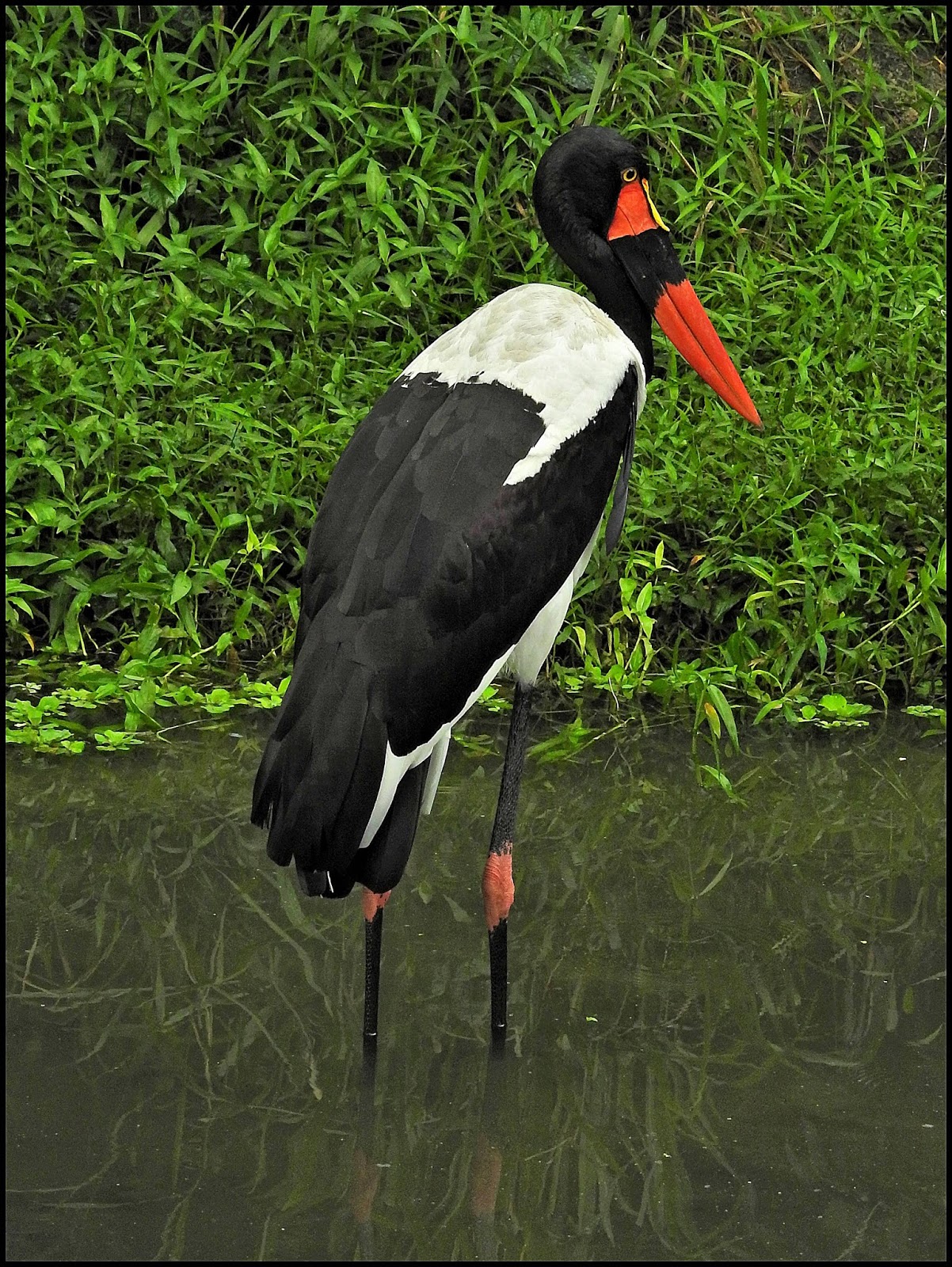
26-11-2015 JURONG, SINGAPORE - SADDLE BILLED STORK (Ephippiorhynchus senegalensis)


19-3-2015 JURONG, SINGAPORE - BLACK CROWNED NIGHT HERON (Nycticorax nycticorax)


26-11-2015 JURONG, SINGAPORE - AMERICAN FLAMINGO (Phoenicopterus ruber)


The American flamingo (Phoenicopterus ruber) is a large species of flamingo native to the West Indies, northern South America (including the Galápagos Islands) and the Yucatan Peninsula. It is closely related to the greater flamingo and Chilean flamingo, and was formerly considered conspecific with the greater flamingo, but that treatment is now widely viewed (e.g. by the American and British Ornithologists' Unions) as incorrect due to a lack of evidence. It is also known as the Caribbean flamingo, although it is also present in the Galápagos Islands. It is the only flamingo that naturally inhabits North America.

It is a cultural icon for the U.S. state of Florida, where it was formerly abundant in the southernmost regions, although it was largely extirpated by 1900 and is now only an uncommon visitor with a few small, potential resident populations.


The American flamingo breeds in South America (in the Galápagos Islands of Ecuador, coastal Colombia and Venezuela, and northern Brazil), in the West Indies (Trinidad and Tobago, Cuba, Jamaica, Hispaniola (the Dominican Republic and Haiti), The Bahamas, the Virgin Islands, and the Turks and Caicos Islands), and tropical and subtropical areas of continental North America (along the northern coast of the Yucatán Peninsula in Mexico, and formerly southern Florida in the United States). It is a vagrant to Puerto Rico, Anguilla, Barbados, Honduras, and (following its extirpation) Florida, although some Florida populations are now thought to be year-round residents. The population in the Galápagos Islands differs genetically from that in the Caribbean; the Galápagos flamingos are significantly smaller, exhibit sexual dimorphism in body shape, and lay smaller eggs. They are sometimes separated as Phoenicopterus ruber glyphorhynchus.

Its preferred habitats are similar to those of its relatives: saline lagoons, mudflats, and shallow, brackish coastal or inland lakes. An example habitat is the Petenes mangroves ecoregion of the Yucatán.


The American flamingo is a large wading bird with reddish-pink plumage. Like all flamingos, it lays a single chalky-white egg on a mud mound, between May and August; incubation until hatching takes from 28 to 32 days; both parents brood their young. They may reach sexual maturity between 3 and 6 years of age, though usually they do not reproduce until they are 6 years old. Their life expectancy of 40 years is one of the longest in birds.

Adult American flamingos are smaller on average than greater flamingos, but are the largest flamingos in the Americas. They measure from 120 to 145 cm (47 to 57 in) tall. The males weigh an average of 2.8 kg (6.2 lb), while females average 2.2 kg (4.9 lb). Most of its plumage is pink, giving rise to its earlier name of rosy flamingo and differentiating adults from the much paler greater flamingo. The wing coverts are red, and the primary and secondary flight feathers are black. The bill is pink and white with an extensive black tip. The legs are entirely pink. The call is a goose-like honking. It is one of the species to which the Agreement on the Conservation of African-Eurasian Migratory Waterbirds applies.


Mating and bonding behaviors of P. ruber individuals have been extensively studied in captivity. The American flamingo is usually monogamous when selecting a nest site, and incubating and raising young; however, extra-pair copulations are frequent.

While males usually initiate courtship, females control the process. If interest is mutual, a female walks by the male, and if the male is receptive, he walks with her. Both parties make synchronized movements until one member aborts this process. For low-intensity courtships, males and females walk in unison with their heads raised. In high-intensity courtships, males and females walk at a quick pace with their heads dropped in a false feeding posture. This high-intensity courtship stops at any point if either bird turns and the other does not follow, the heads are raised, unison movements are stopped, or the pace of movement is slowed. If the female is ultimately receptive to copulation, she stops walking and presents for the male. Long-term pairs do not frequently engage in courtship behaviors or in-group display. Pairs often stand, sleep, and eat in close proximity.

Courtship is most often seen among individuals that change partners often or are promiscuous. A spectrum of pairing relationships is seen. Some birds have a long-term partner throughout the year; others form pairs during periods of courtship and nest attendance. How long a relationship lasts is affected by many factors, including addition and removal of adults, maturation of juveniles, and occurrence of trios and quartets. In most pairs, both individuals usually construct and defend the nest site. In rare cases, one individual undertakes both duties. Within trios, the dominant pair begins the nesting process by choosing and then defending the site.

25-11-2015 JURONG, SINGAPORE - MASKED LAPWING (Vanellus miles)


The masked lapwing (Vanellus miles) is a large, common and conspicuous bird native to Australia (particularly the northern and eastern parts of the continent), New Zealand and New Guinea. It spends most of its time on the ground searching for food such as insects and worms, and has several distinctive calls. It is common in Australian fields and open land, and is known for its defensive swooping behaviour during the nesting season.

Despite the species being also known as the masked plover and often called the spur-winged plover or just plover in its native range, lapwings are classified to their own subfamily, Vanellinae, and not to the closely related plover subfamily, Charadriinae. There are two subspecies: the nominate subspecies and the southern novaehollandiae. The latter has distinctive black markings on the shoulder and side of the chest, and is sometimes recognized as a separate species: the black-shouldered lapwing (Vanellus novaehollandiae).

26-11-2015 JURONG, SINGAPORE - BLUE FACED HONEYEATER (Entomyzon cyanotis)


The blue-faced honeyeater (Entomyzon cyanotis), also colloquially known as the Bananabird, is a passerine bird of the honeyeater family, Meliphagidae. It is the only member of its genus, and it is most closely related to honeyeaters of the genus Melithreptus. Three subspecies are recognised. At around 29.5 cm (11.6 in) in length, the blue-faced species is large for a honeyeater. Its plumage is distinctive, with olive upperparts, white underparts, and a black head and throat with white nape and cheeks. Males and females are similar in external appearance. Adults have a blue area of bare skin on each side of the face readily distinguishing them from juveniles, which have yellow or green patches of bare skin.

Found in open woodland, parks and gardens, the blue-faced honeyeater is common in northern and eastern Australia, and southern New Guinea. It appears to be sedentary in parts of its range, and locally nomadic in other parts; however, the species has been little studied. Its diet is mostly composed of invertebrates, supplemented with nectar and fruit. They often take over and renovate old babbler nests, in which the female lays and incubates two or rarely three eggs.

26-11-2015 JURONG, SINGAPORE - SPOTTED WHISTLING DUCK (Dendrocygna guttata)


The spotted whistling duck (Dendrocygna guttata) is a member of the duck family Anatidae. It is also referred to as the "spotted tree duck". This duck can be found in Indonesia, New Guinea, Australia and the Philippines. Spotted ducks are also held in captive populations.

The Spotted whistling duck is one of the smaller species in the genus Dendrocygna. This duck grows to 43–50 cm tall. Males can weigh anywhere from 590g to 650g while females weigh 610g to 860g. White spots on their flanks and breasts gave these ducks the spotted name. The sides of the neck, faces, and eyebrows are all grey. Black or dark brown coloring stretches from the crown nape to the hindneck. This dark coloring is also found in the eyepatch. Their coloring resembles a cape with a thick collar. This cape starts as a light brown then fades into a darker brown closer to the tail. Their underbelly is mostly brown, sometimes spotted, and significantly lighter than the wings and the “collar.” A white bar on the upper tail coverts can be seen during flight aiding in identification. They have dull pink legs[4] with black webbed feet and sharp nails. The bill is dark, yet often seen with portions of red and a small white mark on the lower mandible. Spotted whistling ducks look as though they are raised from the ground, as though they are standing up tall. (look more into this). Their wings pressed strongly against the body. Inner vanes of the outer primaries are jagged and can be seen in flight (check on this). While flying, the head is positioned down causing the whole bird to look hunched. The tail stays pointed and looks long when in flight. Juveniles are seen with white streaks on flanks instead of spots and have significantly duller coloring. Spotted whistling ducks are visually similar to D. arborea, yet many scientists believe its closest relative is D. eytoni. After gaining their adult plumage at the age of 6 months,. the spotted whistling duck has a single annual molt. Like other ducks, swans, and geese, the spotted whistling duck molts synchronously. Synchronous molting is common within Anseriformes because waterfowl have the ability to avoid terrestrial predators. Unlike other birds, waterfowl float in ponds lakes while they molt, safe from predators. Other more evolved ducks have two molts, whistling ducks only molt once.


Whistling ducks are found all over the world. The spotted whistling duck is distributed throughout the Philippines, Australia, and New Guinea. These ducks live in the southern part of the Philippines and several islands of Indonesia. In Indonesia spotted whistling ducks stretch from the Eastern Lesser Sundas islands to new guinea. Spotted whistling ducks are also found in Weipa and Iron ranges of Australia, but have also been seen at Wonga Beach. Scientists hypothesize the Indonesian population was introduced due to a storm blowing the birds off course.

Spotted whistling ducks live around bodies of water, like many other ducks. These ducks specifically live around small ponds and marshes surrounded by trees. They prefer humid and low altitude habitats. Spotted whistling ducks build hollows within the trees surrounding their habitats.

The Diet of the spotted whistling duck contains grass seeds, aquatic invertebrates, aquatic plants, and small fish. These ducks obtain their food by dabbling and diving. The ducks dabble at the surface of the ponds, filtering the water through their bills. The birds bounce on the surface to enter the water headfirst, after being underwater for a maximum of 15 seconds they emerge with another bounce. Scientists never observed food in the bill after the diving behavior. They concluded the birds consume the food while underwater.(Beruldsen) The majority of feeding occurs at night.

The genus Dendrocygna has strong pair bonds. Male and female birds are visually similar, females are slightly heavier than males. Without weighing the bird sex is difficult to determine. Breeding season begins in September with active nests found as late as April. Their nests are found in hollowed-out trees. Both parents participate in nest building at the same time. One pair can have several clutches a year consisting of 10-11 eggs. Both parents incubate the eggs  for 18–31 days and when hatched the chick weighs 17.5g. In captivity, the chicks fledged at 7 weeks, yet in the wild scientists have observed chicks flying at 45–50 days old. The spotted whistling duck has a breeding system described as ‘primitive,’ which is consistent with other basal groups in Anseriformes.


Spotted whistling ducks are found in groups with their own species and often with D. arcata. Compared to others in the genus, these ducks are less vocal. These birds perch on tree branches in groups slightly smaller than flocks. The flocks are often a mix of adults and juveniles. The adults shepard the juveniles keeping them close to the group. In 2000 Beruldsen observed a group consisting of 6 juveniles and two adults, male and female. The juveniles seemed unbothered by the human presence, but the adults made sure there was distance between Buruldsen and the juveniles. The birds kept their distance but seemed to be unaffected. The adult male positioned himself between the juveniles and the humans, protecting the other birds. This behavior was often accompanied by several high-pitched ticking calls.