TOTAL PAGEVIEWS

TRANSLATE

Sunday, 4 March 2018

4-12-2015 JURONG, SINGAPORE - PAINTED STORK (Mycteria leucocephala)


The typical clutch varies from one to five eggs with early breeders having larger clutches. The incubation period is about a month while the fledging period is nearly two months. There is occasional predation of chicks by migrant Aquila eagles and Pallas's fish eagle. During the mid-day heat, adults will stand at the nest with wings outstretched to shade the chicks. To feed chicks, adults regurgitate fish that they have caught and these are typically smaller than 20 cm (7.9 in) long. Young chicks, when threatened, disgorge food and feign death by crumpling to the nest floor. The daily requirement for chicks has been estimated to be 500–600 grams (18–21 oz) made up of about 9 fish fed in two sessions. Nest survival (measured as daily nest survival) is higher for nests initiated early in the monsoon season, lower with decreasing temperature, and higher at larger colonies. The bare red skin on the head is developed when reaching breeding maturity and involves the loss of feathers and the deposition of lipids under the skin. Birds in captivity have been known to live for as long as 28 years. Birds raised as chicks have been known to be tame and docile, even responding to their names when called.

A bird louse, Ardeicola tantali was described on the basis of a specimen obtained from this species as also a subcutaneous mite, Neottialges kutzeri, of the family Hypoderidae.


Painted storks are widespread throughout the Indian subcontinent. Populations extend from Sri Lanka to Indochina and southern China. Painted storks are predominately non-migratory and most make only local movements. However some birds have been known to migrate to west Burma. 

Painted storks are found within a variety of habitats. They are often restricted to shallow freshwater wetlands and marshes. Painted storks have also been observed in flooded agricultural fields and seepage ponds in the Delhi region of India. 


This species of stork stands 93 to 102 cm tall and weighs between 2 to 5 kg. Painted storks are the only storks within the genus Mycteria that has a black pectoral band. This species has a long, heavy yellow bill and a yellow face. They display white plumage with a rose color near the tail feathers. Non-breeding plumage is usually less vibrant than breeding plumage. Juveniles are pale brown lacking a pectoral band. Males and females are not sexually dimorphic however, male painted storks tend to be slightly larger than female storks. Body length in this species is used as an indicator of sex.

4-12-2015 JURONG, SINGAPORE - PAINTED STORK (Mycteria leucocephala)


The painted stork (Mycteria leucocephala ) is a large wader in the stork family. It is found in the wetlands of the plains of tropical Asia south of the Himalayas in the Indian Subcontinent and extending into Southeast Asia. Their distinctive pink tertial feathers of the adults give them their name. They forage in flocks in shallow waters along rivers or lakes. They immerse their half open beaks in water and sweep them from side to side and snap up their prey of small fish that are sensed by touch. As they wade along they also stir the water with their feet to flush hiding fish. They nest colonially in trees, often along with other waterbirds. The only sounds they produce are weak moans or bill clattering at the nest. They are not migratory and only make short distance movements in some parts of their range in response to changes in weather or food availability or for breeding. Like other storks, they are often seen soaring on thermals.

3-12-2015 JURONG, SINGAPORE - HELMETED GUINEA FOWL (Numida meleagris)


The helmeted guineafowl (Numida meleagris) is the best known of the guineafowl bird family, Numididae, and the only member of the genus Numida. It is native to Africa, mainly south of the Sahara, and has been widely introduced, as a domesticated species, into the West Indies, North America, Colombia, Brazil, Australia and Europe.

The helmeted guineafowl is a large, 53 to 58 cm (21 to 23 in) bird with a round body and small head. They weigh about 1.3 kg (2.9 lb). The body plumage is gray-black speckled with white. Like other guineafowl, this species has an unfeathered head, which in this species is decorated with a dull yellow or reddish bony knob, and bare skin with red, blue, or black hues. The wings are short and rounded, and the tail is likewise short. Various subspecies are proposed, differences in appearance being mostly a large variation in shape, size, and colour of the casque and facial wattles.

3-12-2015 JURONG, SINGAPORE - YELLOW RUMPED CACIQUE (Cassiculus melanicterus)


The yellow-rumped cacique (Cacicus cela) is a passerine bird in the New World family Icteridae. It breeds in much of northern South America from Panama and Trinidad south to Peru, Bolivia and central Brazil. However, they have been sighted as far north as Nayarit state in Mexico.


The song of the male yellow-rumped cacique is a brilliant mixture of fluting notes with cackles, wheezes and sometimes mimicry. There are also many varied calls, and an active colony can be heard from a considerable distance.

The yellow-rumped cacique is a bird associated with open woodland or cultivation with large trees.

It is a colonial breeder, with up to 100 bag-shaped nests in a tree, which usually also contains an active wasp nest. The females build the nests, incubate, and care for the young. Each nest is 30–45 cm long and widens at the base, and is suspended from the end of a branch. Females compete for the best sites near the protection of the wasp nest. The normal clutch is two dark-blotched pale blue or white eggs. Females begin incubating after laying the second egg; hatching occurs after 13 or 14 days. The young fledge in 34 to 40 days, usually only one per nest.

3-12-2015 JURONG, SINGAPORE - WESTERN CROWNED PIGEON (Goura cristata)


The western crowned pigeon (Goura cristata), also known as the common crowned pigeon or blue crowned pigeon, is a large, blue-grey pigeon with blue lacy crests over the head and dark blue mask feathers around its eyes. Both sexes are almost similar but males are often larger than females. It is on average 70 cm (28 in) long and weighs 2.1 kg (4.6 lbs).
Along with its close and very similar-looking relatives the Victoria crowned pigeon, Sclater's crowned pigeon, and Scheepmaker's crowned pigeon, it is one of the largest members of the pigeon family. The western crowned pigeon is found in and is endemic to the lowland rainforests of northwestern New Guinea; the other species of crowned pigeon inhabit different regions of the island. The diet consists mainly of fruits and seeds.

Hunted for food and its plumes, it remains common only in remote areas. Due to ongoing habitat loss, limited range and overhunting in some areas, the western crowned pigeon is evaluated as Vulnerable on the IUCN Red List of Threatened Species. It is listed in Appendix II of CITES.

The western crowned pigeon was first described by the German naturalist Peter Simon Pallas in 1764 and given the binomial name Columba cristata. A molecular phylogenetic study published in 2018 found that the western crowned pigeon was most closely related to Sclater's crowned pigeon (Goura sclaterii).

3-12-2015 JURONG, SINGAPORE - EASTERN CRESTED GUINEAFOWL (Guttera pucherani ssp. pucherani)


The crested guineafowl (Guttera sp.) are a group of three species and members of the Numididae, the guineafowl bird family. They are found in open forest, woodland and forest-savanna mosaics in sub-Saharan Africa.

They have a total length around 50 cm (20 in) and weigh 721–1,543 g (1.590–3.402 lb).[1] The plumage is overall blackish with dense white spots. They have distinctive black crests on the top of their heads, the form of which varies from small curly feathers to down depending upon subspecies, and which easily separates them from all other species of guineafowl, except the plumed guineafowl. The names "crested" and "plumed" are often misapplied across the species.

They are monogamous with probable strong and long-lasting pair bonds. Courtship feeding is common, the author having seen a captive male run 5–10 m to the hen to present some particular morsel. The nest is a well-hidden scrape in long grass or under a bush; eggs vary from nearly white to buff and a clutch is usually around four or five.

G. p. edouardi in Somkhanda Game Reserve, eastern South Africa
The intraspecific taxonomy of the crested guineafowl has been subject to considerable debate, but most recent authorities accept five subspecies across three species. (e.g. I. Martinez in Handbook of the Birds of the World [HBW], 1994). Visual differences between the subspecies, in addition to the form of the crest, are in the colour and position of any patches on the otherwise grey-blue neck and face. Such patches vary from almost white to yellow, to red. The pucherani species is found in East Africa from Somalia to Tanzania, and is distinctive with a grey-blue neck and extensive red to the face. The southern crested guineafowl, in which case the remaining subspecies, which are found in southern, central, and west Africa under the scientific name Guttera edouardi. They have a bluish face and neck, though the nape is very pale greyish (almost white) in some subspecies and the throat is red in others. In 2022, Clements and the IUCN have split the species into three, with the nominate being called eastern crested guineafowl, subspecies sclateri and verreauxi being called western crested guineafowl, and edouardi and Barbara being called southern crested guineafowl. In 2023, the IOCfollowed suit.

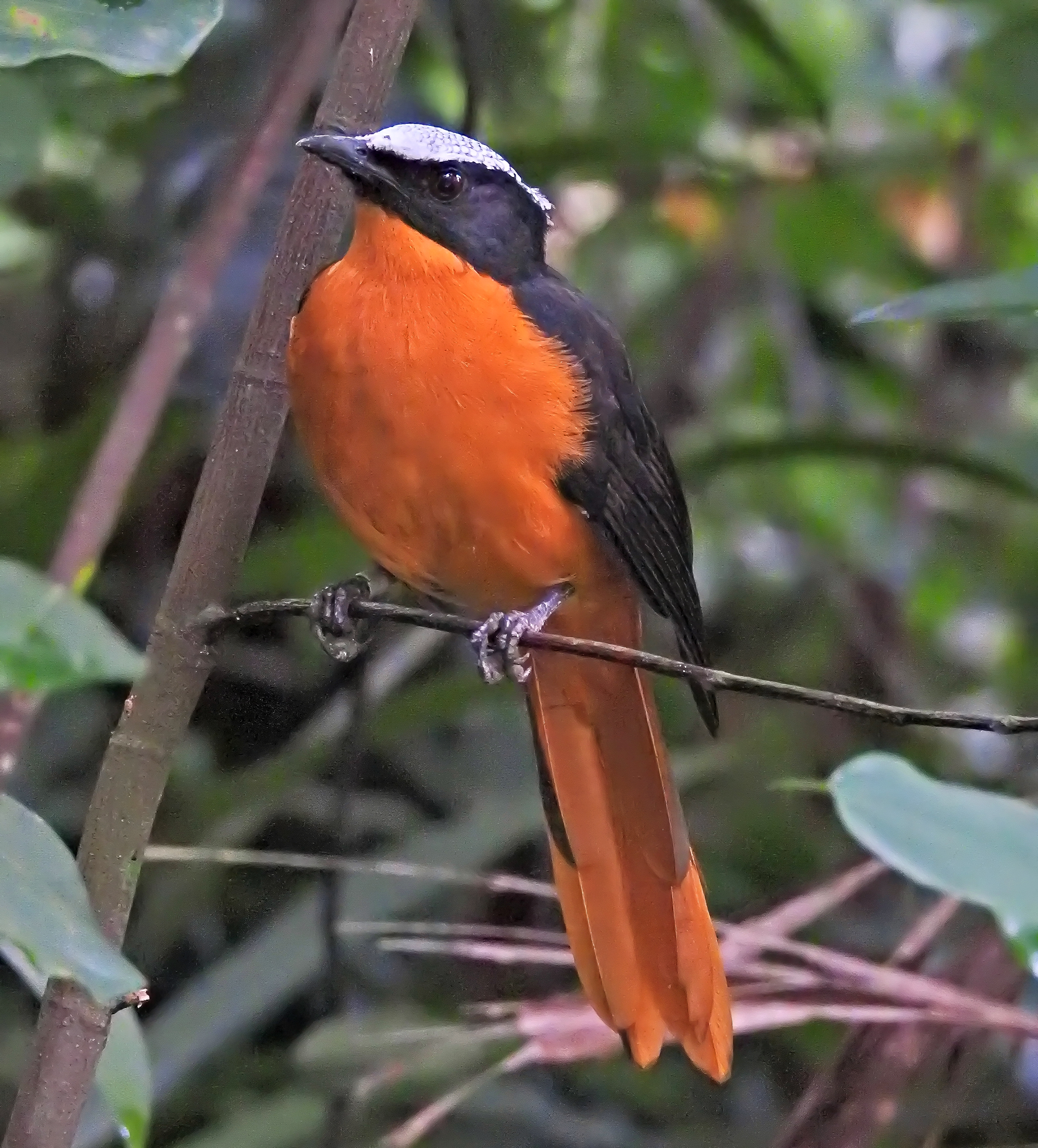
3-12-2015 JURONG, SINGAPORE - WHITE CROWNED ROBIN CHAT (Cossypha albicapillus)


The white-crowned robin-chat (Cossypha albicapillus) is a species of bird in the family Muscicapidae. It is found in Benin, Burkina Faso, Cameroon, Central African Republic, Ivory Coast, Ethiopia, Gambia, Ghana, Guinea, Guinea-Bissau, Mali, Niger, Nigeria, Senegal, Sierra Leone, South Sudan, and Togo. Its natural habitats are dry savanna and subtropical or tropical moist shrubland.


Although widespread, very little is known about the White-crowned Robin Chat. Neither population nor breeding information information is available. Taxonomically, robin chats were once thought to belong to the Thrush family. However recent studies have shown that they are more closely related to the Old World flycatchers.
Widespread this species inhabit eleven countries in the northern part of Africa. Although there have been no formal population studies the white-crowned robin chat is quite common throughout its range.


A large and colorful robin-chat with a black face mask that continues onto the chin. The color of the crown is pure white in the far western part of the range, and white with black markings elsewhere. A shy bird of dense thickets, gardens, and forest, often along rivers and streams. Similar to Snowy-crowned Robin-Chat, but larger, usually with black markings in the white crown, and with a black rather than orange chin. Usually detected by song, a fast and complex mix of musical whistles. 

26-11-2015 JURONG, SINGAPORE - ROSEATE SPOONBILL (Platalea ajaja)


The flamboyant Roseate Spoonbill looks like it came straight out of a Dr. Seuss book with its bright pink feathers, red eye staring out from a partly bald head, and giant spoon-shaped bill. Groups sweep their spoonbills through shallow fresh or salt waters snapping up crustaceans and fish. They fly with necks outstretched, to and from foraging and nesting areas along the coastal southeastern U.S., and south to South America. These social birds nest and roost in trees and shrubs with other large wading birds.


The Roseate Spoonbill is 1 of 6 species of spoonbills in the world and the only one found in the Americas. The other 5 spoonbills (Eurasian, Royal, African, Black-faced, and Yellow-billed) occur in Asia, Africa, Europe, and Australia.
As humans, we are all too familiar with hair loss as we get older. Roseate Spoonbills, it turns out, are familiar with balding too, but instead of losing hair they lose feathers from the top of their head as they get older.
Roseate Spoonbill chicks don't have a spoon-shaped bill immediately after hatching. When they are 9 days old the bill starts to flatten, by 16 days it starts to look a bit more spoonlike, and by 39 days it is nearly full size.

3-12-2015 JURONG, SINGAPORE - MOURNING DOVE (Zenaida macroura)


The mourning dove (Zenaida macroura) is a member of the dove family, Columbidae. The bird is also known as the American mourning dove, the rain dove, the chueybird, colloquially as the turtle dove, and it was once known as the Carolina pigeon and Carolina turtledove. It is one of the most abundant and widespread North American birds and a popular gamebird, with more than 20 million birds (up to 70 million in some years) shot annually in the U.S., both for sport and meat. Its ability to sustain its population under such pressure is due to its prolific breeding; in warm areas, one pair may raise up to six broods of two young each in a single year. The wings make an unusual whistling sound upon take-off and landing, a form of sonation. The bird is a strong flier, capable of speeds up to 88 km/h (55 mph).

Mourning doves are light gray and brown and generally muted in color. Males and females are similar in appearance. The species is generally monogamous, with two squabs (young) per brood. Both parents incubate and care for the young. Mourning doves eat almost exclusively seeds, but the young are fed crop milk by their parents.

3-12-2015 JURONG, SINGAPORE - GREAT WHITE PELICAN (Pelecanus onocrotalus)


The great white pelican (Pelecanus onocrotalus) also known as the eastern white pelican, rosy pelican or simply white pelican is a bird in the pelican family. It breeds from southeastern Europe through Asia and Africa, in swamps and shallow lakes.

The great white pelican has been rated as a species of least concern on the IUCN Red List of Endangered Species (IUCN). It is listed under Appendix I of the Convention on the Conservation of Migratory Species of Wild Animals, Annexure I under the EU Birds Directive on the Conservation of Wild Birds, and Appendix II of the Berne Convention on the Conservation of European Wildlife and Natural Habitats. It is also listed within 108 Special Protection Areas in the European Union. It occurs within 43 Important Bird Areas (IBAs) in its European range. It is one of the species to which the Agreement on the Conservation of African-Eurasian Migratory Waterbirds (AEWA) is applied.

3-12-2015 JURONG, SINGAPORE - SULPHUR CRESTED COCKATOO (Cacatua galerita)


The sulphur-crested cockatoo (Cacatua galerita) is a relatively large white cockatoo found in wooded habitats in Australia, New Guinea, and some of the islands of Indonesia. They can be locally very numerous, leading to them sometimes being considered pests. A highly intelligent bird, they are well known in aviculture, although they can be demanding pets.

In Australia, sulphur-crested cockatoos can be found widely in the north and east, ranging from the Kimberley to as far south as Tasmania, but avoiding arid inland areas with few trees. They are numerous in suburban habitats in cities such as Adelaide, Melbourne, Canberra, Sydney, Brisbane and Perth. Except for highland areas, they occur throughout most of New Guinea and on nearby smaller islands such as Waigeo, Misool and Aru, and various islands in the Cenderawasih Bay and Milne Bay. 


Within Australia, sulphur-crested cockatoos of the nominate race have also been introduced to Perth, which is far outside the natural range. Outside Australia, they have been introduced to Singapore, where their numbers have been estimated to be between 500 and 2000. They have also been introduced to Palau and New Zealand. In New Zealand, the introduced populations may number less than 1000. This species has also been recorded as established in Hawaii and from various islands in Wallacea (e.g. Kai Islands and Ambon), but it is unclear if it has managed to become established there.
Sulphur-crested cockatoos are 44–55 cm (17.5–21.5 in) long, with the Australian subspecies larger than subspecies from New Guinea and nearby islands. The plumage is overall white, while the underwing and -tail are tinged yellow. The expressive crest is yellow. The bill is black, the legs are grey, and the eye-ring is whitish. Males typically have almost black eyes, whereas the females have a more red or brown eye, but this requires optimum viewing conditions to be seen. The differences between the subspecies are subtle. C. g. fitzroyi is similar to the nominate race but lacks the yellow on the ear tufts and has slightly blueish skin around the eye. C. g. eleonora is similar to C. g. fitzroyi but is smaller and has broader feathers in the crest, and C. g. triton is similar to C. g. eleonora except it has a smaller bill.

It is similar in appearance to the three species of corellas found in Australia. However, corellas are smaller, lack the prominent yellow crest and have pale bills. In captivity, the sulphur-crested cockatoo is easily confused with the smaller yellow-crested cockatoo or the blue-eyed cockatoo with a differently shaped crest and a darker blue eye-ring.

20-12-2015 JURONG, SINGAPORE - SPOTTED WHISTLING DUCK (Dendrocygna guttata)


The Spotted whistling duck is one of the smaller species in the genus Dendrocygna. This duck grows to 43-50 cm tall. Males can weigh anywhere from 590g to 650g while females weigh 610g to 860g. White spots on their flanks and breasts gave these ducks the spotted name. The sides of the neck, faces, and eyebrows are all grey. Black or dark brown coloring stretches from the crown nape to the hindneck. This dark coloring is also found in the eyepatch. Their coloring resembles a cape with a thick collar. This cape starts as a light brown then fades into a darker brown closer to the tail. Their underbelly is mostly brown, sometimes spotted, and significantly lighter than the wings and the “collar.” A white bar on the upper tail coverts can be seen during flight aiding in identification. They have dull pink legs with black webbed feet and sharp nails. The bill is dark, yet often seen with portions of red and a small white mark on the lower mandible. Spotted whistling ducks look as though they are raised from the ground, as though they are standing up tall. (look more into this). Their wings pressed strongly against the body. Inner vanes of the outer primaries are jagged and can be seen in flight (check on this). While flying, the head is positioned down causing the whole bird to look hunched. The tail stays pointed and looks long when in flight.Juveniles are seen with white streaks on flanks instead of spots and have significantly duller coloring. Spotted whistling ducks are visually similar to D. arborea, yet many scientists believe its closest relative is D. eytoni. After gaining their adult plumage at the age of 6 months,. the spotted whistling duck has a single annual molt. Like other ducks, swans, and geese, the spotted whistling duck molts synchronously. Synchronous molting is common within Anseriformes because waterfowl have the ability to avoid terrestrial predators. Unlike other birds, waterfowl float in ponds lakes while they molt, safe from predators. Other more evolved ducks have two molts, whistling ducks only molt once.

Saturday, 3 March 2018

3-12-2015 JURONG, SINGAPORE - YELLOW STREAKED LORY (Chalcopsitta scintillata)


The yellow-streaked lory (Chalcopsitta scintillata), also known as the streaked lory or yellowish-streaked lory, is a species of parrot in the family Psittaculidae.

It is found in the Aru Islands and southern New Guinea. Its natural habitats are subtropical or tropical moist lowland forest and subtropical or tropical mangrove forest.

A rather large lory of lowland forest and semi-open areas. Mainly green plumage, medium-length, rounded tail with red undertail, thighs and forehead. In flight, southwestern birds show a distinctive red front part of the underwing. Pairs often seen in flight. Similar to Black Lory which has slight overlap but Yellow-streaked, shows green plumage and streaks. Dusky Lory is smaller with smaller head, red bill and yellow patches in the wing. Call, a sharp, loud “chikeek!”.

3-12-2015 JURONG, SINGAPORE - WHITE COLLARED KINGFISHER (Todiramphus chloris)


The collared kingfisher (Todiramphus chloris) is a medium-sized kingfisher belonging to the subfamily Halcyoninae, the tree kingfishers. It is also known as the white-collared kingfisher, black-masked kingfisher or mangrove kingfisher. It has a wide range extending from the Red Sea across southern Asia to Polynesia. 

The collared kingfisher is 23 to 25 cm (9.1 to 9.8 in) long and the male weighs 51 to 90 g (1.8 to 3.2 oz), while the female weighs 54–100 g (1.9–3.5 oz).[10] It varies from blue to green above while the underparts can be white or buff. There is a white collar around the neck, giving the bird its name. Some races have a white or buff stripe over the eye while others have a white spot between the eye and bill. There may be a black stripe through the eye. The large bill is black with a pale yellow base to the lower mandible. Females tend to be greener than the males. Immature birds are duller than the adults with dark scaly markings on the neck and breast.

It has a variety of calls which vary geographically. The most typical call is a loud, harsh and metallic "kee-kee-kee" repeated several times.

3-12-2015 JURONG, SINGAPORE - BLACK NAPED ORIOLE (Oriolus chinensis)


The black-naped oriole (Oriolus chinensis) is a passerine bird in the oriole family that is found in many parts of Asia. There are several distinctive populations within the wide distribution range of this species and in the past the slender-billed oriole (Oriolus tenuirostris) was included as a subspecies. Unlike the Indian golden oriole which only has a short and narrow eye-stripe, the black-naped oriole has the stripe broadening and joining at the back of the neck. Males and females are very similar although the wing lining of the female is more greenish. The bill is pink and is stouter than in the golden oriole.

4-12-2015 JURONG, SINGAPORE - GOLDEN PHEASANT (MALE) (Chrysolophus pictus)


The golden pheasant (Chrysolophus pictus), also known as the Chinese pheasant, and rainbow pheasant, is a gamebird of the order Galliformes (gallinaceous birds) and the family Phasianidae (pheasants). The genus name is from Ancient Greek khrusolophos, "with golden crest", and pictus is Latin for "painted" from pingere, "to paint".

The adult male is approximately 100 cm (39 in) in length, with its tail accounting for two-thirds of the total length, and around 500–700 g (1–2 lb) in weight. Its coloration is characterized by a golden crest and rump and by a bright red body. It possess an orange ruff or "cape" on the beck that can be spread in display, appearing as an alternating black and orange fan that covers all of the face except for the eyes. The eye is bright yellow, with a pinpoint black pupil. The face, throat, chin, and the sides of neck are rusty tan. The wattles and orbital skin are both yellow. The upper back is green and the rest of the back and rump is golden-yellow. The tertiary feathers on the wings are blue, whereas the scapulars are dark red. The central tail feathers are black spotted with cinnamon, while the tip of the tail is a cinnamon buff. The upper tail coverts are the same colour as the central tail feathers. The male also has a scarlet breast, and scarlet and light chestnut flanks and underparts. Lower legs and feet are a dull yellow.

The adult female (hen) is 60–80 cm (24–31 in) in length and weights around 350 g (1 lb). Her tail is proportionally longer, and makes up roughly half of her total length. She is much less showy than the male, with a duller mottled brown plumage similar to that of the female common pheasant, but is darker and more slender. The female's breast and sides are barred buff and blackish brown, and the abdomen is plain buff. She has a buff face and throat. Some abnormal females may later in their lifetime develop some male plumage. Both males and females have yellow legs and yellow bills.


The golden pheasant is native to forests in mountainous areas of western China, but feral populations have been established in the United Kingdom, Canada, the United States, Mexico, Colombia, Peru, Bolivia, Chile, Argentina, Uruguay, the Falkland Islands, Germany, Belgium, the Netherlands, France, Ireland, Australia and New Zealand. In England they may be found in East Anglia in the dense forest landscape of the Breckland as well as Tresco on the Isles of Scilly.

Golden pheasants were introduced to Maui, in Hawaii, at some point before their first detection in 1996. The original birds were released in Waikamoi Preserve, where the founder population has showed evidence of reproductive behavior. Secondary groups were later recorded in Hanawï Natural Area Reserve and Haleakalä National Park, where they most probably arrived through dispersal from Waikamoi. Overall, the pheasants inhabit areas between 1,700–2,400 m (5,577–7,874 ft) on the windward slope of the island.


Golden pheasants feed on the ground on grain, leaves and invertebrates, but they roost in trees at night. During winter, flocks tend to forage close to human settlements at the edge of forest, taking primarily wheat leaves and seeds. While they can fly clumsily in short bursts, they prefer to run and spend most of their time on the ground. This type of flying is commonly known as "flapping flight" and is due to a lack of a deep layer of M. pectoralis pars thoracicus and the tendon that attaches to it. This muscle is commonly attributed to the stabilization of flight in other birds; however, the absence of this deep layer causes this mode of "flapping flight" is simply a mechanism that it shares with other ground birds in order to escape predators. However, they would rather prefer to simply run away and hide from their predators rather than to fly.

Golden pheasants lay 8 to 12 eggs at a time and will then incubate these for around 22–23 days. They tend to eat berries, grubs, seeds and other types of vegetation.

The male has a metallic call in the breeding season.


The golden pheasant is commonly found in zoos and aviaries, but often as hybrid specimens that have the similar Lady Amherst's pheasant in their lineage.

There are also different mutations of the golden pheasant known from birds in captivity, including the dark-throated, yellow, cinnamon, salmon, peach, splash, mahogany and silver. In aviculture, the wild type is referred to as "red-golden" to differentiate it from these mutations.

The coloration in the feathers can be an indication to the genetic quality of the male golden pheasant. Hue, brightness, and chroma are usually measured to see color differences. results show that heterozygosity of the most polymorphic major histocompatibility complex locus was highly related with the chroma and brightness of the feathers.

4-12-2015 JURONG, SINGAPORE - INDIAN PIED MYNA (Gracupica contra)


The Indian pied myna was formally described by the Swedish naturalist Carl Linnaeus in 1758 in the tenth edition of his Systema Naturae under the binomial name Sturnus contra. Linnaeus based his description on the "Contra, from Bengall" that had been described and illustrated in 1738 by Eleazar Albin and the "Black and White Indian Starling" that had been described and illustrated in 1751 by George Edwards. Albin believed that "contra" was the Bengali word for this species, but this name was not known in the 19th century. Linnaeus specified the type locality as India but this was restricted to Calcutta by the British ornithologist E. C. Stuart Baker in 1921. In the past the Indian pied myna has been included in the genera Sturnus and Sturnopastor but based on results from molecular phylogenetic analysis published in 2008 it is now placed in the resurrected genus Gracupica that had been introduced in 1831 by the French naturalist René Lesson.

Two subspecies are recognised:

G. c. contra (Linnaeus, 1758) – east Pakistan, north, central, India, south Nepal and Bangladesh (includes sordida)
G. c. superciliaris (Blyth, 1863) – Manipur (northeast India), north, central, southeast Myanmar and southwest China
It is found mainly along the Gangetic plains extending south into Andhra Pradesh and east to Bangladesh. The population in northeastern India (Sadiya to Tirap and the Naga Hills) was named as sordida (originally Sturnus contra sordidus) by Sidney Dillon Ripley in 1950. This form differs from the Indian form in having reduced streaking on the shoulders and nape. The populations in Manipur south to Myanmar and east to Yunnan have the white extending over the eye and are included in the subspecies superciliaris first described by Edward Blyth in 1863.


A 2021 study found that G. contra represents a species complex of 3 distinct species: the Indian pied myna (G. contra sensu stricto) from most of the Indian Subcontinent, Myanmar, and Yunnan in China, with subspecies sordida and superciliaris; the monotypic Siamese pied myna (G. floweri) from Thailand and Cambodia, and the monotypic possibly extinct in the wild Javan pied myna(G. jalla), historically known from Java and Bali in Indonesia. G. jalla was likely driven to extinction in the wild due to the illegal songbird trade becoming increasingly pervasive in Indonesia, and in captivity it is likely threatened by hybridization with captured individuals of mainland pied myna species. It has been recommended to search for genetically pure members of the species in the wildlife trade for the purpose of captive breeding; a potential captive population of pure G. jalla exists at Bali Bird Park.


25-11-2015 JURONG, SINGAPORE - MASKED LAPWING (Vanellus miles)


The masked lapwing (Vanellus miles) is a large, common and conspicuous bird native to Australia (particularly the northern and eastern parts of the continent), New Zealand and New Guinea. It spends most of its time on the ground searching for food such as insects and worms, and has several distinctive calls. It is common in Australian fields and open land, and is known for its defensive swooping behaviour during the nesting season.

Despite the species being also known as the masked plover and often called the spur-winged plover or just plover in its native range, lapwings are classified to their own subfamily, Vanellinae, and not to the closely related plover subfamily, Charadriinae. There are two subspecies: the nominate subspecies and the southern novaehollandiae. The latter has distinctive black markings on the shoulder and side of the chest, and is sometimes recognized as a separate species: the black-shouldered lapwing (Vanellus novaehollandiae).

4-12-2015 JURONG, SINGAPORE - GREEN IMPERIAL PIGEON (Ducula aenea)


The adult male of nominate race has iridescent green upperparts tinged bluish or bronzy. The primary and outer secondary flight feathers and the rectrices are grey with slight greenish gloss.
Head and neck, upper mantle, breast and belly are pale pinkish-grey. The undertail-coverts are dark chestnut.
On the grey head, we can see some white feathers around the eyes and at bill base.
The bill is bluish-grey. The eyes are deep red. Legs and feet are reddish.
Both sexes are similar with the female slightly duller than male.
The juvenile is duller than adults, with less pink on head and underparts.


The Green Imperial-Pigeon is a vocal species. It utters single deep, loud “oom” while lowering the head, and a growling “kr-r-r-r-r”. The most often heard is a deep disyllabic “curr-hoo” or “koo koooo”. Actually, all these sounds are variations of the same call according to the situation.

The birds of Sulawesi utter a questioning “woohoo woo”, whereas in India, they give longer call, a deep, resonant “wuck-wuck-woor” or “wuck-woor-woor-woor-woor”. 

The Green Imperial-Pigeon is a forested species. It frequents both primary and secondary forests, mangroves and also open country with scattered trees.
This species usually occurs in lowlands, but in India, it can be seen up to 300-600 metres of elevation, and in Sulawesi Islands, up to 1000 metres.

The Green Imperial-Pigeon is found in tropical southern Asia, from India E to Indonesia.

The Green Imperial-Pigeon is frugivorous, eating numerous fruits and berries. Those from Ficus and Myristica are greatly appreciated.
It is usually seen alone, in pairs or in small groups of 3-5 birds. But occasionally, flocks of up to 60 birds can be seen at fruiting trees and at roost.
The Green Imperial-Pigeon uses nighttimes’ roosts in some areas, and year after year, the same roosts are occupied, and the same routes are used to reach them.

This arboreal pigeon forages mainly in the upper canopy, plucking small and large fruits from the branches. It is not aggressive towards other pigeons when feeding. It may come to the ground, first for drinking, and then, to lick salt-soils.

4-12-2015 JURONG, SINGAPORE - LESSER WHISTLING DUCK (Dendrocygna javanica)


The lesser whistling duck (Dendrocygna javanica ), also known as Indian whistling duck or lesser whistling teal, is a species of whistling duck that breeds in the Indian subcontinent and Southeast Asia. They are nocturnal feeders that during the day may be found in flocks around lakes and wet paddy fields. They can perch on trees and sometimes build their nest in the hollow of a tree. This brown and long-necked duck has broad wings that are visible in flight and produces a loud two-note wheezy call. It has a chestnut rump, differentiating it from its larger relative, the fulvous whistling duck, which has a creamy white rump.

4-12-2015 JURONG, SINGAPORE - VICTORIA CROWNED PIGEON (Goura victoria)


The Victoria crowned pigeon (Goura victoria) is a large, bluish-grey pigeon with elegant blue lace-like crests,
maroon breast and red irises. It is part of a genus (Goura) of four unique, very large, ground-dwelling pigeons native to the New Guinea region. The bird may be easily recognized by the unique white tips on its crests and by its deep 'whooping' sounds made while calling. Its name commemorates the British monarch Queen Victoria.

The Victoria crowned pigeon is a deep blue-grey colour with a small, black mask. Its feather crest (the signature feature of crowned pigeons other than their size) is conspicuously white-tipped. On the wing coverts is a row of feathers that are a paler blue-gray with maroon tips. These form a distinct wing bar. The chest is a deep purple-maroon color. As in all crowned pigeons, melanism has been observed. The other two crowned pigeons are somewhat superficially similar, but only the western crowned pigeon overlaps in range with the Victoria species. The Scheepmaker's crowned pigeon does not. In the western species, the crown is more scraggly and hair-like, the chest is a uniform blue-gray and not maroon, and a less distinct wing-bar is present. Both sexes are similar.


The Victoria crowned pigeon is distributed in the lowland and swamp forests of northern New Guinea and surrounding islands. It usually occurs on areas that were former alluvial plains, including sago forests. Though typically found at or near sea level, occasionally birds of this species may venture up in the hills to an elevation up to about 3,000 feet.

Like other crowned pigeons, the Victoria crowned pigeon is a gregarious species. They usually travel in pairs or small parties as they search for food. They walk with an unhurried gait along the forest floor. Their food typically consists of fallen fruit. Birds of this species in captivity are particularly fond of eating figs. Seeds and invertebrates may occasionally supplement the diet. When disturbed, these birds fly straight up into the canopy or a large horizontal branch of a large forest tree. After being disturbed, they may remain on their perch for a considerable time engaging in contact calls and flicking their tails. In the wild, this species tends to be shier than the western crowned pigeon, but can still occasionally be quietly approached. The males regularly engage in aggressive displays to establish dominance. In these interactions, the pigeons puff up their chests and repeatedly raise their wings as if preparing to strike their opponent. They also make short dashes at each other and may actually hit one another, but rarely make contact and can be completely peaceful towards other males outside of the early mating season.

4-12-2015 JURONG, SINGAPORE - ASIAN GLOSSY STARLING (JUVENILE) (Aplonis panayensis)


The Asian glossy starling (Aplonis panayensis) is a species of starling in the family Sturnidae. It is found in Bangladesh, Brunei, India, Indonesia, Malaysia, Myanmar, the Philippines, Singapore, Taiwan (introduced) and Thailand. Its natural habitats are subtropical or tropical moist lowland forest and subtropical or tropical mangrove forest. There is also a huge number of this species inhabiting towns and cities, where they take refuge in abandoned buildings and trees. They often move in large groups and are considered one of the noisiest species of birds. In the Philippines, it is known as kulansiyang, galansiyang, or kuling-dagat.


The Asian Glossy Starling often appears black, but the conspicuous bright red eyes light up the glossy plumage of this beautiful bird.

Both sexes are similar.
The adult has black plumage with greenish gloss overall, except on vent which is matt black.
On the head, we can see a small black mask on the lores and around the eye. Nape and neck exhibit more elongated feathers which are fluffed up according to the situation and the mood of the bird.
The strong bill, legs and feet are black. The eyes are bright red.

3-3-2018 GANDIA RIO SERPIS, VALENCIA - LITTLE EGRET (Egretta garzetta)


The Little Egret, Egretta garzetta, is a dainty heron adorned in pure white plumage. It is characterized by a slender black beak, long black legs, and, notably in the western race, yellow feet. This elegant bird is a sight to behold with its graceful neck and poised stance.

Adult Little Egrets measure between 55–65 cm in length with a wingspan of 88–106 cm, and weigh 350–550 g. Their plumage is predominantly white, though some may exhibit bluish-grey coloration. Breeding adults boast ornate nape plumes reaching about 150 mm, along with distinctive feathers on the breast and elongated scapulars. The bill and lores are black, with greenish-grey skin at the base of the lower mandible and around the eye, which houses a yellow iris. Legs are black with contrasting yellow feet, though juveniles may have greenish-black legs and duller feet. The subspecies E. g. nigripes is distinguished by yellow skin between the bill and eye, and blackish feet.

The Little Egret frequents a variety of wetland habitats, from the shores of lakes and rivers to marshes and coastal regions. It is often found in open environments, such as mangroves, swamps, mudflats, and sandy beaches, as well as human-altered landscapes like rice fields.

The species has a broad breeding distribution across warm temperate to tropical regions of Asia, Africa, Australia, and Europe. Northern populations are migratory, wintering in Africa and southern Asia, while others remain as permanent residents in warmer areas.


Little Egrets are social yet territorial when feeding. They exhibit a range of foraging behaviors, from active chasing to patient ambush. Their movements are often in response to the presence of other animals, which may stir up prey.

The Little Egret's vocalizations include croaking and bubbling sounds at breeding colonies and a harsh alarm call when disturbed. These calls are similar to those of the Black-crowned Night Heron and the Cattle Egret.

Breeding colonies are often mixed with other water birds. Nests are platforms of sticks located in trees, shrubs, or reed beds. Clutches typically consist of three to five bluish-green eggs, incubated by both parents for about three weeks. The young fledge at approximately six weeks old.

The diet is diverse, including fish, amphibians, small reptiles, mammals, birds, crustaceans, molluscs, insects, spiders, and worms. The Little Egret employs various hunting techniques, both in water and on land, to capture its prey.

4-12-2015 JURONG, SINGAPORE - MANDARIN DUCK (FEMALE) (Aix galericulata),

The beautiful mandarin duck was introduced from the Far East, where it can still be found in China, Japan, Korea and parts of Russia. It escaped, or was deliberately released, from captivity in the UK. Mandarin ducks are actually quite shy birds, often hiding beneath overhanging willows and usually only forming small flocks.
 
A beautiful, unmistakable duck: male mandarins have elaborate plumage with orange plumes on their cheeks, orange 'sails' on their back, and pale orange sides; females are dull in comparison, with grey heads, brown backs and white eyestripe.
 
Introduced from China and now found on park lakes and other wetlands with overhanging trees, mainly in South East England, but also in North England, Wales and Scotland. 

4-12-2015 JURONG, SINGAPORE - RUDDY HEADED GOOSE (Chloephaga rubidiceps)


The ruddy-headed goose (Chloephaga rubidiceps) is a species of waterfowl in tribe Tadornini of subfamily Anserinae. It is found in Argentina, Chile, and the Falkland Islands.

The ruddy-headed goose is monotypic.

The ruddy-headed goose is 45 to 52.5 cm (18 to 21 in) long. Males weigh 1.65 to 2.02 kg (3.6 to 4.5 lb) and females 1.20 to 1.50 kg (2.6 to 3.3 lb). Adults have the same plumage. Their heads and necks are red-brown, their back, breast, and flanks gray and buff with brown barring, their belly cinnamon, and their tail black. Their wing's upperside is gray and the underside gray, black, and white. Their bill is black and the legs and feet orange with black markings. Juveniles are similar to adults but duller overall.


The ruddy-headed goose is found in the eastern Chilean and Argentinian parts of Tierra del Fuego and north from there to Buenos Aires Province, Argentina. It is also found on the Falkland Islands. It inhabits open landscapes such as meadows, Pampas wetlands, the borders of ponds, and coastal grasslands.

Ruddy-headed geese are year-round residents of the Falkland Islands, though they make local movements there. The species nests in Tierra del Fuego and far southern mainland Argentina and for the winter migrates north from there as far as Argentina's Buenos Aires Province.

The ruddy-headed goose is almost entirely vegetarian and feeds mostly on the ground rather than in water. On the breeding grounds its diet is small berries and the roots, leaves, stems, and seeds of grasses and sedges. During winter it feeds on young wheat and in harvested fields of maize, sunflower, and sorghum.


The ruddy-headed goose's breeding season begins as early as September on the Falkland Islands and in mid-October on the mainland. It nests singly or in small loose groups. Nests are placed in long grass or amid boulders and are lined with down. The clutch size is three to eight eggs. Males guard females during the incubation period of about 30 days. The time to fledging is not known.
Male and female ruddy-headed geese have different vocalizations: Males make a "short, whistled 'seep'" and females a "short rasping quack".

The IUCN has assessed the ruddy-headed goose as being of Least Concern, though its population size is unknown and believed to be decreasing. The population in the Falklands appears robust but that in Tierra del Fuego and mainland South America may be only a few hundred birds after major decline in the 20th century. A major cause of the crash is predation by the South American gray fox, which was introduced to Tierra del Fuego in the 1950s to control rabbits. A Memorandum of Understanding was negotiated in 2006 with Argentina and Chile under the Bonn Convention in an attempt to safeguard the remaining migratory Tierra del Fuego/mainland population.