TOTAL PAGEVIEWS

TRANSLATE

Friday, 5 January 2024

3-1-2024 BAKAU, GAMBIA - HOODED VULTURE (Necrosyrtes monachus)

The hooded vulture, Necrosyrtes monachus, is one of the smallest of the Old World vultures. The species gets its common name from the cream-colored hood, formed from a patch of downy feathers, along the back of its neck to the crown of its head.

The small vulture is scruffy-looking and has a rather short, rounded tail. The male and female vultures appear similar, while females have longer eyelashes than males. Juveniles are similar in appearance to adults, only darker and plainer in color with a purple sheen.

The vulture’s face is usually pinkish-white in color, though it can flush red when agitated. It has dark brown plumage with a feathered nape and hind-neck. The hooded vulture’s long thin black bill leads into its bare face, crown, and foreneck.


Soaring above savannah and human settlements, the hooded vulture typically scavenges on carcasses from wildlife or domesticated animals. They also feed on grasshoppers, grubs, and locusts and congregate during the seasonal emergence of insects.

The hooded vulture feeds at low tide on mussels, lobsters, mollusks, and dead fish along the coast. When limited food is available, the species can go without food for several days by not excreting and in turn slowing down its metabolism. 

Thursday, 4 January 2024

3-1-2024 BAKAU, GAMBIA - PLAIN TIGER BUTTERFLY (Danaus chrysippus)


Clearly a relative of the well known monarch, D. plexippus, this species is slightly smaller. Rather more widespread but very scarce in coastal areas of the Mediterranean from Spain to Greece. It has a world wide distribution.

There is almost no variation recorded across its vast worldwide range. There are exceptions in a few places such as east Africa where additional forms are present and appear to be controlled by Mendelian genetics - why the effect is localised is not clear.

Mediterranean coasts from Spain, where it is most frequent, to Greece, but absent from large parts of the cost. North Africa in Morocco to Tunisia where it can be found well inland. Seemingly greatly reduced in the Canary Islands now. Flies at all times of the year, with a period of relative inactivity in winter.

A powerful species, roaming widely. Frequents hot dry places.

Wednesday, 3 January 2024

3-1-2024 BAKAU, GAMBIA - YELLOW BILLED KITE (Milvus migrans ssp. parasitus)


The yellow-billed kite is the Afrotropic counterpart of the black kite, of which it is most often considered a subspecies. However, DNA studies suggest that the yellow-billed kite differs significantly from black kites in the Eurasian clade, and should be considered as a separate, allopatric species. 

2-1-2024 CALYPSO BAR, GAMBIA - COMMON SANDPIPER (Actitis hypoleucos)


The common sandpiper (Actitis hypoleucos) is a small Palearctic wader. This bird and its American sister species, the spotted sandpiper (A. macularia), make up the genus Actitis. They are parapatric and replace each other geographically; stray birds of either species may settle down with breeders of the other and hybridize. Hybridization has also been reported between the common sandpiper and the green sandpiper, a basal species of the closely related shank genus Tringa.

The common sandpiper breeds across most of temperate and subtropical Europe and Asia, and migrates to Africa, southern Asia and Australia in winter. The eastern edge of its migration route passes by Palau in Micronesia, where hundreds of birds may gather for a stop-over. They depart the Palau region for their breeding quarters around the last week of April to the first week of May.

2-1-2024 CALYPSO BAR, GAMBIA - YELLOW CASQUED HORNBILL (Ceratogymna elata)


The yellow-casqued hornbill (Ceratogymna elata), also known as the yellow-casqued wattled hornbill, is found in the rainforest of coastal regions of West Africa, for example in Côte d'Ivoire. It is threatened by habitat loss.

The yellow-casqued hornbill is one of the largest birds of the West African forest, with adults weighing up to 2 kg (4.4 lb). They live mainly in the forest canopy, rarely feeding on the ground. They live in small family groups containing at least one adult male and female, with one or two immature birds, though they sometimes gather in larger flocks to exploit a major food supply such as an ant or termite nest.

The birds are occasionally preyed upon by crowned hawk-eagles, and they respond to the presence of an eagle (sometimes indicated by its characteristic shriek) by mobbing – approaching it and emitting calls. Since the eagles depend on surprise to make a catch, this frequently causes them to leave the area. Recent research (Rainey et al., 2004) has shown that the birds respond in the same way to the alarm calls that Diana monkeys, which live in the same areas, emit if they notice an eagle, and that they can distinguish the calls made by the monkeys in the presence of eagles from those they make in the presence of leopards, which prey on the monkeys but not on the hornbills.

2-1-2024 CALYPSO BAR, GAMBIA - PIED KINGFISHER (Ceryle rudis)


The pied kingfisher (Ceryle rudis) is a species of water kingfisher widely distributed across Africa and Asia. Originally described by Carl Linnaeus in 1758, it has five recognised subspecies. Its black and white plumage and crest, as well as its habit of hovering over clear lakes and rivers before diving for fish, make it distinctive. Males have a double band across the breast, while females have a single broken breast band. They are usually found in pairs or small family groups. When perched, they often bob their head and flick up their tail.


2-1-2024 LAMIN RICE FIELDS, GAMBIA - HAMERKOP (Scopus umbretta)


The hamerkop (Scopus umbretta) is a medium-sized wading bird. It is the only living species in the genus Scopus and the family Scopidae. The species and family was long thought to sit with the Ciconiiformes but is now placed with the Pelecaniformes, and its closest relatives are thought to be the pelicans and the shoebill. The shape of its head with a long bill and crest at the back is reminiscent of a hammer, which has given this species its name after the Afrikaans word for hammerhead. It is a medium-sized waterbird with brown plumage. It is found in Africa, Madagascar and Arabia, living in a wide variety of wetlands, including estuaries, lakesides, fish ponds, riverbanks, and rocky coasts. The hamerkop is a sedentary bird that often shows local movements.

The hamerkop takes a wide range of prey, mostly fish and amphibians, but shrimps, insects and rodents are taken too. Prey is usually hunted in shallow water, either by sight or touch, but the species is adaptable and will take any prey it can. The species is renowned for its enormous nests, several of which are built during the breeding season. Unusually for a wading bird the nest has an internal nesting chamber where the eggs are laid. Both parents incubate the eggs, and raise the chicks.

The species is not globally threatened and is locally abundant in Africa and Madagascar, and the International Union for Conservation of Nature (IUCN) has assessed it as being of least concern.


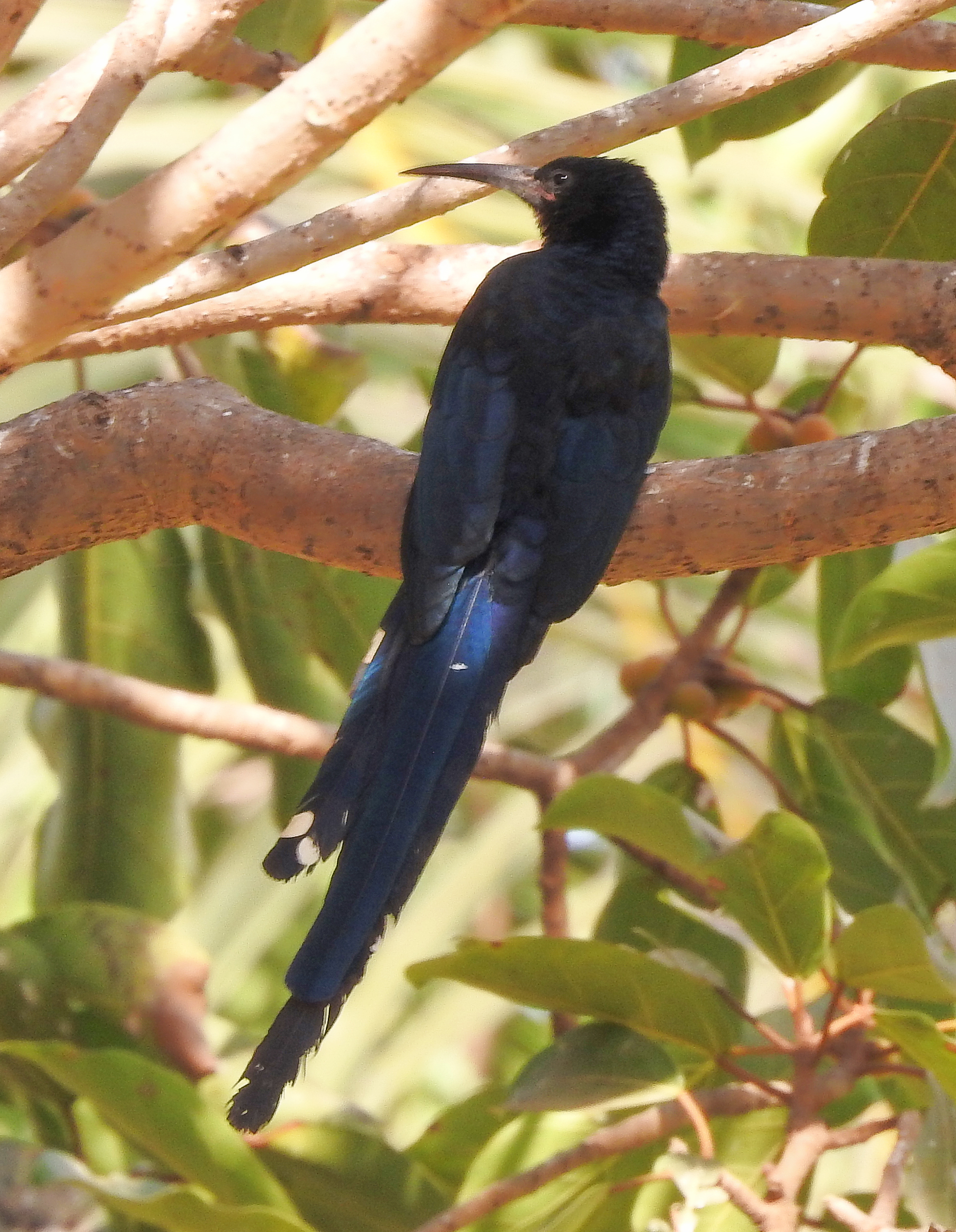
2-1-2024 LAMIN RICE FIELDS, GAMBIA - GREEN WOOD HOOPOE (Phoeniculus purpureus)


The green wood hoopoe (Phoeniculus purpureus) is a large, up to 44 cm (17 in) long tropical bird native to Africa. It is a member of the family Phoeniculidae, the wood hoopoes, and was formerly known as the red-billed wood hoopoe.

This abundant species is a metallic dark green, with a purple back and very long diamond-shaped purple tail. Distinctive white markings on the wings and white chevrons on the tail edges make it easily identifiable, as does its long, thin, curved red bill. Sexes are similar, but immatures have a black bill.

It advertises its presence with its loud kuk-uk-uk-uk-uk call and other vocalisations.


The green wood hoopoe is an insect-eating species. It feeds mainly on the ground, at termite mounds, or on tree trunks, and forms flocks outside the breeding season. Its specialised claws enable it to cling easily to the underside of branches while closely inspecting the bark for insects.

The green wood hoopoe is a cooperative breeder and common resident in the forests, woodlands and suburban gardens of most of sub-Saharan Africa. It is found in groups of up to a dozen or so birds with only one breeding pair. The breeding female lays two to four blue eggs in a natural tree hole or old barbet nest and incubates them for about 18 days. On hatching, she and the nestlings are fed by the rest of the group, even after they have fledged and left the nest hole. The group is fearless in defence of the nestlings against intruders. This species is parasitised by the greater and lesser honeyguide.


Tuesday, 2 January 2024

2-1-2024 LAMIN RICE FIELDS, GAMBIA - YELLOW BILLED KITE (Milvus migrans ssp. parasitus)


The yellow-billed kite is the Afrotropic counterpart of the black kite, of which it is most often considered a subspecies. However, DNA studies suggest that the yellow-billed kite differs significantly from black kites in the Eurasian clade, and should be considered as a separate, allopatric species. 

2-1-2024 LAMIN RICE FIELDS, GAMBIA - SHIKRA (Accipiter badius)


The shikra (Accipiter badius) is a small bird of prey in the family Accipitridae found widely distributed in Asia and Africa where it is also called the little banded goshawk. The African forms may represent a separate species but have usually been considered as subspecies of the shikra. The shikra is very similar in appearance to other sparrowhawk species including the Chinese goshawk (Accipiter soloensis) and Eurasian sparrowhawk (Accipiter nisus). They have a sharp two note call and have the typical flap and glide flight. Their calls are imitated by drongos and the common hawk-cuckoo resembles it in plumage. 

2-1-2024 LAMIN RICE FIELDS, GAMBIA - BROAD SCARLET DRAGONFLY (Crocothemis erythraea)


The scarlet dragonfly (Crocothemis erythraea) is a species of dragonfly in the family Libellulidae. Its common names include broad scarlet, common scarlet-darter, and scarlet darter.

The scarlet dragonfly is a common species in southern Europe and throughout Africa. It also occurs across western Asia as far as southern China. It is a very rare vagrant in Britain. Its first record in the country was at Hayle Kimbro Pool, The Lizard, Cornwall, on 7 August 1995. Since then there have been a few further records at scattered locations throughout Britain.

A wide range of both running and standing waters, except those that are shaded. Adults may be found some distance from water in habitats ranging from desert to open woodland; absent from dense forest.

Crocothemis erythraea can reach a length of 33–44 millimetres (1.3–1.7 in). These dragonflies haves a flattened and rather broad abdomen. The adult male scarlet dragonfly has a bright scarlet red, widened abdomen, with small amber patches at the bases of the hindwings. Also the veins on the leading edges of the wings are red. Females and immatures are yellow-brown and have a conspicuous pale stripe along the top of the thorax.

2-1-2024 LAMIN RICE FIELDS, GAMBIA - HOODED VULTURE (JUVENILE) (Necrosyrtes monachus)


The hooded vulture (Necrosyrtes monachus) is an Old World vulture in the order Accipitriformes, which also includes eagles, kites, buzzards and hawks. It is the only member of the genus Necrosyrtes, which is sister to the larger Gyps genus, both of which are a part of the Aegypiinae subfamily of Old World vultures. It is native to sub-Saharan Africa, where it has a widespread distribution with populations in southern, East and West Africa. It is a scruffy-looking, small vulture with dark brown plumage, a long thin bill, bare crown, face and fore-neck, and a downy nape and hind-neck. Its face is usually a light red colour. It typically scavenges on carcasses of wildlife and domestic animals. Although it remains a common species with a stable population in the lower region of Casamance, some areas of The Gambia, and Guinea-Bissau, other regions such as Dakar, Senegal, show more than 85% losses in population over the last 50 years. Threats include poisoning, hunting, loss of habitat and collisions with electricity infrastructure, and the International Union for Conservation of Nature has rated its conservation status as "critically endangered" in their latest assessment (2022). The highest current regional density of hooded vultures is in the western region of The Gambia. 


2-1-2024 LAMIN RICE FIELDS, GAMBIA - GREY KESTREL (Falco ardosiaceus)

The grey kestrel (Falco ardosiaceus) is an African bird of prey belonging to the falcon family Falconidae. Its closest relatives are the banded kestrel and Dickinson's kestrel and the three are sometimes placed in the subgenus Dissodectes.

It is a fairly small, stocky kestrel with a large, flat-topped head and fairly short wings that don't reach past the tip of the tail when at rest. It is 28–33 cm long with a wingspan of 58–72 cm and a weight of up to 300 grams. The female is 4-11% larger and 5-11% heavier than the male. The plumage of the adult is uniformly dark grey apart from darker wingtips, faint dark streaking on the body and slightly barred flight feathers. The feet and cere are yellow and there is bare yellow skin around the eye. The most similar species is the sooty falcon which has a more rounded head, long wings extending past the tail and less yellow around the eye. 

Juvenile grey kestrels are browner than the adults with a greenish cere and greenish around the eye. Juvenile Dickinson's kestrels are similar but have a barred tail and a more strongly barred underwing.

The grey kestrel is generally silent outside the breeding season but has a shrill, chattering call and a rattling whistle.

It inhabits savannas, open woodland and forest clearings. It favours areas with palm trees, especially near water. It often perches on exposed branches, telegraph poles and wires.


2-1-2024 LAMIN RICE FIELDS, GAMBIA - STRIATED HERON (Butorides striata)


The striated heron (Butorides striata) also known as mangrove heron, little green heron or green-backed heron, is a small heron, about 44 cm tall. Striated herons are mostly sedentary and noted for some interesting behavioral traits. Their breeding habitat is small wetlands in the Old World tropics from west Africa to Japan and Australia, and in South America and the Caribbean. Vagrants have been recorded on Oceanic islands, such as Chuuk and Yap in the Federated States of Micronesia, the Marianas and Palau; the bird recorded on Yap on February 25, 1991, was from a continental Asian rather than from a Melanesian population, while the origin of the bird seen on Palau on May 3, 2005 was not clear. 

2-1-2024 LAMIN RICE FIELDS, GAMBIA - PIED KINGFISHER

Pied kingfishers are widely distributed across Africa and Asia. Males have a double black band across their breast. Females have a black chest that is often broken with a white stripe in the middle. They are sociable birds that are usually found in pairs or small family groups and form large roosts at night.

Its black and white plumage and crest, as well as its habit of hovering over clear lakes and rivers before diving for fish, make it distinctive. Males have a double band across the breast, while females have a single broken breast band. They are usually found in pairs or small family groups.

Pied Kingfisher thrives near water bodies, such as rivers, estuaries, lakes, rocky and sandy coasts, lagoons, streams, irrigation ditches, canals, inlets, bays, floodlands, and fresh or brackish water tanks. They perch in nearby trees, posts, poles, and fences. The species has a vast range, occurring in sub-Saharan Africa, the Middle East, Asia.


Pied Kingfishers primarily feed on fish, but may occasionally consume aquatic insects, amphibians, frogs, molluscs, and crustaceans. They hunt by hovering around 50 to 65 feet above the water, before plunge diving to catch their prey. With their unique ability, they are considered as the largest hovering bird in the world that can fly without using air currents.

They are skilled not only due to their exceptional hovering ability, but their remarkable vision also plays a vital role in their incredible hunting strategy. These birds can spot the exact position of their victim from above plus their eyesight is not affected by water refraction, allowing them to make sudden movements based on the reaction of their prey.

2-1-2024 LAMIN RICE FIELDS, GAMBIA - REED (LONG TAILED) CORMORANT (Microcarbo africanus)

The reed cormorant (Microcarbo africanus ), also known as the long-tailed cormorant, is a bird in the cormorant family Phalacrocoracidae. It breeds in much of Africa south of the Sahara, and Madagascar. It is resident but undertakes some seasonal movements.

The Reed Cormorant or Long-tailed Cormorant is a small, short-billed, long-tailed cormorant found in sub-Saharan Africa. There is a larger subspecies in Madagascar. It frequents a wide variety of freshwater habitats except the fast-flowing streams.

This is a small cormorant at 50–55 cm length and an 85 cm wingspan. It is mainly black, glossed green, in the breeding season. The wing coverts are silvery. It has a longish tail, a short head crest and a red or yellow face patch. The bill is yellow.

Sexes are similar, but non-breeding adults and juveniles are browner, with a white belly. Some southern races retain the crest all year round.

This is a common and widespread species, and is not considered to be threatened. It breeds on freshwater wetlands or quiet coasts. 

2-1-2024 LAMIN RICE FIELDS, GAMBIA - GREAT EGRET (Ardea alba)


The Great White Egret is a large, white heron. Great White Egrets can look similar to Little Egrets, but they are much larger - the same size as the familiar Grey Heron. Other identification features to look out for include black feet (not yellow), yellow beak (in juvenile and non-breeding plumage) and a different fishing technique, more like that of the Grey Heron. 

2-1-2024 LAMIN RICE FIELDS, GAMBIA - AFRICAN JACANA


The African jacana (Actophilornis africanus) is a wader in the family Jacanidae. It has long toes and long claws that enables it to walk on floating vegetation in shallow lakes, its preferred habitat. It is widely distributed in sub-Saharan Africa. For the origin and pronunciation of the name, see Jacanidae.

The African jacanas is a conspicuous and unmistakable bird. It measures 23 to 31 cm (9.1 to 12.2 in) in overall length. As in other jacanas, the female is on average larger than the male. Males can weigh from 115 to 224 g (4.1 to 7.9 oz), averaging 137 g (4.8 oz) and females from 167 to 290 g (5.9 to 10.2 oz), averaging 261 g (9.2 oz). Alongside the similarly-sized Madagascar jacana, this appears to be the heaviest jacana species. They have chestnut upperparts with black wingtips, rear neck, and eyestripe. The underparts are also chestnut in the adults, only in juveniles they are white with a chestnut belly patch. The blue bill extends up as a coot-like head shield, and the legs and long toes are grey.


African jacanas feed on insects and other invertebrates picked from the floating vegetations or the surface of the water.

African jacanas breed throughout sub-Saharan Africa. It is sedentary apart from seasonal dispersion. It lays four black-marked brown eggs in a floating nest.

The jacana has evolved a highly unusually polyandrous mating system, meaning that one female mates with multiple males and the male alone cares for the chicks. Such a system has evolved due to a combination of two factors: firstly, the lakes that the jacana lives on are so resource-rich that the relative energy expended by the female in producing each egg is effectively negligible. Secondly the jacana, as a bird, lays eggs, and eggs can be equally well incubated and cared for by a parent bird of either sex. This means that the rate-limiting factor of the jacana's breeding is the rate at which the males can raise and care for the chicks. Such a system of females forming harems of males is in direct contrast to the more usual system of leks seen in animals such as stags and grouse, where the males compete and display in order to gain harems of females.

The parent that forms part of the harem is almost always the one that ends up caring for the offspring; in this case, each male jacana incubates and rears a nest of chicks. The male African jacana has therefore evolved some remarkable adaptations for parental care, such as the ability to pick up and carry chicks underneath its wings.

1-1-2024 BAKAU, GAMBIA - LAUGHING DOVE (Streptopelia senegalensis)


The laughing dove (Spilopelia senegalensis) is a small pigeon that is a resident breeder in Africa, the Middle East, South Asia, and Western Australia where it has established itself in the wild after being released from Perth Zoo in 1898. This small long-tailed dove is found in dry scrub and semi-desert habitats where pairs can often be seen feeding on the ground. It is closely related to the spotted dove (Spilopelia chinensis) which is distinguished by a white and black chequered necklace. Other names include laughing turtle dove, palm dove and Senegal dove while in Asia the name little brown dove is often used.


1-1-2024 NGALA LODGE, GAMBIA - RED BILLED HORNBILL

Fairly small, slim, long-tailed hornbill. Note the red bill, dark eye with a ring of black skin, and heavily spotted back. White patches on the wing and outer tail are conspicuous in flight. Found in savanna and woodland. Call is a series of clucks that starts with single notes, then becomes louder and more emphatic, with doubled notes. Similar to Northern Red-billed Hornbill, but separated by the black rather than pale bare skin around the eye.

The western red-billed hornbill is a species of hornbill in the family Bucerotidae. It is found from Senegal and Gambia to southern Mauritania and western Mali. There are five species of red-billed hornbills generally recognized now, but all five were once considered conspecific. Some authorities still categorize the group as Tockus erythrorhynchus with the remaining four as its subspecies.


Western red-billed hornbills are small hornbills in the genus Tockus. They have curved red beaks which are more orange on the lower beak and more bright red on the upper beak, with both ending with a dark orange colour. Their heads are greyish white and have black feathers along the back of their heads and neck. They have white plumage on their faces and large dark grey eye rings. Their sclera is dark brown and their pupils are black. Their wings are like all red-billed hornbills, with large and small circles of white feathers surrounded by black feathers on the exterior and white on the upper half of the interior and black on the lower half of the interior. They have long tail feathers that are black on the exterior and a greyish white on the interior.