TOTAL PAGEVIEWS

TRANSLATE

Wednesday, 13 February 2019

13-2-2019 BONAIRE, VALENCIA - SPOTLESS STARLING (Sturnus unicolor)


The Spotless Starling, known scientifically as Sturnus unicolor, is a member of the starling family, Sturnidae. It bears a striking resemblance to its cousin, the Common Starling, but is distinguished by its slightly larger size, measuring 21-23 cm in length and weighing between 70-100 grams. Its plumage is a glossy, oily black, which may exhibit purple or green iridescence under bright light. Notably, during the spring and summer, its feathers are completely devoid of spots, while in winter, it sports only minuscule pale spots.

To identify the Spotless Starling, look for its longer throat feathers, which are double the length of those on the Common Starling, creating a pronounced "beard" especially visible when the bird vocalizes. Its legs are a vivid pink, and the bill color changes with the seasons: yellow with a bluish or pinkish base in summer, and a duller, often blackish hue in winter. Juveniles present a dull brown plumage, darker than their common counterparts, with a black bill and brown legs.

The Spotless Starling is quite adaptable, inhabiting a variety of open environments from farmlands and olive groves to urban areas. It thrives particularly well in open grazed holm oak woods and in cities like Gibraltar, where it is a common sight.

This bird has a more restricted range compared to the Common Starling, being native to the Iberian Peninsula, Northwest Africa, southernmost France, and the islands of Sicily, Corsica, and Sardinia. It is largely sedentary, with its population having expanded northward in recent decades.

13-2-2019 ALBUFERA, VALENCIA - EUROPEAN STONECHAT (FEMALE) (Saxicola rubicola)


The European stonechat, Saxicola rubicola, is a small, charming passerine bird, once thought to be a member of the thrush family but now placed within the Old World flycatcher family, Muscicapidae. This species exhibits a striking sexual dimorphism, with males donning a black plumage with vibrant orange throats and females wearing a more subdued brown.

Males in their summer plumage are unmistakable with their black heads, orange throats, and white bellies. They also sport a distinctive white half-collar and small white patches on the wings and rump. Females, on the other hand, are predominantly brown with less pronounced white wing patches. Both sexes have notably short wings, which are shorter than those of their migratory relatives.

The European stonechat favors heathlands, coastal dunes, and open grasslands dotted with shrubs, brambles, and heather. These habitats provide the perfect backdrop for their active foraging and breeding behaviors.

13-2-2019 ALBUFERA, VALENCIA - COMMON KINGFISHER (MALE) (Alcedo atthis)


The Common kingfisher (Alcedo atthis) is a small kingfisher widely distributed across Eurasia and North Africa. It is amongst the most colorful birds but despite its extraordinary colors, sometimes the Common kingfisher is difficult to see when it is in a dappled shade, and its colors are also not very obvious in flight. Furthermore, due to its shy nature, the Common kingfisher often remains hidden from a human's eye.

The Common kingfisher has the typical short-tailed, dumpy-bodied, large-headed, and long-billed shape. The adult male of the western European subspecies, A. a. ispida has green-blue upperparts with pale azure-blue back and rump, a rufous patch by the bill base, and a rufous ear patch. It has a green-blue neck stripe, white neck blaze and throat, rufous underparts, and a black bill with some red at the base. The legs and feet are bright red. The female is identical in appearance to the male except that her lower mandible is orange-red with a black tip. The juvenile is similar to the adult but with duller and greener upperparts and paler underparts. Its bill is black, and the legs are also initially black. Feathers are moulted gradually between July and November with the main flight feathers taking 90-100 days to moult and regrow. Some that moult late may suspend their moult during cold winter weather.

Tuesday, 12 February 2019

14-11-2016 YANDOBA, MYANMAR - WHITE WAGTAIL (Motacilla alba)


The White wagtail is a slender bird with the characteristic long, constantly wagging tail of its genus. There are a number of other subspecies, some of which may have arisen because of partial geographical isolation, such as the resident British and Irish form, the pied wagtail M. a. yarrellii, which now also breeds in adjacent areas of the neighbouring European mainland. The Pied wagtail exchanges the grey colour of the nominate form with black (or very dark grey in females), but is otherwise identical in its behaviour. Other subspecies, the validity of some of which is questionable, differ in the colour of the wings, back, and head, or other features. Some races show sexual dimorphism during the breeding season. As many as six subspecies may be present in the wintering ground in India or Southeast Asia and here they can be difficult to distinguish.

White wagtails breed throughout Eurasia, only being absent in the Arctic. They also breed in the mountains of Morocco and western Alaska. These birds are residents in the milder parts of their range such as western Europe and the Mediterranean, but migratory in much of the rest of their range. Northern European breeders winter around the Mediterranean and in tropical and subtropical Africa, and Asiatic birds move to the Middle East, India, and Southeast Asia. Birds from the North American population also winter in tropical Asia. White wagtails occupy a wide range of habitats but are absent from deserts. They inhabit grasslands, seashores, rocky shorelines, sand beaches, tidepools, rivers, lakeshores, farmland, gardens, and parks. They are also often found in towns and villages.

12-2-2019 OLIVA, VALENCIA - DOUBLED GOATFOOT SORREL (Oxalis pes-caprae f. pleniflora)


The 'Doubled Goatfoot Sorrel' (Oxalis pes-caprae f. pleniflora) is a double-flowered form of the Bermuda Buttercup, native to South Africa but considered an invasive weed in many parts of the world. It is known for its bright yellow, multi-petaled flowers and its ability to spread rapidly via underground bulbils. 
Key Facts

Scientific Name: Oxalis pes-caprae forma pleniflora.
Common Names: Also known as Bermuda buttercup, African wood-sorrel, Bermuda sorrel, sourgrass, or soursob.
Appearance: This specific form features "doubled" or multi-petaled yellow flowers, in contrast to the typical single-petaled flowers of the common variety. The leaves are long-stalked and divided into three clover-like leaflets, often featuring a brown spot.
Origin & Habitat: It is indigenous to the Cape of Good Hope region of South Africa but has become a widespread, naturalized weed in other regions, including parts of the U.S. (especially coastal California), Europe, and Australia.

12-2-2019 OLIVA, VALENCIA - STORKS BILL (Genus Erodium)


Erodium is a genus of flowering plants in the botanical family Geraniaceae. The genus includes about 120 species with a subcosmopolitan distribution, native to Europe, North Africa, Asia, Australia, and more locally in North and South America. They are perennials, annuals, or subshrubs, with five-petalled flowers in shades of white, pink, and purple, that strongly resemble the better-known Geranium (crane's-bills). In English-speaking areas of Europe, the species are known as stork's-bills. In North America they are known as filarees or heron's bill.

Erodium species are used as food plants by the larvae of some Lepidoptera species including the pasture day moth.

Monday, 11 February 2019

11-2-2019 JALON, ALICANTE - RED VALERIAN (Centranthus ruber)


Red valerian, or Centranthus ruber, is a low-maintenance perennial with bright red, pink, or white flowers that blooms for a long period. Native to the Mediterranean, it thrives in full sun and well-drained soil, can tolerate poor conditions, and self-seeds easily, making it a popular plant for garden walls and rocky areas. It attracts pollinators like bees and butterflies and is also known as Jupiter's Beard. 

Botanical and growing facts
Botanical Name: Centranthus ruber
Common Names: Red valerian, Jupiter's Beard, Keys of Heaven
Native Range: Mediterranean region
Growth Habit: Herbaceous perennial, grows to about 2-3 feet tall and 18-24 inches wide, with a woody base as it matures.
Flowers: Dense clusters of small, star-shaped flowers that are typically red, pink, or white. They bloom from late spring through autumn.
Leaves: Opposite, oval, and pale green.
Soil: Prefers well-drained, alkaline soil, but is very adaptable and tolerates poor soil conditions.

11-2-2019 JALON, ALICANTE - EUROPEAN ROBIN (Erithacus rubecula)


The European robin (Erithacus rubecula), known simply as the robin or robin redbreast in Great Britain and Ireland, is a small insectivorous passerine bird, a member of the chat subfamily of the Old World flycatcher family. It is a plucky little bird, with a length of about 12.5–14.0 cm and a weight of 16–22 g. Both sexes are similarly adorned with an orange breast and face, lined with grey, brown upper-parts, and a whitish belly.
Adult robins can be identified by their orange breast and face, bordered by a bluish-grey on the sides of the neck and chest. The upperparts are brownish, or olive-tinged in British birds, and the belly is whitish. The bill and eyes are black. Juvenile robins are distinguishable by their spotted brown and white plumage, with patches of orange gradually appearing as they mature.

The European robin is a bird of diverse habitats, found in woodlands, gardens, and parks across its range. It is particularly associated with areas where the soil is dug or disturbed, allowing it easy access This bird has a wide distribution across Europe, extending east to Western Siberia and south to North Africa. It is sedentary in most of its range except the far north, where it is migratory.

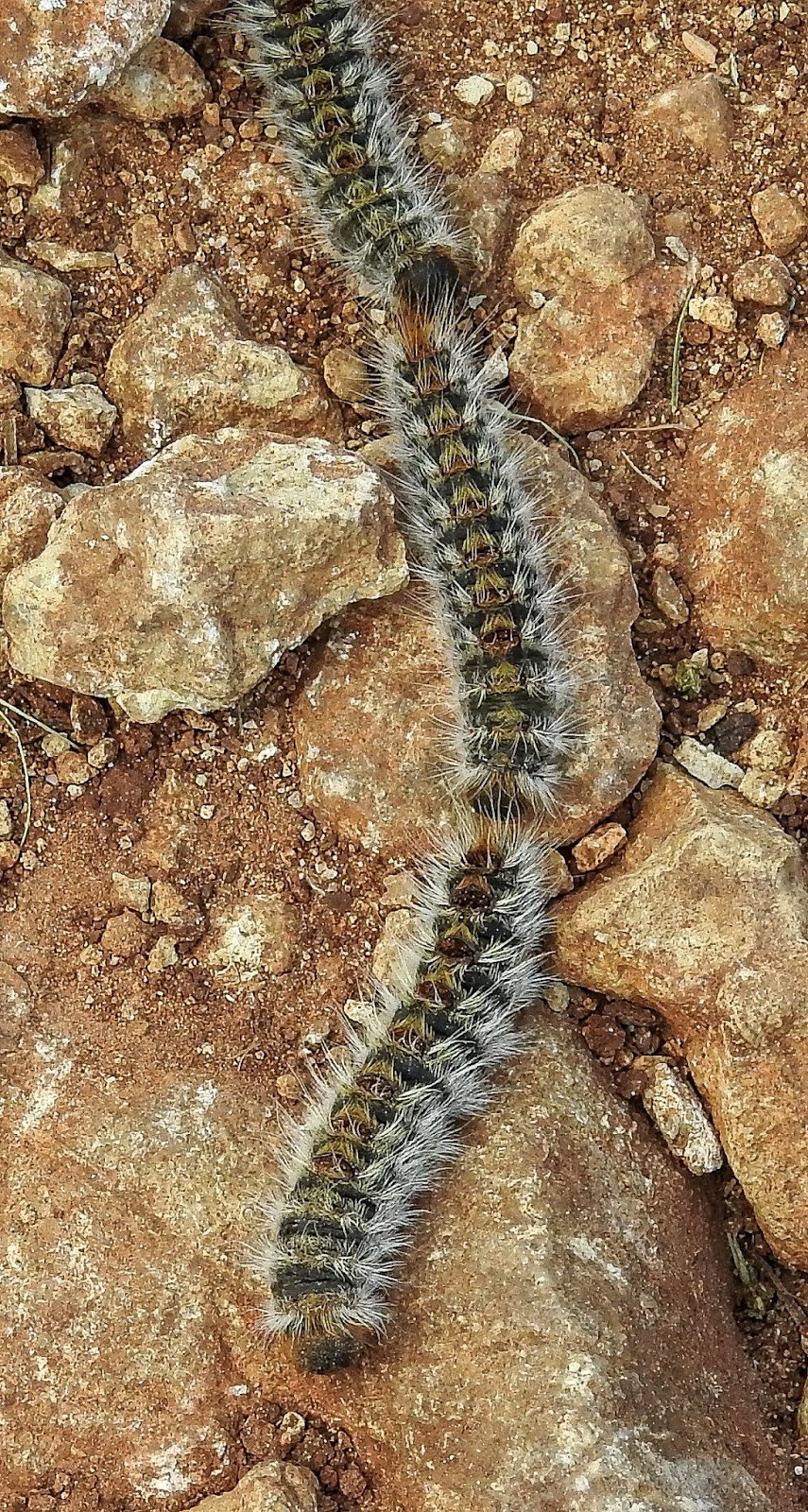
11-2-2019 JALON, ALICANTE - PINE PROCESSIONARY CATERPILLAR (Thaumetopoea pityocampa)


Pine processionary caterpillars are a danger to humans and animals due to their urticating (stinging) hairs, which can cause severe rashes, eye irritation, and in pets, potentially fatal reactions. They are known for forming long, single-file processions when descending trees to pupate. These caterpillars build silky nests in pine trees during the fall and winter and emerge as moths in the summer. 

Key facts

Appearance: They are typically 3 to 4 cm long and orange to brown in color.

Behavior: They form long, single-file "processions" from head to tail, especially when moving from the tree to the ground to burrow and pupate.

Nests: They construct large, silken, tent-like nests on pine trees, often in the branches.

Diet: They feed on pine needles.

Life cycle: Adult moths lay eggs on pine trees in late summer. Caterpillars hatch, grow in nests, and then descend in procession in late winter or early spring to pupate in the soil.

Habitat: Native to the Mediterranean, Middle East, and North Africa, they have been spreading north due to climate change. 


Dangers and risks

Urticating hairs: Each caterpillar has hundreds of thousands of tiny, barbed, stinging hairs that can be easily released into the air.

Human contact: Direct contact can cause a rash that is itchy, painful, and can last for weeks. The hairs can cause inflammation and irritation, and severe reactions, including anaphylactic shock, are possible.

Animal contact: Pets, especially dogs, are at a high risk. They can experience severe reactions if they come into contact with the hairs on their nose or mouth. Symptoms can include swelling, excessive drooling, and chomping. In severe cases, this can lead to tissue damage and requires immediate veterinary care.

Tree damage: They can defoliate trees, weakening them and making them vulnerable to other pests and diseases. 

Safety and prevention
Avoid contact: The best way to stay safe is to avoid areas with pine processionary caterpillars, especially in the spring.

Keep pets on a leash: Keep pets on a leash in wooded areas and be vigilant.

Handle with care: If you must remove nests, avoid touching them and wear protective gear.

Disposal: If you find a procession, do not stand on them or scatter them, as this can release the hairs. Spray the procession with hairspray to disable the hairs, then douse the ground with soapy water and brush thoroughly before disposal.

Emergency: If you or a pet has a reaction, seek medical or veterinary attention immediately. 

11-2-2019 JALON, ALICANTE - WILD DAFFODIL (Narcissus pseudonarcissus)


Narcissus pseudonarcissus, commonly named the wild daffodil or Lent lily (Welsh: Cennin Pedr), is a perennial flowering plant.

This species has pale yellow tepals, with a darker central trumpet. The long, narrow leaves are slightly greyish green in colour and rise from the base of the stem. The plant grows from a bulb. The flowers produce seeds which, when germinated, take five to seven years to produce a flowering plant. (Sexual seed reproduction mixes the traits of both parent flowers, so if garden hybrid cultivars are planted close to wild populations of Narcissus pseudonarcissus, there is a danger that the new seedlings, having hybrid vigour, could out-compete the wild plants.

The species is native to Western Europe from Spain and Portugal east to Germany and north to England and Wales. It is commonly grown in gardens and populations have become established in the Balkans, Australia, New Zealand, the Caucasus, Madeira, British Columbia, Ontario, Newfoundland, Nova Scotia, Oregon, Washington state, much of the eastern United States, and the Falkland Islands. Wild plants grow in woods, grassland and on rocky ground. In Britain native populations have decreased substantially since the 19th century due to intensification of agriculture, clearance of woodland and uprooting of the bulbs for use in gardens. In Germany it was a subject of a national awareness campaign for the protection of wildflowers in 1981.

11-2-2019 JALON, ALICANTE - PLANTAIN FAMILY (Antirrhinum controversum)


Antirrhinum controversum is a subshrub species native to southern Spain, Portugal, and northern Morocco that produces pale-pink flowers and grows between February and November. It thrives in rocky or calcareous soils in sunny to partially shaded, mild-winter areas and can reach heights of 35 to 150 cm. As a species of snapdragon (Antirrhinum), it is part of the Plantaginaceae family and has specific adaptations to its native subtropical environment. 

Physical characteristics
Type: Subshrub
Height: Grows 35 to 150 cm tall
Flowers: Produces dense inflorescences of pale-pink flowers at the end of its stems
Bloom Time: February to November in its native range 
Habitat and ecology
Native Range: Southeastern and southern Spain, Portugal, and northern Morocco
Biome: Favors subtropical biomes
Soil: Indifferent to soil type but has a preference for calcareous soils; it grows in rocky areas, crevices, and on walls

11-2-2019 JALON, ALICANTE - MEDITERRANEAN PALE GLOW-WORM (Nyctophila reichii)


Nyctophila reichii, commonly known as the Mediterranean firefly, is a species of firefly. The species is very common in the southern and eastern part of the Iberian Peninsula.

The Mediterranean firefly is a small beetle, typically measuring 15-18 mm for the male and up to 4 cm for the female. Its body coloration is predominantly black or brown.

These organisms exhibit significant sexual dimorphism, with females tending to have a morphology more similar to that of larvae, while males have a more classic beetle shape.


Females, therefore, are flightless, although they have vestigial wings and have an elongated shape. They are characterized by the ability to generate a large amount of greenish light in the ventral region of the last three abdominal segments. Furthermore, they can expose more of the bioluminescent region by twisting the terminal area of ​​their body.

Males, on the other hand, have a more classic beetle shape, with elytra that cover the entire abdomen and membranous wings that allow flight. Their pronotum is wide, light-colored, with a reddish spot on its surface, and conceals well-developed eyes for detecting the bioluminescence of females. It's worth noting that, unlike other fireflies, these males are not capable of generating bioluminescence.

Sunday, 10 February 2019

10-2-2019 PEGO MARJAL, ALICANTE - COMMON CHAFFINCH (MALE) (Fringilla coelebs)


10-2-2019 PEGO MARJAL, ALICANTE - GLOSSY IBIS (Plegadis falcinellus)


It is the only ibis which is native to Europe. In Spain, a stable reproductive population has settled in the Guadalquivir marshes.
They are easily recognised because they usually fly in a V formation as a group.

This bird usually measures between 55 and 65 centimetres.

The eggs that the glossy ibis lays are greenish blue.

It has a long, curved bill. Adults mostly dark with iridescent green and reddish tones. Very thin white border surrounding the dark facial skin. Dark eyes. Usually gregarious, it is found mainly in salty marshes and shallow wetlands. Unmistakable in most of its range, though American birds are best distinguished from White-faced Ibis by distribution and facial pattern.

10-2-2019 PEGO MARJAL, ALICANTE - BOOTED EAGLE (Hieraaetus pennatus)


The booted eagle (Hieraaetus pennatus) is a medium-sized mostly migratory bird of prey with a wide distribution in the Palearctic and southern Asia, wintering in the tropics of Africa and Asia, with a small, disjunct breeding population in south-western Africa. Like all eagles, it belongs to the family Accipitridae.

The booted eagle has breeding populations in many different regions in both the northern and southern hemisphere. These include southern Europe, North Africa and across Asia, and also in western South Africa and Namibia. The northern populations are migratory spending November to February in Sub-Saharan Africa and South Asia, while the small southern African populations is sedentary. This is a species of wooded, often hilly countryside with some open areas. It breeds in rocky, broken terrain but migrants will use almost any type of habitat other than dense forest. The birds of the Palearctic breeding population tend to nest in coniferous or deciduous woodlands and often in trees.

10-2-2019 OLIVA PLAYA, VALENCIA - BLACK REDSTART (FEMALE) (Phoenicurus ochruros)


The Black Redstart (Phoenicurus ochruros) is a small, charismatic passerine bird, exhibiting a blend of dark and vibrant plumage. Males are distinguished by their dark grey to black upperparts and breast, with a striking orange-red rump and tail. Females and juveniles are more subdued in color, with grey to grey-brown feathers and the same vivid tail coloration that is the hallmark of the species.

Adult males are easily identified by their dark upperparts and black breast, contrasting with the orange-red lower rump and tail. The belly and undertail may vary from blackish-grey to orange-red, depending on the subspecies. Females and juveniles are less conspicuous, with overall greyer tones and a distinctive orange-red rump and tail. The presence of pale fringes on the secondaries forms a whitish wing panel in some subspecies.

The Black Redstart has adapted remarkably to urban environments, often found nesting in crevices or holes within buildings. Originally a dweller of stony mountainous regions, it now thrives in industrial areas with similar structural features.

This species is widely distributed across south and central Europe, Asia, and north-west Africa. It is a resident in milder regions, while populations in the northeast migrate to warmer areas during winter.

The Black Redstart is known for its robin-like movements, including quick ducks of the head and body, and frequent tail flicking. Males possess a rattling song and a tick call, adding to their distinctive presence.

Friday, 8 February 2019

8-2-2019 MONTE CORONA, VALENCIA - HOUSE SPARROW (MALE) (Passer domesticus)


Male house sparrows are distinguished by their vibrant head and throat markings, including a gray crown, white cheeks, and a black bib that can vary in size with age and dominance. They have a brown back with black markings, a black bill, and grey undersides. 

Identification
Head: Grey crown and white cheek patches.
Throat and Chest: A black bib that can be larger in older or more dominant males.
Back: Brown with black markings.
Undersides: Pale grey.
Bill: Black, especially during the breeding season. 

Behavior and diet
Diet: Omnivorous, eating seeds, grains, berries, and insects.
Social: Live in colonies, often in large groups, and forage in flocks for safety.
Dominance: The size of the black bib is thought to be an indicator of a male's dominance.
Aggression: Can be aggressive at garden feeders, sometimes dominating other birds. 

9-2-2019 MONTE CORONA, VALENCIA - MEDITERRANEAN SPOTTED CHAFER (Oxythyrea funesta)


Oxythyrea funesta is a phytophagous beetle species belonging to the family Cetoniidae, subfamily Cetoniinae.

Common name “White spotted rose beetle”.

This beetle is present in most of Europe, in the eastern Palearctic realm, and in the Near East.

Larvae are up to 30 mm long, they feed on plant roots and can remain until next spring in the soil.

The adults appear early in the spring, they grow up to 8–12 millimetres (0.31–0.47 in) and can mostly be encountered from May through July. They are considered an insect pest that do not just feed on pollen, but rode the floral organs, especially damaging light in color buds and flowers.

Their colour is black, more or less bronzed. Most of the specimens show six white spots in two longitudinal rows on the pronotum and many others on the elytra. They are completely covered with white pubescence (easily visible in profile). Older specimens usually have no hairs, as they are rubbed off with time.

8-2-2019 MONTE CORONA, VALENCIA - HAIRY ROSE BEETLE (Tropinota squalida)


The hairy rose beetle (Tropinota squalida or Tropinota hirta) is a type of flower chafer beetle found in Europe and parts of Asia that feeds on flower pollen and nectar. It is considered a pest because adult beetles damage fruit and ornamental plants by consuming flowers and buds, while the larvae feed on rotting plant material and roots in the soil. Adults are 8–15 mm long, grayish-black, and covered in yellowish hairs, which wear off with age. 

Appearance and identification

Size: Adults are typically between 8 and 15 mm long.
Color: The body is grayish-black.
Hairs: The entire body is covered in thick, yellowish hairs that can wear off over time.
Distinctive markings: Elytra have two rows of white spots on the sides, and males have a longitudinal hollow on the underside of their abdomen. 

Thursday, 7 February 2019

15-5-2018 MONTE CORONA, VALENCIA - HOOKED STRIKING JUMPING SPIDER (Icius hamatus)


This species is mainly present in Portugal, Spain, France, Italy, Poland, Greece and Romania.

The adults of these spiders reach approximately 5–7 millimetres (0.20–0.28 in) of length. They prefer dry and hot habitats ("xerothermic") and can mainly be encountered on sunny bushes, shrubs and walls of houses (synanthropic organism), where they actively pursue their preys.

In males the basic color of the hairy body is rusty brown, with a white longitudinal stripe and a white line on the edge of the opistosoma. The prosoma is mainly rusty brown, while the pedipalps and the legs are whitish. In the females the basic color is mainly brownish or greyish, with darker markings. These spiders have eight eyes with very large anterior median eyes and smaller on each side. Their eyesight is excellent and very useful in their way of hunting.

6-2-2019 ALBUFERA, VALENCIA - WESTERN CATTLE EGRET (Bubulcus ibis ssp. ibis)


The Western Cattle-Egret is a gregarious, white, upland ardeid (Ardeidae), easily recognized by its foraging association with grazing animals and its exaggerated, head-pumping strut. It differs from the Eastern Cattle-Egret (Ardea coromanda) in having less buff-orange breeding plumage in the head and neck regions.

Small, compact white heron with relatively short yellow bill. More frequently seen in dry habitats than other egrets. In breeding season, look for pale salmon color on head and breast and brighter bill. Leg color varies from reddish or yellow during the breeding season to black during the nonbreeding season. Juveniles have dark bill. Always note relatively short, thick neck and short legs compared with other egrets. Often gathers in flocks, frequently following cattle or tractors in fields.


The Western Cattle-Egret is a gregarious, white, upland heron ( Ardeidae ), easily recognized by its foraging association with grazing animals and its exaggerated head-waving. It is distinguished from the Eastern Cattle-Egret (Ardea coromanda) due to having less buffy-orange breeding plumage on the head and neck regions. Its preference for grasslands, lawns, pastures, and grazing animals is quite distinct from that of other herons and egrets, which usually feed in or beside water and not in close association with livestock. In Britain and Europe, it is also known as the buffalo heron, referring to the color of its breeding plumes; but in many languages, it is simply called the cow crane, cow heron, or cowbird, or named after the wild grazing animal with which it is usually associated, e.g., elephant bird, rhinoceros egret, or hippopotamus egret. 
The Western Cattle-Egret's Arabic name, Abu Qerdan, means "father of ticks" and refers to the abundance of ticks on Egyptian herons. Other names that include the word "tick," such as "tickbird," refer to the mistaken belief that they pick attached ticks off grazing animals; instead, most of their prey are insects disturbed by grazing animals. Derivation of the scientific name:Bubulcus(the previous genus) from Latin "belonging to cattle" andibisfrom the Greek in reference to its slightly curved beak like that of the ibis.

6-2-2019 ALBUFERA, VALENCIA - LITTLE EGRET (Egretta garzetta)


The Little Egret, Egretta garzetta, is a dainty heron adorned in pure white plumage. It is characterized by a slender black beak, long black legs, and, notably in the western race, yellow feet. This elegant bird is a sight to behold with its graceful neck and poised stance.

Adult Little Egrets measure between 55–65 cm in length with a wingspan of 88–106 cm, and weigh 350–550 g. Their plumage is predominantly white, though some may exhibit bluish-grey coloration. Breeding adults boast ornate nape plumes reaching about 150 mm, along with distinctive feathers on the breast and elongated scapulars. The bill and lores are black, with greenish-grey skin at the base of the lower mandible and around the eye, which houses a yellow iris. Legs are black with contrasting yellow feet, though juveniles may have greenish-black legs and duller feet. The subspecies E. g. nigripes is distinguished by yellow skin between the bill and eye, and blackish feet.

The Little Egret frequents a variety of wetland habitats, from the shores of lakes and rivers to marshes and coastal regions. It is often found in open environments, such as mangroves, swamps, mudflats, and sandy beaches, as well as human-altered landscapes like rice fields.


The species has a broad breeding distribution across warm temperate to tropical regions of Asia, Africa, Australia, and Europe. Northern populations are migratory, wintering in Africa and southern Asia, while others remain as permanent residents in warmer areas.

Little Egrets are social yet territorial when feeding. They exhibit a range of foraging behaviors, from active chasing to patient ambush. Their movements are often in response to the presence of other animals, which may stir up prey.

The Little Egret's vocalizations include croaking and bubbling sounds at breeding colonies and a harsh alarm call when disturbed. These calls are similar to those of the Black-crowned Night Heron and the Cattle Egret.

Breeding colonies are often mixed with other water birds. Nests are platforms of sticks located in trees, shrubs, or reed beds. Clutches typically consist of three to five bluish-green eggs, incubated by both parents for about three weeks. The young fledge at approximately six weeks old.

The diet is diverse, including fish, amphibians, small reptiles, mammals, birds, crustaceans, molluscs, insects, spiders, and worms. The Little Egret employs various hunting techniques, both in water and on land, to capture its prey.

6-2-2019 ALBUFERA, VALENCIA - GLOSSY IBIS (Plegadis falcinellus)


The Glossy Ibis, Plegadis falcinellus, is a wading bird of the family Threskiornithidae, known for its striking, sickle-shaped bill. This mid-sized ibis measures 48–66 cm in length, with a wingspan of 80–105 cm. Breeding adults boast reddish-brown bodies and iridescent bottle-green wings, while non-breeders and juveniles display a more subdued coloration. The species is characterized by a brownish bill, dark facial skin with blue-gray to cobalt blue borders, and red-brown legs. In flight, the ibis extends its neck and exhibits a graceful V formation.
When identifying the Glossy Ibis, look for its unique glossy feathers and the distinct shape of its bill. The bird's flight pattern is also a telltale sign, as it flies with its neck outstretched, unlike herons. Listen for its various croaks and grunts, particularly the hoarse grrrr sound during the breeding season.


The Glossy Ibis favors freshwater or brackish wetlands with tall, dense emergent vegetation such as reeds, papyrus, or rushes, and low trees or bushes. It can also be found in lagoons, floodplains, wet meadows, swamps, reservoirs, sewage ponds, rice paddies, and irrigated farmland. Coastal habitats like estuaries and salt marshes are less common for this species.

This ibis is the most widespread of its kind, breeding in warm regions across Europe, Asia, Africa, Australia, and the Americas. It is migratory, with European birds wintering in Africa and North American birds migrating southward. The species has been expanding its range, with increasing numbers in Europe and successful breeding in Britain as of 2022.

The Glossy Ibis is known for its nomadic tendencies and dispersal movements post-breeding. Northern populations are migratory, traversing vast distances such as the Sahara Desert. The species nests in mixed colonies and forms large flocks during migration and winter. It often roosts communally with other species, sometimes in trees far from feeding areas.

6-2-2019 ALBUFERA, VALENCIA - NORTHERN LAPWING (Vanellus vanellus)


The Northern Lapwing, known scientifically as Vanellus vanellus, is a distinctive bird with a notable crest on its head. It measures 28–33 cm in length, with a wingspan of 67–87 cm and a body mass ranging from 128–330 g. The species exhibits sexual dimorphism; males have a pronounced crest and a stark black crown, throat, and breast, which contrasts sharply with their white face. Females and juveniles have shorter crests and less defined head markings, but their overall plumage is similar to that of the males, with a black and white coloration and a greenish tint on the back.

When identifying the Northern Lapwing, look for its rounded wings, short legs, and the characteristic crest that adorns its head. The male's long crest and contrasting black and white facial patterns are particularly striking during the breeding season. In flight, the species can be recognized by its slow wingbeats and the rounded shape of its wings.

The Northern Lapwing is a ground-nesting bird that favors open landscapes such as cultivated fields, grasslands, and wetlands. It is adaptable and can be found in a variety of temperate environments across Eurosiberia.

This bird is a widespread resident throughout temperate regions of Eurosiberia. It is highly migratory, wintering in regions as far south as North Africa and parts of Asia. Western European populations are more sedentary, while vagrants have been known to appear in North America following storms.


The Northern Lapwing is known for its acrobatic display flights, accompanied by a cacophony of calls during the breeding season. It migrates predominantly during the day, often in large flocks. The species is fiercely protective of its nest and young, boldly confronting any potential threats. In winter, it gathers in massive flocks on open land, and it is known to feed nocturnally when the moon is bright.

The Northern Lapwing is quite vocal, especially in the breeding season. Its contact call is a loud "pee-wit," which is also the origin of one of its common names. Males perform a display flight while emitting a wheezy "pee-wit, wit wit, eeze wit," and they may also produce squeaking or mewing sounds.

Breeding takes place on the ground in a simple scrape. The species typically lays 3–4 eggs, which are zealously defended against all intruders. The Northern Lapwing's breeding strategy includes feigning injury to distract predators from its nest.

Its diet consists primarily of insects and other small invertebrates. The Northern Lapwing often feeds in mixed flocks with Golden Plovers and Black-headed Gulls, the latter of which may steal food but also offer some protection against predators.

6-2-2019 ALBUFERA, VALENCIA - MEADOW PIPIT (Anthus pratensis)


The meadow pipit (Anthus pratensis) is a small passerine bird, which breeds in much of the Palearctic, from southeastern Greenland and Iceland east to just east of the Ural Mountains in Russia, and south to central France and Romania; an isolated population also occurs in the Caucasus Mountains. It is migratory over most of its range, wintering in southern Europe, North Africa, and south-western Asia, but is resident year-round in western Europe, though even here many birds move to the coast or lowlands in winter.
The nest is on the ground hidden in dense vegetation, with two to seven (most often three to five) eggs; the eggs hatch after 11–15 days, with the chicks fledging 10–14 days after hatching. Two broods are commonly raised each year. This species is one of the most important nest hosts of the cuckoo, and it is also an important prey species for merlins and hen harriers.

Its food is primarily insects and other invertebrates, mostly small items less than 5 mm (3⁄16 in) long. It also eats the seeds of grasses, sedges, rushes, and heather, and crowberry berries, mainly in winter.