TOTAL PAGEVIEWS

TRANSLATE

Friday, 28 June 2019

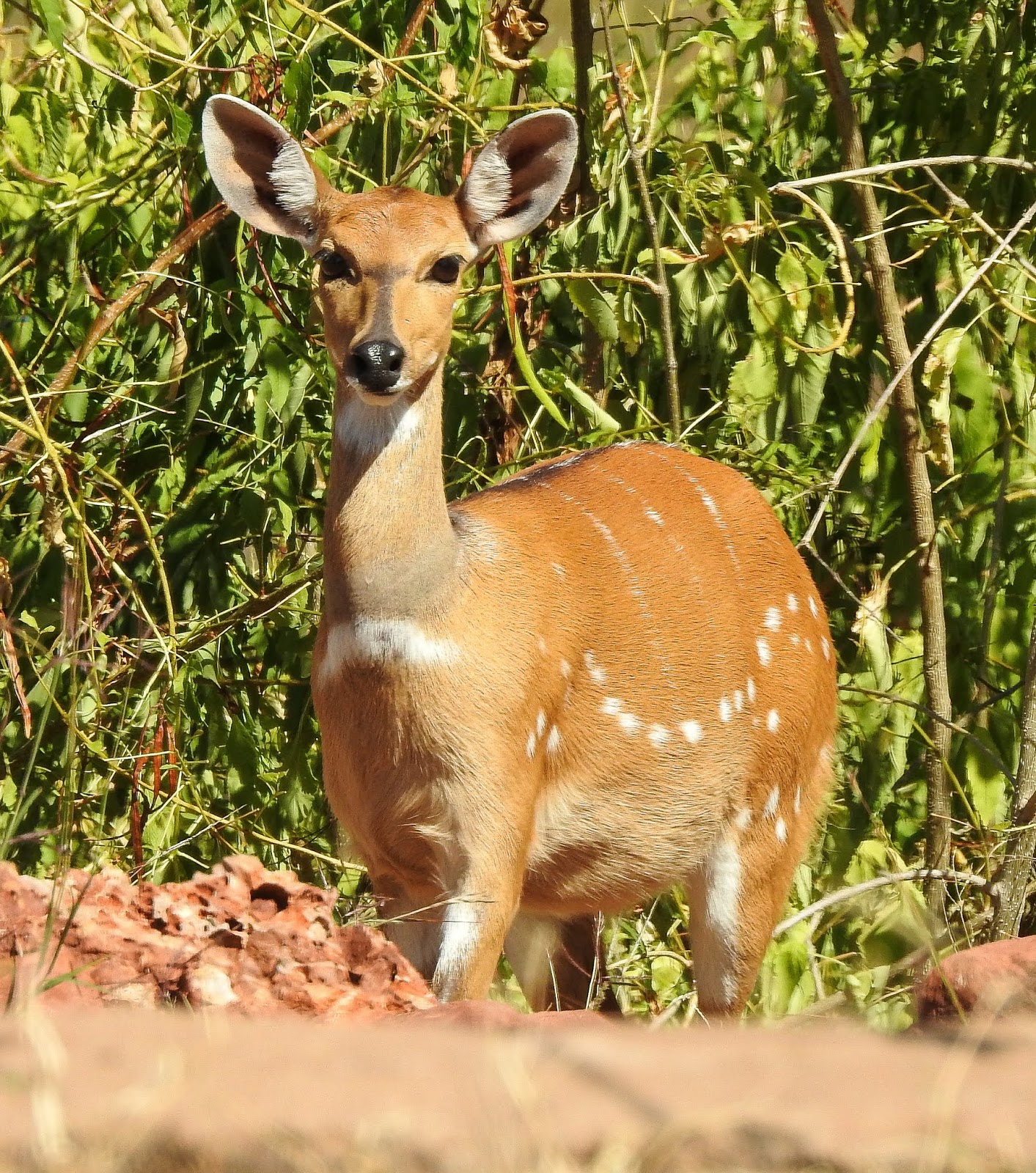
21-5-2019 BUMI HILLS, ZIMBABWE - SOUTHERN BUSHBUCK (FEMALE) (Tragelaphus scriptus)


The bushbuck (Tragelaphus scriptus ) is a common and a widespread species of antelope in Sub-Saharan Africa. Bushbuck are found in a wide range of habitats, such as rain forests, montane forests, forest-savanna mosaic, savanna, bushveld and woodland. Bushbuck stand about 90 centimetres (35 in) at the shoulder and weigh from 45 to 80 kilograms (99 to 176 lb). They are generally solitary, territorial browsers.

The bushbuck is a widespread species of antelope in Sub-Saharan Africa. These animals have a light brown coat, with up to seven white stripes and white splotches on the sides. The white patches are usually geometrically shaped and on the most mobile parts of their body such as the ears, chin, tail, legs, and neck. 


The muzzle is also white and horns are found only on the males.Cape bushbucks stand around 90 cm (35 in) at the shoulder and weigh from 60 to 80 kg (130 to 180 lb) in males and 25 to 60 kg (55 to 132 lb)in females. They have a light brown coat, with up to seven white stripes and white splotches on the sides. The white patches are usually geometrically shaped and on the most mobile parts of their bodies, such as the ears, chin, tail, legs, and necks. The muzzles are also white. Horns, found only on the males, can reach over half a metre and have a single twist. At 10 months old, young males sprout horns that are particularly twisted and at maturity form the first loop of a spiral.

28-6-2019 MARCHUQUERA, VALENCIA - PAINTED LADY BUTTERFLY (Vanessa cardui)


Vanessa cardui is the most widespread of all butterfly species. It is commonly called the painted lady, or formerly in North America the cosmopolitan.

V. cardui occurs in any temperate zone, including mountains in the tropics. The species is resident only in warmer areas, but migrates in spring, and sometimes again in autumn. It migrates from North Africa and the Mediterranean to Britain and Europe in May and June, occasionally reaching Iceland, and from the Red Sea basin, via Israel and Cyprus, to Turkey in March and April. The occasional autumn migration made by V. cardui is likely for the inspection of resource changes; it consists of a round trip from Europe to Africa.

For decades, naturalists have debated whether the offspring of these immigrants ever make a southwards return migration. Research suggests that British painted ladies do undertake an autumn migration, making 14,500 km (9,000 mi) round trip from tropical Africa to the Arctic Circle in a series of steps by up to six successive generations. The Radar Entomology Unit at Rothamsted Research provided evidence that autumn migrations take place at high altitude, which explains why these migrations are seldom witnessed. In recent years, thanks to the activity of The Worldwide Painted Lady Migration citizen science project, led by the Barcelona-based Institute of Evolutionary Biology (Catalan: Institut de Biologia Evolutiva), the huge range of migration has begun to be revealed. For example, some butterflies migrated from Iceland to the Sahara desert, and even further south.

28-6-2019 MARCHUQUERA, VALENCIA - EURASIAN TREE SPARROW (MALE) (Passer montanus)


The Eurasian tree sparrow (Passer montanus) is a charming passerine bird, easily recognized by its rich chestnut crown and nape, and a distinctive black patch on each pure white cheek. Both sexes are similarly adorned, and the juveniles mirror the adults, albeit with slightly duller hues. This species is somewhat smaller than the closely related house sparrow, and its size is approximately 12.5–14 cm in length, with a wingspan of about 21 cm.

To identify the Eurasian tree sparrow, look for the kidney-shaped black ear patch on each white cheek, the black chin and throat, and the light brown upperparts streaked with black. The wings bear two narrow white bars, and the legs are pale brown. The bill is lead-blue in summer, darkening almost to black in winter. Unlike the house sparrow, there is no sexual dimorphism in plumage, making both males and females equally easy to identify.

In Europe, the Eurasian tree sparrow is typically found in lightly wooded open countryside, while in eastern Asia, it is more common in urban settings. It prefers nesting in natural cavities, holes in buildings, or even the abandoned nests of other large birds. This species is not typically found in mountainous regions, despite its scientific name suggesting otherwise.

26-6-2019 BONAIRE, VALENCIA - EURASIAN MAGPIE (Pica pica)


The Eurasian magpie, or common magpie (Pica pica), is a striking bird that graces the northern reaches of the Eurasian continent. It is a member of the crow family, known as corvids, and is part of the "monochrome" magpie group within the Holarctic radiation. The bird is easily recognized by its black and white plumage and long, iridescent tail.
Adult Eurasian magpies measure 44–46 cm in length, with over half of this being the tail. They have a wingspan of 52–62 cm. The head, neck, and breast are glossy black with a metallic sheen of green and violet, while the belly and scapulars are pure white. The wings are black with green or purple gloss, and the primaries have white inner webs. The tail is black with green and reddish-purple gloss. Both sexes have similar plumage, though females are slightly smaller. 

The Eurasian magpie favors open countryside with scattered trees, avoiding dense forests and treeless areas. It adapts well to suburban environments, including parks and gardens, and can be found in city centers.
This magpie's range spans temperate Eurasia from the western edges of Portugal and Spain to the eastern limits of the Kamchatka Peninsula.

The Eurasian magpie is known for its intelligence, comparable to that of great apes. It is monogamous, with pairs often remaining together across seasons. They are sedentary, though northern populations may move south in severe weather.


The magpie's call is a distinctive "chac-chac" or a repetitive "chac-chac-chac-chac." Young birds emit a similar call and a high-pitched "Uik Uik," which can resemble a small dog's bark.

Magpies typically breed after their first year. They build large, domed nests in tall trees, laying clutches of five to six pale blue-green eggs, which are incubated for 21–22 days. The chicks are altricial and fledge at around 27 days, with parental care continuing for several weeks.

The Eurasian magpie can be confused with the North American black-billed magpie (Pica hudsonia), though they are now considered separate species.

Omnivorous, the Eurasian magpie's diet includes young birds, eggs, small mammals, insects, carrion, acorns, grain, and other plant matter.

With an extensive range and stable population trends in Europe, the Eurasian magpie is classified by the IUCN as Least Concern. Estimates suggest a total population of 46 to 228 million individuals globally.

20-5-2019 BUMI HILLS, ZIMBABWE - SOUTHERN RED BILLED HORNBILL (Tockus rufirostris)


The Southern red-billed hornbill, Tockus rufirostris, is a distinguished member of the Bucerotidae family, gracing the savannas and drier bushlands of southern Africa with its presence. This bird is characterized by its striking red bill and the streaks of blackish plumage that extend from its ear coverts down the side of its neck.

Upon observing this species, one will note the sexual dimorphism where males are generally larger with slightly longer bills. The male's lower mandible may exhibit varying degrees of black pigmentation. Both sexes boast a yellow iris surrounded by pale orbital skin, ranging from pink to greyish hues. The throat is a pristine white, and the wing coverts are adorned with conspicuous spots.


The Southern red-billed hornbill is a native inhabitant of the savannas and dryer bushlands, thriving in these open environments where it can forage and nest.

This hornbill's range extends from Malawi and Zambia to southern Angola, northeastern Namibia, Botswana, Zimbabwe, eastern Eswatini, and northern South Africa, including Transvaal and northern KZN province. It is also found in the upper Zambezi valley of Mozambique, though it is mostly absent from the eastern lowlands.


A notable behavior of the Southern red-billed hornbill is its unique call, an accelerating series of notes that culminates in a crescendo of double notes. Unlike its congeners, this species does not engage in wing-raising displays.

The vocal repertoire of this hornbill includes a distinctive call that starts with a series of "kuk kuk kuk" notes and ends with a flourish of double notes, "kuk-we kuk-we."


The Southern red-billed hornbill can be confused with other red-billed hornbills, but it can be distinguished by its unique combination of yellow iris, pale orbital skin, and the pattern of blackish streaking on the neck.

The conservation status of the Southern red-billed hornbill is not explicitly mentioned, but given its wide distribution, it may not currently be of significant conservation concern. However, like all wildlife, it would benefit from ongoing habitat protection and monitoring.

19-5-2019 BUMI HILLS, ZIMBABWE - BLACK CROWNED TCHAGRA (Tchagra senegalus)


The black-crowned tchagra, Tchagra senegalus, is a member of the bushshrike family, Malaconotidae. This group is akin to the true shrikes of the Laniidae family, with which they were once classified. The adult black-crowned tchagra is a striking bird, measuring 19–22 cm in length, with a distinctive black crown and eye stripes, set off by a broad white supercilium. Its underparts are a pale grey, while the upperparts are a soft pale brown. The wings, when folded, reveal a rich chestnut color, and the tail is black with a white tip. The bill is a stark black. Both sexes are similar in appearance, but the juveniles can be identified by their brown cap and pale yellow bill.

To identify the black-crowned tchagra, look for the solid black crown bordered by buff superciliary stripes. Juveniles will have a brownish crown instead. There are 14 subspecies, which may vary in size and the coloration of the back, underparts, and eyestripe.

This species thrives in a variety of environments including scrub, open woodland, semi-desert regions, and areas of cultivation.

The black-crowned tchagra is widely distributed across the Arabian Peninsula and most of Africa.

20-5-2019 BUMI HILLS, ZIMBABWE - AFRICAN SAVANNA ELEPHANT (Loxodonta Africana)


The African bush elephant (Loxodonta africana), also known as the African savanna elephant, is a species of elephant native to sub-Saharan Africa. It is one of three extant elephant species and, along with the African forest elephant, one of two extant species of African elephant. It is the largest living terrestrial animal, with fully grown bulls reaching an average shoulder height of 3.04–3.36 metres (10.0–11.0 ft) and a body mass of 5.2–6.9 tonnes (5.7–7.6 short tons); the largest recorded specimen had a shoulder height of 3.96 metres (13.0 ft) and an estimated body mass of 10.4 tonnes (11.5 short tons). The African bush elephant is characterised by its long prehensile trunk with two finger-like processes; a convex back; large ears which help reduce body heat; and sturdy tusks that are noticeably curved. The skin is grey with scanty hairs, and bending cracks which support thermoregulation by retaining water.


The African bush elephant inhabits a variety of habitats such as forests, grasslands, woodlands, wetlands and agricultural land. It is a mixed herbivore feeding mostly on grasses, creepers, herbs, leaves, and bark. The average adult consumes about 150 kg (330 lb) of vegetation and 230 L (51 imp gal; 61 US gal) of water each day. A social animal, the African bush elephant often travels in herds composed of cows and their offspring. Adult bulls usually live alone or in small bachelor groups. During the mating season, males go through a process called musth, a period of high testosterone levels and heightened aggression. For females, the menstrual cycle lasts three to four months, and gestation around 22 months, the longest of any mammal.


Since 2021, the African bush elephant has been listed as Endangered on the IUCN Red List. It is threatened foremost by habitat destruction, and in parts of its range also by poaching for meat and ivory. Between 2003 and 2015, the illegal killing of 14,606 African bush elephants was reported by rangers across 29 range countries. Chad is a major transit country for smuggling of ivory in West Africa. This trend was curtailed by raising penalties for poaching and improving law enforcement. Poaching of the elephant has dated back to the 1970s and 80s, which were considered the largest killings in history. In human culture, elephants have been extensively featured in literature, folklore and media, and are most valued for their large tusks in many places.

20-5-2019 BUMI HILLS, ZIMBABWE - SOUTHERN RED BILLED HORNBILL (Tockus rufirostris)


The Southern red-billed hornbill, Tockus rufirostris, is a distinguished member of the Bucerotidae family, gracing the savannas and drier bushlands of southern Africa with its presence. This bird is characterized by its striking red bill and the streaks of blackish plumage that extend from its ear coverts down the side of its neck.

Upon observing this species, one will note the sexual dimorphism where males are generally larger with slightly longer bills. The male's lower mandible may exhibit varying degrees of black pigmentation. Both sexes boast a yellow iris surrounded by pale orbital skin, ranging from pink to greyish hues. The throat is a pristine white, and the wing coverts are adorned with conspicuous spots.


The Southern red-billed hornbill is a native inhabitant of the savannas and dryer bushlands, thriving in these open environments where it can forage and nest.

This hornbill's range extends from Malawi and Zambia to southern Angola, northeastern Namibia, Botswana, Zimbabwe, eastern Eswatini, and northern South Africa, including Transvaal and northern KZN province. It is also found in the upper Zambezi valley of Mozambique, though it is mostly absent from the eastern lowlands.

A notable behavior of the Southern red-billed hornbill is its unique call, an accelerating series of notes that culminates in a crescendo of double notes. Unlike its congeners, this species does not engage in wing-raising displays.


The vocal repertoire of this hornbill includes a distinctive call that starts with a series of "kuk kuk kuk" notes and ends with a flourish of double notes, "kuk-we kuk-we."

The Southern red-billed hornbill can be confused with other red-billed hornbills, but it can be distinguished by its unique combination of yellow iris, pale orbital skin, and the pattern of blackish streaking on the neck.

The conservation status of the Southern red-billed hornbill is not explicitly mentioned, but given its wide distribution, it may not currently be of significant conservation concern. However, like all wildlife, it would benefit from ongoing habitat protection and monitoring.

Thursday, 27 June 2019

20-5-2019 BUMI HILLS, ZIMBABWE - AFRICAN CORMORANT (Microcarbo africanus ssp. africanus)


It is a small cormorant reaching between 50 and 55 cm in length and a wingspan of 85 cm. It is mainly black, bright green when breeding. The wing coverts are silvery. It has a fairly long tail, a short crest on its head, and a red or yellow facial patch. The beak is yellow.

Both sexes are similar, but non-breeding adults and juveniles are browner, with a white belly. Some southern breeds retain the crest throughout the year.

26-6-2019 BONAIRE, VALENCIA - COMMON HOUSE MARTIN (Delichon urbicum)


The Western House Martin (Delichon urbicum), sometimes known as the Common House Martin, is a migratory passerine bird belonging to the swallow family. It is characterized by a blue head and upperparts, a distinctive white rump, and pure white underparts. This species exhibits sexual dimorphism, with both sexes appearing similar, and juveniles displaying a sooty black coloration with white-tipped wing coverts and quills.

Adults measure approximately 13 cm in length, with a wingspan ranging from 26 to 29 cm and an average weight of 18.3 grams. They possess brown eyes, a small black bill, and pink toes and exposed leg parts. The white rump and underparts are particularly noticeable in flight, aiding in distinguishing them from other swallows.

The Western House Martin favors open country with low vegetation, such as pastures, meadows, and farmland, often near water. It is also found in urban areas and can nest in city centers if air quality permits.


This bird breeds across Europe, North Africa, and the Palearctic, migrating to sub-Saharan Africa and tropical Asia for the winter. It is a broad-front migrant, traveling during daylight and feeding on insects in flight.

The Western House Martin is a social bird, often breeding colonially with nests built in close proximity. It is known for its aerial agility, which it uses to evade predators such as the Eurasian Hobby.

The male's song is a soft twitter of melodious chirps, while the contact call is a hard "chirrrp." The alarm call is a shrill "tseep."

Nests are constructed from mud pellets under eaves or similar overhangs on buildings, usually in colonies. The species is known to produce two broods per year, with four to five white eggs per brood. Juveniles fledge after 22 to 32 days and are fed by parents for about a week thereafter.

20-5-2019 BUMI HILLS, ZIMBABWE - SOUTHERN GREATER KUDU (MALE) (Tragelaphus Strepsiceros)


The greater kudu (Tragelaphus strepsiceros) is a large woodland antelope, found throughout eastern and southern Africa. Despite occupying such widespread territory, they are sparsely populated in most areas due to declining habitat, deforestation, and poaching. The greater kudu is one of two species commonly known as kudu, the other being the lesser kudu, T. imberbis.

Kudu (/kuːduː/ koo-DOO), or koodoo, is the Khoikhoi name for this antelope. Trag- (Greek) denotes a goat and elaphos (Greek) a deer. Strepho (Greek) means 'twist', and strepsis is 'twisting'. Keras (Greek) refers to the horn of the animal.

Greater kudus have a narrow body with long legs, and their coats can range from brown/bluish grey to reddish brown. They possess between 4 and 12 vertical white stripes along their torso. The head tends to be darker in colour than the rest of the body, and exhibits a small white chevron which runs between the eyes. Greater kudu bulls tend to be much larger than the cows, and vocalize much more, utilizing low grunts, clucks, humming, and gasping. The bulls also have beards running along their throats, and large horns with two and a half twists, which, were they to be straightened, would reach an average length of 120 cm (47 in), with the record being 187.64 cm (73.87 in). They diverge slightly as they slant back from the head. The horns do not begin to grow until the bull is between the ages of 6–12 months. The horns form the first spiral rotation at around 2 years of age, and not reaching the full two and a half rotations until they are 6 years old; occasionally they may even have 3 full turns.

The greater kudu is one of the largest species of antelope, being slightly smaller than the bongo. Bulls weigh 190–270 kg (420–600 lb), with a maximum of 315 kg (694 lb), and stand up to 160 cm (63 in) tall at the shoulder. The ears of the greater kudu are large and round. Cows weigh 120–210 kg (260–460 lb) and stand as little as 100 cm (39 in) tall at the shoulder; they are hornless, without a beard or nose markings. The head-and-body length is 185–245 cm (6.07–8.04 ft), to which the tail may add a further 30–55 cm (12–22 in).

20-5-2019 BUMI HILLS, ZIMBABWE - SOUTHERN GREATER KUDU (FEMALE) (Tragelaphus Strepsiceros)


The Greater kudu (Tragelaphus strepsiceros) is a woodland antelope found in Africa. Despite occupying such widespread territory, Greater kudus are sparsely populated in most areas due to declining habitat, deforestation, and poaching.

Greater kudus have a narrow body with long legs, and their coats can range from brown/bluish-grey to reddish-brown. They possess between 4 and 12 vertical white stripes along their torso. The head is usually darker in color than the rest of the body and exhibits a small white v-shaped mark that runs between the eyes. Bulls tend to be much larger than cows, and vocalize much more; they also have beards running along their throats and large horns with two and a half twists.

The range of Greater kudu extends from the east in Ethiopia, Tanzania, Eritrea, and Kenya into the south where they are found in Zambia, Angola, Namibia, Botswana, Zimbabwe, and South Africa. Other regions where they occur are the Central African Republic, Chad, the Democratic Republic of the Congo, Djibouti, Malawi, Mozambique, Somalia, Swaziland, and Uganda. These antelopes live in mixed scrub woodlands and bush on abandoned fields and degraded pastures, mopane bush, and acacia in lowlands, hills, and mountains. They will occasionally venture onto plains only if there is a large abundance of bushes but normally avoid such open areas to avoid becoming an easy target for their predators.

20-5-2019 BUMI HILLS, ZIMBABWE - WESTERN GREY HERON (Ardea cinerea ssp. cinerea)


The term "western grey heron" is a variation of Grey Heron (Ardea cinerea), a large, long-legged wading bird found in wetlands across much of Europe, Asia, and Africa. It has grey upperparts, a white head with black stripes leading to a crest, and a yellowish-pink bill. Known for its calm foraging behavior, it hunts by standing still and striking quickly at fish, amphibians, and small mammals. 


Appearance

Plumage: Ashy-grey on the back and wings, with a greyish-white underside.
Head: White with a black stripe running from above the eye to the back of the head, where it forms a crest.
Neck: Light colored with dark streaks on the front.
Bill: Long, strong, and yellowish-pink, becoming brighter in the breeding season.
Legs: Long and brownish.

Size: Stands about 1 meter tall with a wingspan of around 1.75 meters. 
Behavior and diet
Foraging: Stalks or stands motionless in the water, waiting for prey to come close.


Diet: Primarily fish, but also eats amphibians, small mammals, reptiles, and insects.

Hunting: Strikes at prey with its long beak like a harpoon.

Flight: Folds its neck into an "S" shape while flying. 

Habitat and distribution

Habitat: Found in various wetlands, including rivers, lakes, ponds, and coastlines. It nests in colonies called heronries, often in trees near water.
Distribution: Its range includes Europe, Asia, and Africa. In some western populations, such as in parts of southern Africa, the population is increasing due to factors like irrigation and reservoirs. 

Calls

Main call: A harsh, croaking "fraaank".
Other noises: A variety of guttural and raucous sounds are made, especially at breeding colonies. 

27-6-2019 MONTE CORONA, VALENCIA - PAINTED LADY BUTTERFLY (Vanessa cardui)


Vanessa cardui is the most widespread of all butterfly species. It is commonly called the painted lady, or formerly in North America the cosmopolitan.

V. cardui occurs in any temperate zone, including mountains in the tropics. The species is resident only in warmer areas, but migrates in spring, and sometimes again in autumn. It migrates from North Africa and the Mediterranean to Britain and Europe in May and June, occasionally reaching Iceland, and from the Red Sea basin, via Israel and Cyprus, to Turkey in March and April. The occasional autumn migration made by V. cardui is likely for the inspection of resource changes; it consists of a round trip from Europe to Africa.


For decades, naturalists have debated whether the offspring of these immigrants ever make a southwards return migration. Research suggests that British painted ladies do undertake an autumn migration, making 14,500 km (9,000 mi) round trip from tropical Africa to the Arctic Circle in a series of steps by up to six successive generations. The Radar Entomology Unit at Rothamsted Research provided evidence that autumn migrations take place at high altitude, which explains why these migrations are seldom witnessed.


In recent years, thanks to the activity of The Worldwide Painted Lady Migration citizen science project, led by the Barcelona-based Institute of Evolutionary Biology (Catalan: Institut de Biologia Evolutiva), the huge range of migration has begun to be revealed. For example, some butterflies migrated from Iceland to the Sahara desert, and even further south.


V. cardui is known for its distinct migratory behaviour. In California, they are usually seen flying from north to north-west. These migrations appear to be partially initiated by heavy winter rains in the desert where rainfall controls the growth of larval food plants. In March 2019, after heavy rain produced an abundance of vegetation in the deserts, Southern California saw these butterflies migrating by the millions across the state.
Similarly, heavier than usual rain during the 2018-2019 winter seems to have been the cause of the extraordinarily large migration observed in Israel at the end of March, estimated at a billion individual butterflies. Painted lady migration patterns are highly erratic and they do not migrate every year. Some evidence suggests that global climatic events, such as el Niño, may affect the migratory behaviour of the painted lady butterflies, causing large-scale migrations. The first noticeable wave of migration in eastern Ukraine was noted in the 20s of April 2019. From May 15, numbers began to grow and it was possible to observe hundreds of this species in the Kharkiv region of Ukraine, including in the city streets of Kharkiv.

19-5-2019 BUMI HILLS, ZIMBABWE - BLACK CROWNED TCHAGRA (Tchagra senegalus)


The Black-crowned Tchagra (Tchagra senegalus) is a distinctive African and Arabian bushshrike known for its bold black crown, eye stripes, and white eyebrows, feeding on insects and small creatures in dry woodlands, often calling with rising, musical scales, and building cup nests bound with spiderwebs in thorny bushes. They are solitary or in pairs, run quickly to cover, and their calls can be mimicked to attract them. 

Key Facts:
Appearance: Black crown, black eye stripes, broad white supercilium (eyebrow), pale brown back, grey belly, chestnut wing edges, black tail with white tip.

Habitat: Dry, thorny savannahs, open woodlands, forest edges, semi-desert, and gardens across Africa and the Arabian Peninsula.


Diet: Primarily insects (grasshoppers, beetles, caterpillars), spiders, and termites, but also small frogs, lizards, and snakes.

Foraging: Forages on or near the ground, running and hopping, flicking debris with its bill; also gleans from vegetation.

Vocalization: Famous for its unique, musical call that ascends in pitch and speed, often described as playing a penny whistle.

Nesting: Builds a shallow, cup-shaped nest of twigs, roots, and spiderwebs in low, dense bushes; both parents build and incubate.

Behavior: Solitary or in pairs, runs very fast to cover when threatened, generally discreet but tolerant of humans.

Name: "Tchagra" is an onomatopoeia for its grating call. 

20-5-2019 BUMI HILLS, ZIMBABWE - AFRICAN PIED WAGTAIL (Motacilla aguime)


The African pied wagtail, known scientifically as Motacilla aguimp, presents a striking black and white plumage. The upperparts are a glossy black, creating a stark contrast with the bird's white underparts. A distinctive white supercilium and a white patch on the folded wing add to its bold patterning. Juvenile birds exhibit a greyer hue, and those of the nominate subspecies display grey flanks. This species measures approximately 20 cm in length.

When identifying the African pied wagtail, look for the characteristic black and white coloration. The black upperparts contrast sharply with the white underparts, and the white supercilium is a key feature. In flight, the white wing patch is visible. Juveniles are greyer than adults, and some variation in flank color can be observed in different subspecies.

This bird favors subtropical or tropical environments, particularly seasonally wet or flooded lowland grasslands and riverine areas. It can also be found in freshwater marshes. In urban settings, it often lives in close association with humans.

The African pied wagtail has a wide range across sub-Saharan Africa, from the Eastern Cape northward to the southernmost reaches of Egypt, and from Guinea to western Eritrea and Somalia. It is occasionally seen as a vagrant in Burkina Faso, Gambia, Mauritania, and the Western Cape.

26-6-2019 BONAIRE, VALENCIA - TRUE WEEVIL (Family Curculionidae Genus Coniocleonus)


Coniocleonus are weevils (snout beetles) in the Curculionidae family, known for preferring dry, warm steppe/semi-desert areas in Europe, with species like C. nigrosuturatus being nearly monophagous on Common Stork'sbill (Erodium cicutarium), where larvae tunnel underground while adults feed above ground. They're notable for their specific habitat needs (disturbed ground, sparse vegetation) and specific life cycles, with some adults flying in spring/autumn, feeding, mating, and overwintering, while larvae develop in soil tunnels. 

Key Facts about Coniocleonus

Classification: Genus of beetles (Coleoptera) in the family Curculionidae (weevils).

Habitat: Found in Europe, favoring dry, warm, disturbed steppe or semi-desert environments, often near roads or pastures.


Host Plants: Many species are poorly studied, but C. nigrosuturatus feeds exclusively on Erodium cicutarium (Common Stork'sbill), avoiding thyme (Thymus) as previously thought. Other species use Calluna vulgaris or Erica as refuges, notes Biotaxa.

Life Cycle (e.g., C. nigrosuturatus):
Adults emerge in spring (March), peak activity mid-April to May for feeding/mating.
Larvae live in soil, feeding externally on the stem base of host plants in vertical tunnels.

Pupation occurs in July in earthen cells; adults emerge late July/autumn.

Behavior: Adults fly (good ability, though sometimes phenologically absent) and mate on host plants, with males stimulating females with their legs.

Species: Includes C. nebulosus, C. nigrosuturatus, C. cicatricosus, among others, with about 17 species in Europe, mostly Mediterranean.

Conservation: Some species, like C. turbatus, have specific conservation statuses (e.g., endangered in Germany). 

Wednesday, 26 June 2019

26-6-2019 CATAROJA, VALENCIA - PURPLE HERON (Ardea purpurea)


The Purple Heron (Ardea purpurea), a statuesque avian, stands with a height ranging from 70 to 94 cm and boasts a wingspan of 120 to 152 cm. Despite its grand stature, it is a slender creature, tipping the scales at a mere 0.5 to 1.35 kg. This bird is slightly smaller and more svelte than its cousin, the Grey Heron, and is adorned with darker, reddish-brown plumage.

Adult Purple Herons are distinguished by their black foreheads and crowns, with a dark stripe cascading down the back of the neck, culminating in a modest, dangling crest. Their heads and necks are a buffish chestnut, streaked with dark lines, while the mantle dons an oily brown hue. The upper parts and tail are a brownish grey, and the underparts are a mix of chestnut and black. During the breeding season, the beak of the adult brightens, and the eyes gleam with a yellow iris.

The Purple Heron is a denizen of marshes, lagoons, and lakes, often shrouded by dense vegetation. It has a penchant for freshwater habitats, particularly those with expansive reed beds of Phragmites. Coastal mangrove swamps are also within its realm, though less frequently visited.

This heron has a broad range that spans Africa, central and southern Europe, and the southern and eastern Palearctic. While the Western Palearctic populations are migratory, their African and tropical-Asian counterparts are mostly sedentary, save for occasional dispersive movements.


The Purple Heron is a creature of stealth and grace, often retreating to the sanctuary of reed beds. It exhibits a slow, deliberate flight, with its neck retracted and legs trailing behind. On land, it moves with long toes that allow it to traverse floating vegetation or even bushwalk without grasping the branches. Dawn and dusk are its preferred times for activity, with the bird often seen stalking or standing in ambush for its prey.
The heron's vocalization is a subdued "frarnk," a quieter and higher-pitched affair compared to the Grey Heron. It is generally less vocal, but similar guttural sounds may emanate from its colonies.

Purple Herons are colonial breeders, constructing bulky nests from dead reeds or sticks in close proximity to water. They lay about five bluish-green eggs, with both parents sharing incubation duties. The young emerge after approximately four weeks and take their first flight six weeks later.

A versatile predator, the Purple Heron's diet includes fish, rodents, frogs, insects, and more. It employs both stalking and ambush tactics to capture its prey, often waiting motionlessly or slowly stalking its victim.

26-6-2019 CATAROJA, VALENCIA - LITTLE EGRET (Egretta garzetta)


The Little Egret, Egretta garzetta, is a dainty heron adorned in pure white plumage. It is characterized by a slender black beak, long black legs, and, notably in the western race, yellow feet. This elegant bird is a sight to behold with its graceful neck and poised stance.

Adult Little Egrets measure between 55–65 cm in length with a wingspan of 88–106 cm, and weigh 350–550 g. Their plumage is predominantly white, though some may exhibit bluish-grey coloration. Breeding adults boast ornate nape plumes reaching about 150 mm, along with distinctive feathers on the breast and elongated scapulars. The bill and lores are black, with greenish-grey skin at the base of the lower mandible and around the eye, which houses a yellow iris. Legs are black with contrasting yellow feet, though juveniles may have greenish-black legs and duller feet. The subspecies E. g. nigripes is distinguished by yellow skin between the bill and eye, and blackish feet.

The Little Egret frequents a variety of wetland habitats, from the shores of lakes and rivers to marshes and coastal regions. It is often found in open environments, such as mangroves, swamps, mudflats, and sandy beaches, as well as human-altered landscapes like rice fields.


The species has a broad breeding distribution across warm temperate to tropical regions of Asia, Africa, Australia, and Europe. Northern populations are migratory, wintering in Africa and southern Asia, while others remain as permanent residents in warmer areas.

Little Egrets are social yet territorial when feeding. They exhibit a range of foraging behaviors, from active chasing to patient ambush. Their movements are often in response to the presence of other animals, which may stir up prey.

The Little Egret's vocalizations include croaking and bubbling sounds at breeding colonies and a harsh alarm call when disturbed. These calls are similar to those of the Black-crowned Night Heron and the Cattle Egret.

Breeding colonies are often mixed with other water birds. Nests are platforms of sticks located in trees, shrubs, or reed beds. Clutches typically consist of three to five bluish-green eggs, incubated by both parents for about three weeks. The young fledge at approximately six weeks old.

The diet is diverse, including fish, amphibians, small reptiles, mammals, birds, crustaceans, molluscs, insects, spiders, and worms. The Little Egret employs various hunting techniques, both in water and on land, to capture its prey.

26-6-2019 CATAROJA, VALENCIA - ZITTING CISTICOLA (Cisticola juncidis)


The Zitting Cisticola, or Streaked Fantail Warbler, is a diminutive bird, measuring a mere 10 to 12 centimeters in length. Its upper parts are adorned with a brown plumage, intricately streaked with black, while its underparts remain a modest whitish hue. The tail is a noteworthy feature, broad and tipped with white, and is frequently flicked—a behavior that has inspired one of the bird's colloquial names.

To identify the Zitting Cisticola, look for its rufous rump and the absence of gold on the collar. The tail, brownish with white tips, is another distinguishing characteristic. Males, during the breeding season, exhibit less crown streaking and more pronounced back markings than females, though differences between sexes are generally subtle.

The Zitting Cisticola favors grasslands as its primary habitat, often found in proximity to bodies of water.


This species boasts a broad range, encompassing southern Europe, Africa (excluding deserts and rainforests), and southern Asia, extending to northern Australia. It is largely sedentary, though certain East Asian populations undertake migrations to warmer climes in winter.
These birds are predominantly insectivorous and may be observed in small flocks. The breeding season is timed with the rains, and in many regions, the Zitting Cisticola is known to produce two broods annually. Males display polygynous tendencies, though monogamous pairings are not uncommon. The male initiates nest construction within the grasses and performs a specialized display to attract females, who then complete the nest.

The male's breeding season is marked by a distinctive flight display, punctuated by a series of "zitting" calls reminiscent of the sound of scissors snipping.

Nests are artfully constructed with living leaves woven into a soft matrix of plant down, cobwebs, and grass. The structure is cup-shaped with an overhead canopy for camouflage. Females lay 3 to 6 eggs and are solely responsible for incubation, which lasts approximately 10 days. Multiple broods may be raised in a single season.

Their diet consists primarily of insects, which they forage for within their grassland habitats.

26-6-2019 CATARROJA, VALENCIA - SQUACCO HERON (Ardeola ralloides)


The Squacco Heron, Ardeola ralloides, is a diminutive member of the heron family, measuring a mere 44–47 cm in length, with a compact body of 20–23 cm and a wingspan stretching 80–92 cm. This species is adorned with a buff-brown back and, during the summer months, adults boast elongated neck feathers that add to their allure.

In the field, one may identify the Squacco Heron by its stocky build, abbreviated neck, and stout bill. Its back is cloaked in a buff-brown hue. When in flight, the heron undergoes a remarkable transformation, revealing a predominantly white plumage that contrasts starkly with its resting appearance.

The Squacco Heron favors marshy wetlands in temperate regions for its habitat, where the water is warm and inviting.

Originating from the Old World, the Squacco Heron breeds in the southern reaches of Europe and extends into the Greater Middle East. When not breeding, it migrates to winter in the African continent.


This species is migratory by nature, seeking the warmer climates of Africa to spend the winter. It is seldom seen north of its breeding grounds. The Squacco Heron has been observed as a vagrant in the Fernando de Noronha islands and, on rarer occasions, in mainland South America. It nests in modest colonies, often in the company of other wading birds, and constructs its nests from sticks on platforms in trees or shrubs.

The Squacco Heron selects freshwater locales across Europe and the Middle East to breed, later migrating southward to the Sub-Saharan African region. During the breeding season, they lay a clutch of three to four eggs.


Adept at foraging, the Squacco Heron feeds on a diet consisting of fish, frogs, and insects, making the most of its wetland environment.

The IUCN Red List currently classifies the Squacco Heron as Least Concern, indicating a stable population without immediate threats to its survival.

Non-breeding Squacco Herons share certain physical characteristics with other heron species such as the Indian Pond Heron and the Malagasy Pond Heron, including tawny plumage, lighter streaking, a smaller bill, and narrower wing tips.