This Blog contains Wildlife, Plants and Bird Photos from Walks, Safaris, Birding Trips and Vacations. Most of the pictures have been taken with my Nikon P900 and P950X cameras. Just click on any image for a larger picture. On the right column under the Blog Archive are the entries by date. Below that under Animal categories all the diffent species of Animals, Birds, Insects and Plants contained in the website are listed. Clicking on any entry will show all the entries for that species.
TOTAL PAGEVIEWS
TRANSLATE
Saturday, 27 November 2021
2-6-2019 LINYANTI, BOTSWANA - MAGPIE SHRIKE (Corvinella melanoleuca)
The magpie shrike is a long-tailed, black and white bird native to African savannas that hunts insects and small vertebrates by dropping onto them from a perch. It is known for its large size, glossy black head, white wing patches, and very long tail, which can be nearly as long as its body. These birds are social, live in small family groups, and are listed as a species of "least concern".
Physical characteristics
Size: 34–50 cm in length, including the long tail.
Plumage: Glossy black with white patches on the wings and a long, floppy, graduated tail.
Sexual dimorphism: The flanks are white in females and black in males.
Habitat and distribution
Habitat: Found in dry and moist savannas and sparse broadleaf woodlands. They often move into recently burned areas to forage.
Distribution: Native to eastern and southeastern Africa, including areas in Kenya, Tanzania, Angola, Namibia, Zambia, Zimbabwe, Botswana, and South Africa.
Behavior and diet
Hunting: Perch-and-wait predators that drop down on prey like insects, small lizards, and nestlings.
Social Structure: Live in small, non-migratory family groups of 3 to 10 birds.
Vocalizations: Noisy birds that make a shrill, starling- or parrot-like "pleeee-eouuu" and harsh, grating cries.
Food storage: Like other shrikes, they are known to impale prey on thorns or barbed wire to store for later, which is why some shrikes are informally called "butcher birds".
Reproduction
Courtship: Includes dancing and flight displays, with the male offering food to the female.
Nesting: Lays 2–6 eggs in a cup-shaped nest.
Incubation and care: The female incubates the eggs for about 16 days, often with food provided by the male and other group members. Both parents and previous offspring help care for the chicks, who leave the nest after 15–19 days.
Conservation status
Global status: Least Concern (LC) according to the IUCN.
Local status: Also listed as Least Concern in South Africa.
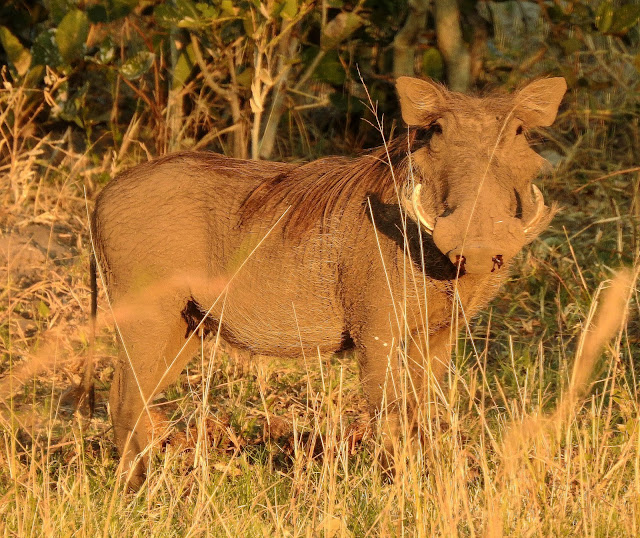
2-6-2019 LINYANTI, BOTSWANA - COMMON WARTHOG (Phacochoerus Africus)
The Common warthog (Phacochoerus africanus) is a wild member of the pig family (Suidae) found in sub-Saharan Africa. It is the only pig species that has adapted to grazing and savanna habitats.
Common warthogs are found in sub-Saharan Africa. They live in grasslands, savanna, open bushlands, and woodlands. These animals prefer open areas and avoid rainforests, thickets, cool montane grasslands, and severe deserts.
A warthog has two pairs of tusks protruding from the mouth and curving upwards. The lower pair, which is far shorter than the upper pair, becomes razor-sharp by rubbing against the upper pair every time the mouth is opened and closed. The upper canine teeth can grow to 25.5 cm (10.0 in) long and have a wide elliptical cross-section, being about 4.5 cm (1.8 in) deep and 2.5 cm (0.98 in) wide. A tusk will curve 90° or more from the root, and will not lie flat on a table, as it curves somewhat backward as it grows. The tusks are not used for digging, but are used for combat with other hogs and in defense against predators - the lower set can inflict severe wounds. Common warthog ivory is taken from the constantly growing canine teeth. The tusks, particularly the upper set, work in much the same way as elephant tusks with all designs scaled down. Tusks are carved predominantly for the tourist trade in eastern and southern Africa. The head of the Common warthog is large, with a mane down the spine to the middle of the back. Sparse hair covers the body. Its color is usually black or brown. Tails are long and end with a tuft of hair. Common warthogs do not have subcutaneous fat and the coat is sparse, making them susceptible to extreme environmental temperatures.
Friday, 26 November 2021
2-6-2019 LINYANTI CAMP, BOTSWANA - AFRICAN WATTLED LAPWING (Vanellus senegallus)
The African wattled lapwing (Vanellus senegallus), also known as the Senegal wattled plover or simply wattled lapwing, is a large lapwing, a group of largish waders in the family Charadriidae. It is a resident breeder in most of sub-Saharan Africa outside the rainforests, although it has seasonal movements.
These are conspicuous and unmistakable birds. They are large brown waders with a black crown, white forehead and large yellow facial wattles. The tail is white, tipped black, and the long legs are yellow.
In flight, the upperwings have black flight feathers and brown coverts separated by a white bar. The underwings are white with black flight feathers. The African wattled lapwing has a loud peep-peep call.
This species is a common breeder in wet lowland habitats, especially damp grassland. It often feeds in drier habitats, such as golf courses, picking insects and other invertebrates from the ground. It lays three or four eggs on a ground scrape.
The African wattled lapwing is one of the species to which the Agreement on the Conservation of African-Eurasian Migratory Waterbirds (AEWA) applies. Occurs across sub-Saharan Africa; in southern Africa it is fairly common in Zimbabwe, northern Botswana and Namibia (including the Caprivi Strip), north-eastern South Africa, Swaziland and central and southern Mozambique. It generally prefers waterlogged grassland at streams, seeps edges of marshes and flood plains, as well as exposed areas along the edges of lakes and pans, burnt grassland and cultivated land.
Monogamous, territorial solitary nester, with the male defending its territory vigorously against intruders (mainly other African wattled lapwings) by striking them with its wings. Displays and fights are most intense at the beginning of the breeding season, as later males only call and use threat postures to defend their territory.
The nest (see image below) is a shallow depression in the ground, several of which are created by the male before the female chooses one to be lined thickly with grass stems, roots, pebbles and dry dung. It is typically placed on bare ground in short or burnt grassland, or occasionally small islands in marshy areas.
Egg-laying season is from July-December, peaking from September-October.
It lays 2-4 eggs, which are incubated by both sexes for about 28-32 days, often mobbing predators which come to close.
The chicks leave the nest within 24 hours, and are always tended by at least one adult, fledging at about 40 days old but only leaving the family group at the start of the following breeding season.
It is currently not threatened, in fact it may have benefited from the modification of habitats by humans.
2-6-2019 LINYANTI, BOTSWANA - DICKINSON'S KESTREL (Falco dickinsonii)
Dickinson's kestrel (Falco dickinsoni) is a bird of prey of southern and eastern Africa belonging to the falcon family Falconidae. It is named after John Dickinson, an English physician and missionary who collected the type specimen. It is also known as the white-rumped kestrel. Its closest relatives are the grey kestrel and banded kestrel and the three are sometimes placed in the subgenus Dissodectes.
It is a fairly small, stocky kestrel with a large, square head. It is 27–30 cm (11–12 in) long with a wingspan of 61–68 cm (24–27 in) and a weight of 167–246 g (5.9–8.7 oz). The female is about 4% larger and 10-20% heavier than the male. The plumage is mostly dark grey with a pale head and rump. The tail is grey with narrow black bars and a broad subterminal band. The underside of the flight feathers are also barred. The cere and feet are yellow and there is bare yellow skin around the eye. The bill is dark grey and the eyes are brown. Juvenile birds are grey-brown with barred flanks and without the paler head and rump. They have a greenish cere and eye-ring.
It is usually silent but has a high-pitched alarm and contact call. At the nest, a soft, mewing call attracts the young for feeding.
It inhabits savanna and open woodland, particularly swampy areas near water. It favours miombo woodland and is typically associated with palm trees (such as Hyphaene and Borassus species) and is also often found near baobab trees. It occurs in coconut plantations in some areas.
Its range covers most of Mozambique, Zimbabwe, Zambia and Malawi along with north-eastern South Africa (mainly in Kruger National Park), northern Botswana, north-east Namibia, eastern Angola, southern Democratic Republic of the Congo and parts of Tanzania. It is an occasional visitor to Kenya. The total range is about 3,400,000 km2 (1,300,000 sq mi). It is generally rather scarce but is commoner in some areas such as Zanzibar and Pemba Islands. Loss of palm trees is a potential threat to the species.
3-6-2019 LINYANTI CAMP, BOTSWANA - COMMON WATERBUCK (Kobus ellipsiprymnus ssp. ellipsiprymnus)
The waterbuck (Kobus ellipsiprymnus) is a large antelope found widely in sub-Saharan Africa. It is in the genus Kobus of the family Bovidae. It was first described by Irish naturalist William Ogilby in 1833. Its 13 subspecies are grouped under two varieties: the common or ellipsiprymnus waterbuck and the defassa waterbuck. Their coat colour varies from brown to grey. The long, spiral horns, present only on males, curve backward, then forward, and are 55–99 cm (22–39 in) long.
Waterbucks are rather sedentary in nature. As gregarious animals, they may form herds consisting of six to thirty individuals. These groups are either nursery herds with females and their offspring or bachelor herds. Males start showing territorial behaviour from the age of five years, but are most dominant from six to nine. The waterbuck cannot tolerate dehydration in hot weather, and thus inhabits areas close to sources of water.
Predominantly a grazer, the waterbuck is mostly found on grassland. In equatorial regions, breeding takes place throughout the year, but births are at their peak in the rainy season. The gestational period lasts 7–8 months, followed by the birth of a single calf.
Waterbucks inhabit scrub and savanna areas along rivers, lakes, and valleys. Due to their requirement for grasslands and water, waterbucks have a sparse ecotone distribution. The IUCN lists the waterbuck as being of least concern. More specifically, the common waterbuck is listed as of least concern, while the defassa waterbuck is near threatened.
The population trend for both is downwards, especially that of the defassa, with large populations being eliminated from certain habitats because of poaching and human disturbance.
Thursday, 25 November 2021
3-6-2019 LINYANTI CAMP, BOTSWANA - RED BILLED SPURFOWL (Pternistis adspersus)
The red-billed spurfowl (Pternistis adspersus), also known as the red-billed francolin, is a species of bird in the family Phasianidae. It is found in Southern Africa, including Angola, Botswana, Namibia, South Africa, Zambia, and Zimbabwe.
The species exhibits sexual dimorphism in size. Males are larger, measuring 38 cm (15 in) in length and weighing 340–635 g (12.0–22.4 oz), whereas females measure 33 cm (13 in) in length and weigh 340–549 g (12.0–19.4 oz). The species has barred underparts (in contrast to the related Natal spurfowl) and a conspicuous yellow eye-ring.
The red-billed spurfowl was described in 1838 by the English naturalist George Robert Waterhouse from specimens collected by James Edward Alexander on his expedition to Namaqualand and Damaraland. Waterhouse coined the binomial name Francolinus adspersus and noted that the specimens had come near the Fish River in what is now Namibia. The specific epithet adspersus is Latin for "sprinkling". The species is now placed in the genus Pternistis that was introduced by the German naturalist Johann Georg Wagler in 1832. The red-billed spurfowl is considered as monotypic: the proposed subspecies mesicus is not recognised.
3-6-2019 LINYANTI CAMP, BOTSWANA - ARNOT'S CHAT (Myrmecocichla arnotti)
Arnot's chat ranges in size from 16 to 18 cm (6.3–7.1 in) and weighs around 35 g (1.2 oz). The plumage of the adults is sexually dimorphic; the male of the nominate race is overall black with a white crown and a white patch on the wing coverts. The female is similar but with a black crown and a white (tipped with black) throat and neck. The bill and legs are black. Juvenile birds are like the adults but with white feather tips on the crown or throat instead of fuller white. The male of the race harterti has less extensive white on the wings and a mostly black head with a small area of white on the forehead and above the eye; the white throat of the female is also less extensive than on the nominate.
Wednesday, 24 November 2021
3-6-2019 LINYANTI CAMP, BOTSWANA - ZAMBESI CRESTED BARBET (Trachyphonus vaillantii ssp. nobilis)
The Zambezi crested barbet is the common crested barbet (Trachyphonus vaillantii), a vibrantly colored sub-Saharan bird known for its loud trilling call and aggressive, territorial behavior.
Appearance: This is a small (23–24 cm), chunky bird with a thick, pale bill and colorful plumage. It has a speckled yellow and red face, a small black crest, a yellow belly with red spots, and black wings with white specks. The male and female plumage is similar.
Habitat and Distribution: It is found in a variety of wooded areas, including forests, savannas, riverine thickets, and even suburban gardens across countries like Zambia, South Africa, Botswana, and Mozambique.
Behavior: Crested barbets are usually seen singly or in pairs and are notably aggressive, chasing away other birds (like doves and thrushes) and have even been known to attack rats and snakes in their territory. They do not fly easily or for long distances, preferring to hop around on the ground to forage.
Diet: Their diet is omnivorous, consisting of insects, fruits, snails, and sometimes the eggs or chicks of other birds. They are considered a friend to gardeners because they consume the local snail population.
3-6-2019 LINYANTI CAMP, BOTSWANA - RED EYED DOVE (Streptopelia semitorquata)
The red-eyed dove (Streptopelia semitorquata ) is a dove that is a widespread and common in Sub-Saharan Africa. It has been listed as Least Concern on the IUCN Red List since 2004.
The red-eyed dove is a largish, stocky pigeon, typically 30 cm (12 inches) in length. Its back, wings and tail are pale brown. When flying, it shows blackish flight feathers. The head and underparts are dark vinous-pink, shading to pale grey on the face. There is a black hind neck patch edged with white. The legs and a patch of bare skin around the eye are red. The call is a loud doo-doo-du-du.
Sexes are similar, but juveniles are duller than adults, and have scalloping on the body feathers.
Red-eyed doves eat grass seeds, grains and other vegetation. They often forage on the ground.
3-6-2019 LINYANTI CAMP, BOTSWANA - MARTIAL EAGLE (Polemaetus bellicosus)
The Martial Eagle (Polemaetus bellicosus), a formidable raptor, reigns over the sub-Saharan skies. This solitary species, the sole member of its genus, is distinguished by its impressive size and power. With feathered tarsi characteristic of the booted eagle subfamily, it is one of the largest of its kind. The Martial Eagle is an apex predator, soaring high to stoop upon a diverse array of prey, from mammals to reptiles.
Adult Martial Eagles exhibit a dark brown plumage on their upperparts, head, and upper chest, with occasional lighter feather edges. Their underparts are white, marked with sparse blackish-brown spots. In flight, their long broad wings and short tail give them a distinctive silhouette. Juveniles are paler with a greyish mottled appearance and take up to seven years to acquire their adult plumage.
The Martial Eagle favors wooded belts within open savanna landscapes, avoiding dense forests and arid deserts. It is often found perched in an upright position in large trees, surveying its territory.
This eagle's range spans across sub-Saharan Africa, with higher densities in southern and parts of east Africa. It is more sporadic in west Africa, with notable populations in protected areas such as South Africa's Kruger National Park.
Martial Eagles spend a significant portion of their day aloft, soaring at great heights. They are solitary outside of the breeding season and exhibit a preference for less disturbed areas, likely due to the abundance of prey and aversion to human activity.
The Martial Eagle is not a frequent vocalizer, but it does emit a low mellow whistle as a contact call and a louder, trilling call during territorial displays.
Breeding occurs at various times across their range, with nests built high in large trees. They lay usually one egg, with the female performing most of the incubation. Fledglings remain dependent on their parents for several months post-fledging.
The Black-chested Snake Eagle may be confused with the Martial Eagle but is significantly smaller with different coloring and flight patterns. Juvenile Martial Eagles may be mistaken for juvenile Crowned Eagles but differ in wing and tail proportions.
Martial Eagles are opportunistic predators, with a diet comprising mammals, birds, and reptiles. They are known for hunting from a high soar, using their keen eyesight to spot prey from several kilometers away.
The Martial Eagle is currently classified as Endangered by the IUCN, with populations declining due to factors such as persecution, habitat destruction, and collisions with power lines. Conservation efforts focus on education and the expansion of protected areas.
Subscribe to:
Comments (Atom)
%2020.jpg)
%2021.jpg)
%2020.jpg)
%2021.jpg)
%2022.jpg)
%2023.jpg)
%2021.jpg)
%2022.jpg)
%2023.jpg)
%2020.jpg)
%2020.jpg)