TOTAL PAGEVIEWS

TRANSLATE

Sunday, 27 February 2022

5-6-2019 LINYANTI CAMP, BOTSWANA - SENEGAL COUCAL (Centropus senegalensis)


The Senegal coucal, Centropus senegalensis, is a medium-sized bird within the cuckoo order, Cuculiformes. It boasts a striking appearance with a black crown, nape, upper parts, bill, legs, and elongated tail. The eyes of this species are a captivating red, while the wings present a rich chestnut hue. The underparts are a creamy white, accented with blackish barring on the flanks.

When identifying the Senegal coucal, look for its black upper body and tail, contrasting with chestnut wings and creamy underparts. The red eyes are a distinctive feature, as is the barring on the flanks. Juveniles may appear browner with more pronounced barring and streaking.

This bird favors grassy environments interspersed with trees, such as bushlands and savannahs, providing it with ample cover and foraging opportunities.

The Senegal coucal's range spans across central and southern Africa, south of the Sahara Desert. It can be found from Senegal and Gambia in the west, across to Ethiopia and Kenya in the east, and reaching down to Angola and Congo in the south. A separate population resides in southern Africa, particularly around Zambia, Zimbabwe, and northern Botswana.

Saturday, 26 February 2022

5-6-2019 LINYANTI CAMP, BOTSWANA - AFRICAN BLACK WINGED KITE (Elanus caeruleus ssp. caeruleus)


The black-winged kite (Elanus caeruleus), also known as the black-shouldered kite (not to be confused with the closely-related Australian species of the same name), is a small diurnal bird of prey in the family Accipitridae best known for its habit of hovering over open grasslands in the manner of the much smaller kestrels. This Palearctic and Afrotropical species was sometimes combined with the Australian black-shouldered kite (Elanus axillaris) and the white-tailed kite (Elanus leucurus) of North and South America which together form a superspecies. This kite is distinctive, with long wings; white, grey and black plumage; and owl-like forward-facing eyes with red irises. 

The owl-like behaviour is even more pronounced in the letter-winged kite (Elanus scriptus), a nocturnal relative in Australia. Although mainly seen on plains, they are sometimes seen on grassy slopes of hills in the higher elevation regions of Asia. They are not migratory, but show nomadism in response to weather and food availability. They are well adapted to utilize periodic upsurges in rodent populations and can raise multiple broods in a single year unlike most birds of prey. Populations in southern Europe have grown in response to human activities, particularly agriculture and livestock rearing.


The black-winged kite is a species primarily of open land and semi-deserts in sub-Saharan Africa and tropical Asia, but it has a foothold within Europe in Spain and Portugal. The species range appears to be expanding in southern Europe and possibly in West Asia. The first records of breeding in Europe were in the 1860s and since then they have become more widespread and populations are on the rise. It is thought that land-use changes, particularly agriculture and pastureland have helped the species.The species has expanded its range in southern Europe.


Several geographic populations have been named as subspecies and these include the nominate subspecies which occurs in Spain, Africa and Arabia. The subspecies vociferus is found east of this range across South Asia and into Southeast Asia. Along Sumatra, Java, Borneo and the Philippines subspecies hypoleucus (sometimes considered a full species) includes the population wahgiensis described from New Guinea. Subspecies sumatranus is not always recognized. The white-tailed kite and the black-shouldered kite were formerly included with this species but have since been treated as separate species.

Although found mainly on the plains they have been seen at higher altitudes in Sikkim (3,650 m (11,980 ft)), the Nilgiris (Doddabetta, 2,670 m (8,760 ft))[23] and Nagaland (2,020 m (6,630 ft)).

They are said to be winter visitors in some parts of their range such as the Western Ghats.

4-6-2019 LINYANTI CAMP, BOTSWANA - HIPPOPOTAMUS (Hippopotamus amphibius)


The hippopotamus (Hippopotamus amphibius; /ˌhɪpəˈpɒtəməs/; pl.: hippopotamuses), often shortened to hippo (pl.: hippos), further qualified as the common hippopotamus, Nile hippopotamus and river hippopotamus, is a large semiaquatic mammal native to sub-Saharan Africa. It is one of only two extant species in the family Hippopotamidae, the other being the pygmy hippopotamus (Choeropsis liberiensis or Hexaprotodon liberiensis). Its name comes from the Ancient Greek for "river horse" (ἱπποπόταμος).

After elephants and rhinoceroses, the hippopotamus is the next largest land mammal. It is also the largest extant land artiodactyl. Despite their physical resemblance to pigs and other terrestrial even-toed ungulates, the closest living relatives of the hippopotamids are cetaceans (whales, dolphins, porpoises, etc.), from which they diverged about 55 million years ago.

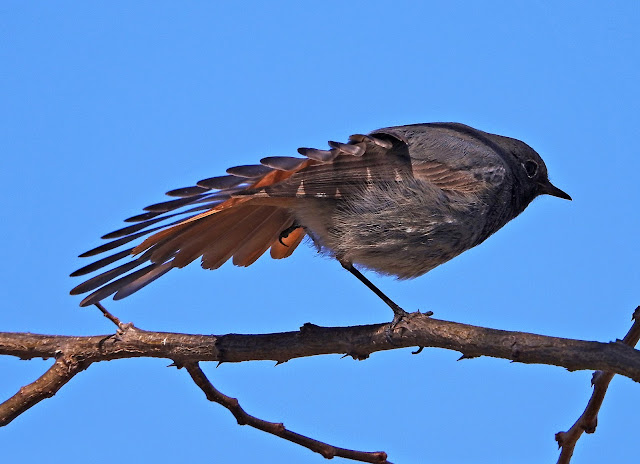
23-2-2022 LLUTXENT, VALENCIA - EURASIAN BLACKCAP (MALE) (Sylvia atricapilla)


Tuesday, 22 February 2022

4-6-2019 LINYANTI CAMP, BOTSWANA - JAMESON'S FIREFINCH (Lagonosticta rhodopareia)


Jameson's firefinch is a small, native African bird found in savannas and woodlands, known for the male's red plumage and the species' tendency to live in pairs or small flocks. Its diet consists mainly of grass seeds and small insects, and it is a host for the parasitic Village Indigobird, which lays its eggs in their nests. 
Key facts
Classification: It belongs to the order Passeriformes and the family Estrildidae.

Appearance:
Size: Approximately 
 11cm long and weighs around 10g.

Male: Reddish plumage on the face, chest, and underparts; it has a blue-gray bill and black undertail coverts.

Female: More subdued brownish tones with a reddish rump, and the same blue-gray bill and black undertail coverts.


Habitat: Found in eastern and southern Africa, including savannas, woodlands, and scrub, often near water or along forest edges.

Diet: Primarily forages on the ground for fallen grass seeds, but also eats small insects like ants and termites.

Behavior:
Usually seen in pairs or small groups.
Vocalizes with a short trill, according to eBird.

Breeding:
Nests are oval-shaped, made of dry grass, and lined with soft grass or feathers.
Lays 2–7 eggs, with a clutch size of 3–4 is more typical, and both parents incubate the eggs and feed the chicks.
Breeding often peaks during the summer months.

Conservation Status: Listed as Least Concern on the IUCN Red List.
Parasitism: The Village Indigobird is a brood parasite that lays its eggs in the Jameson's firefinch's nest, as noted by Wildlife Vagabond. 

22-2-2022 XERACO STATION, VALENCIA - EUROPEAN SERIN (Serinus serinus)


Monday, 21 February 2022

4-6-2019 LINYANTI CAMP, BOTSWANA - DOUBLE BANDED SANDGROUSE (Pterocles bicinctus)


The double-banded sandgrouse (Pterocles bicinctus ) is a species of ground-living bird in the family Pteroclidae. It is found in arid parts of southern Africa.

A moderate sized bird with a plump body, the double-banded sandgrouse has a small pigeon-like head and long wings and tail. The general colour of the plumage is light brown with darker mottling and rows of whitish specks. The male is distinguished by having a conspicuous black and white band on its forehead and a chestnut throat area delineated by another black and white band. Both sexes have an area of bare yellow skin surrounding their eye and the male has an orange beak. The female is smaller and duller in colour. The juvenile resembles the female.

The double-banded sandgrouse is found in Angola, Botswana, Malawi, Mozambique, Namibia, South Africa, Zambia and Zimbabwe. It has a preference for short trampled grass beside roads and tracks, gravel patches, tussocky grassland and recently burned areas of scrub with green shoots starting to develop. It is also seen in areas of scanty vegetation beneath scattered Terminalia sericea and Burkea africana trees and in scrubby mopane woodland. It is less common than Burchell's sandgrouse (Pterocles burchelli ) and Namaqua sandgrouse (Pterocles namaqua ), both of which have an overlapping distribution in southern Africa.

4-6-2019 LINYANTI, BOTSWANA - LILAC BREASTED ROLLER (Coracias caudatus)


The lilac-breasted roller (Coracias caudatus) is a member of the roller family, Coraciidae, resplendent in a panoply of pastel hues. This African bird is a sight to behold, with its lilac throat and breast, olive crown to mantle, and cheeks of lilac-rufous. The species is further adorned with long, black tail streamers, which juveniles lack. Unofficially, it is considered the national bird of Kenya.
In the field, the lilac-breasted roller is almost unmistakable. Adults boast a lilac throat that deepens into a darker lilac breast, with an olive crown and mantle. The cheeks and ear coverts are a lilac-rufous. Juveniles and immatures can be identified by their lack of tail streamers and a throat and breast of rufous-tawny with broad diffuse buffy-white streaks. The species is not sexually dimorphic, though males may be slightly larger.

The lilac-breasted roller favors open woodland and savanna, typically avoiding treeless expanses. They are often seen perched high, surveying the landscape for prey.

This species is widely distributed across Southern and Eastern Africa and is a vagrant to the southern Arabian Peninsula. It is most abundant in Kenya and can be found from sea level to elevations of 2,000 meters or more.