TOTAL PAGEVIEWS

TRANSLATE

Sunday, 26 December 2021

31-5-2019 THORNTREE CAMP, ZAMBIA - AFRICAN PIED WAGTAIL (Motacilla aguime)


The African pied wagtail, or African wagtail, (Motacilla aguimp) is a species of bird in the family Motacillidae.

The African pied wagtail is found in sub-Saharan Africa from the Eastern Cape north to extreme southern Egypt and from Guinea to western Eritrea and Somalia. It is a vagrant to Burkina Faso, Gambia, Mauritania and the Western Cape.


The African pied wagtail inhabits subtropical or tropical seasonally wet or flooded lowland grassland, rivers, and, sometimes, freshwater marshes. In some areas it is commensal with humans in towns and villages.

26-12-2021 MONTE CORONA, VALENCIA - GEOMETER MOTH (Charissa mucidaria)


31-5-2019 THORNTREE CAMP, ZAMBIA - AFRICAN DARTER (Anhinga rufa)


The African darter (Anhinga rufa), sometimes called the snakebird, is a water bird of sub-Saharan Africa and Iraq.

The African darter is a member of the darter family, Anhingidae, and is closely related to American (Anhinga anhinga), Oriental (Anhinga melanogaster), and Australasian (Anhinga novaehollandiae) darters.

The African darter is 80 cm (31 in) long. Like other anhingas, it has a very long neck. The male is mainly glossy black with white streaking; females and immature birds are browner. The African darter differs in appearance from the American darter most recognisably by its thin white lateral neck stripe against a rufous background colour. The pointed bill prevents confusion with cormorants.


The African darter is found throughout sub-Saharan Africa wherever large bodies of water occur; overall the species remains widespread and common.

The only non-African subspecies, the Levant darter (Anhinga rufa chantrei), occurred at Lake Amik (Amik Gölü) in south-central Turkey, in the Hula Valley lake and marshes in northern Israel and in the Mesopotamian Marshes of the lower Euphrates and Tigris rivers in southern Iraq. The Turkish population disappeared during the 1930s and the Israeli population during the drainage of the Hula in the 1950s. In Khuzestan, 110 birds were counted in 1990, but the subspecies was feared extinct as a result of oil spills during the Gulf War and the drainage of the Mesopotamian Marshes that followed it. However, a small population was documented in the Hawizeh Marshes in 2007. The drainage of the marshes was interrupted and reversed after the Iraq War.

Friday, 24 December 2021

24-12-2021 MONTE CORONA, VALENCIA - CARPET MOTH (Nebula ibericata)


31-5-2019 THORNTREE CAMP, ZAMBIA - TAWNY FLANKED PRINIA (Prinia subflava)


The tawny-flanked prinia (Prinia subflava) is a small passerine bird belonging to the genus Prinia in the family Cisticolidae, a family of Old World warblers. It is widespread and common in most parts of Africa south of the Sahara. The plain prinia (P. inornata) of southern Asia was formerly included in this species but is now usually considered to be a separate species.

The tawny-flanked prinia is 11–12 cm (4.3–4.7 in) in length with a long, narrow, graduated tail[6] and a fairly long, slender bill. The tail is often held erect or waved from side to side. The upperparts are grey-brown with rufous-brown edges to the flight feathers and a rufous tinge to the rump. The throat and breast are whitish while the flanks and vent are warm buff. There is a whitish stripe over the eye and the lores are dark. The tail feathers have a white tip and a dark subterminal band.


The sexes are similar in appearance. Non-breeding birds have a longer tail than breeding birds. Juveniles have pale yellow underparts and a yellowish bill. There are many recognised subspecies.

The call is short, wheezy and rapidly repeated. The song is a monotonous series of shrill notes. The male often sings from an exposed perch.

The pale prinia (P. somalica) of North-east Africa is similar but paler and greyer with whitish flanks. It inhabits drier, more open habitats than the tawny-flanked prinia. The river prinia (P. fluviatilis) of West Africa is also paler and greyer and has a longer tail. It is restricted to waterside vegetation.


There are ten subspecies distributed across most parts of sub-Saharan Africa except for the driest and wettest areas. It is absent from much of the Congo Basin, southern Namibia, south-west Botswana and the western half of South Africa. It is found amongst shrubs and grass in a variety of habitats including woodland, savanna and cultivated areas. It adapts well to man-made habitats and is not considered to be threatened.

It feeds on insects and other invertebrates. It forages in small flocks which move through shrubs and undergrowth.

The nest is purse-shaped and made of strips of grass woven together. It is built one to two metres above the ground. Two to four eggs are laid; they are variable in ground colour and usually have brown or purple spots or blotches.

31-5-2019 THORNTREE CAMP, ZAMBIA - BROWN HOODED KINGFISHER (Halcyon albiventris)


The brown-hooded kingfisher (Halcyon albiventris) is a species of bird in the subfamily Halcyoninae, the tree kingfishers. It has a brown head and blackish and turquoise wings. It is found in Sub-Saharan Africa, living in woodland, scrubland, forest edges, and also suburban areas. The International Union for Conservation of Nature (IUCN) has assessed it as being of least concern.

This species was described as Alcedo albiventris by Giovanni Antonio Scopoli in 1786. Four subspecies are recognised: Halcyon albiventris albiventris, H. a. orientalis, H. a. prentissgrayi and H. a. vociferans. Subspecies hylophila and erlangeri have also been described, but they are not considered distinct enough.


The brown-hooded kingfisher is about 22 cm (8.7 in) long. The head is brown, with blackish streaks. There is a broad buffy collar above the brownish-black mantle. The wing coverts are mostly brownish-black, and the secondary flight feathers are turquoise. The rump is azure-blue. The chin is white, the breast is tawny with some dark streaks, and the belly is buffy. The beak is red, tipped brown, the legs are carmine, and the eyes are dark brown. The female has dark brown upperparts, and its underparts are more streaked than the male. The juvenile bird is duller, with scalloped whitish underparts. The subspecies differ in shade and streaking.


This kingfisher is found in Sub-Saharan Africa, in Gabon, Congo, the Democratic Republic of the Congo, Angola, Kenya, Tanzania, Zambia, Somalia, Mozambique, Malawi, Zimbabwe, Botswana, Namibia, South Africa and Eswatini. It occurs below 1,800 m (5,900 ft) in elevation, living in woodland, grassland with trees, scrubland, forest edge, and also cultivations, parks and gardens. It sometimes occurs near water, and can adapt to suburban habitats. Most populations do not migrate, but there is evidence of seasonal movements in some areas.

This kingfisher is generally seen alone or in pairs. It usually forages on the ground, mainly feeding on insects, and also eating scorpions, reptiles, small birds, rodents and fishes. Eating snakes and lizards as long as 25 cm (9.8 in) has been reported. The song, given while vibrating the wings, is a tiiiu or ki-ti-ti-ti trill, and a sharp cheerit is given when alarmed. The breeding season is mainly between September and April. A burrow nest is dug in a river bank, gully or road cutting. The family stays together for a few weeks after breeding.

24-12-2021 MONTE CORONA, VALENCIA - SHORT TAILED ICHNEUMOID WASP (Genus Ophion)


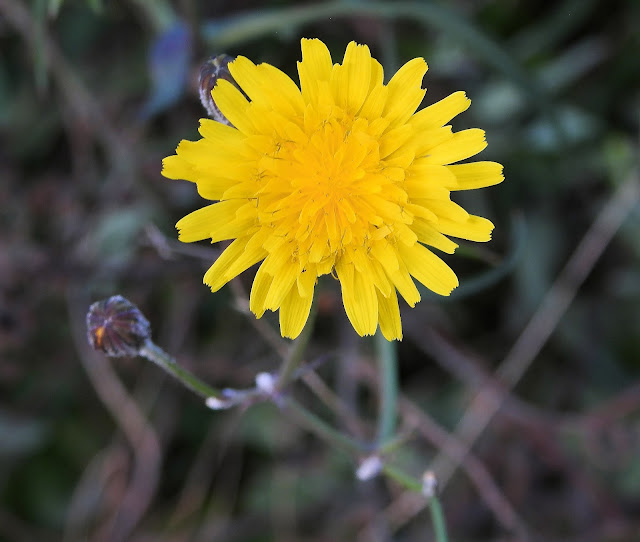
24-12-2021 ADOR CAMPO, VALENCIA - SLENDER SOWTHISTLE (Sonchus tenerrimus)


24-12-2021 ADOR CAMPO, VALENCIA - BLACK REDSTART (MALE) (Phoenicurus ochruros)


Thursday, 23 December 2021

31-5-2019 THORNTREE CAMP, ZAMBIA - MEVES'S STARLING (Lamprotornis mevesii)


Meves's starling (Lamprotornis mevesii) or Meves's glossy-starling, is a species of starling in the family Sturnidae. It is found in Angola, Botswana, Malawi, Mozambique, Namibia, South Africa, Zambia, and Zimbabwe.

Its common name and Latin binomial commemorate the German ornithologist Friedrich Wilhelm Meves. 

A medium-large, iridescent glossy starling with a very long and graduated tail. The color of the iridescence is blue and purple in most of the range, but the southwestern Angola population shows yellowish bronzy gloss. Pairs, groups, and flocks are resident in open savanna, preferring broadleaf woodland like Brachystegia (miombo) and areas with baobabs. The species feeds on the ground, walking with long strides, and sits low in trees, searching mostly for insects to eat. The similar Burchell’s Starling differs from Meves’s Starling by being greener and larger, with a less graduated tail that is proportionately shorter.

31-5-2019 THORNTREE CAMP, ZAMBIA - COMMON BULBUL (Pycnonotus barbatus)


The common bulbul (Pycnonotus barbatus) is a member of the bulbul family of passerine birds. It is found in north-eastern, northern, western and central Africa.

The common bulbul was originally described in the genus Turdus. Some authorities treat the Somali, Dodson's and dark-capped bulbul as subspecies of the common bulbul. The common bulbul is considered to belong to a superspecies along with the Himalayan bulbul, white-eared bulbul, white-spectacled bulbul, African red-eyed bulbul, and the Cape bulbul. Alternate names for the common bulbul include the black-eyed bulbul, brown bulbul (also used for the Asian red-eyed bulbul), brown-capped geelgat, common garden bulbul, garden bulbul and white-vented bulbul as well as one name used for another species (yellow-vented bulbul).

23-12-2021 MONTE CORONA, VALENCIA - GARDEN CARPET MOTH (Xanthorhoe fluctuata)


31-5-2019 THORNTREE CAMP, ZAMBIA - ARROW MARKED BABBLER (Turdoides jardineii ssp. tamalakanei)


The arrow-marked babbler (Turdoides jardineii) is a species of bird in the family Leiothrichidae. It is native to woodlands in the southern Afrotropics.

It is found in Angola, Botswana, Burundi, Republic of the Congo, DRC, Eswatini, Gabon, Kenya, Malawi, Mozambique, Namibia, Rwanda, South Africa, Tanzania, Uganda, Zambia, and Zimbabwe. Its natural habitats are subtropical or tropical dry forest, dry savanna, and subtropical or tropical moist shrubland.

Wednesday, 22 December 2021

22-12-2021 MONTE CORONA, VALENCIA - GEOMETER MOTH (Agriopis bajaria)


1-6-2019 LINYANTI CAMP, BOTSWANA - PALE EMERALD SPOTTED WOOD DOVE (Turtur chalcospilos ssp. zambesiensis)


The emerald-spotted wood dove or emerald-spotted dove (Turtur chalcospilos) is a bird of the family Columbidae, resident across eastern and southern Africa. It is a species of open drier deciduous woodland and second growth. It is absent from evergreen rainforests and semidesert areas.

At Hluhluwe-Umfolozi, South Africa, showing the bluish-emerald wing spots
Calling in woodland during autumn
The emerald-spotted wood dove is a small plump pigeon, typically 20 cm in length. Its back, hindneck, wings, and tail are pale grey-brown, and the folded wings have green metallic patches. There are blackish bands on the lower back and tail. The forehead, crown, and nape are bluish-grey, fading to pinkish-grey on the throat. The underparts are mauve-pink, becoming whiter on the belly.

The bill of this dove is blackish with a red base. The sexes are similar, but the female may be slightly duller than the male. The immature has duller green spots and buff fringes to the feathers. When flying, the black-billed wood dove is told from this species by its bright chestnut underwings.

1-6-2019 LINYANTI CAMP, BOTSWANA - RED BILLED FRANCOLIN (Pternistis-adspersus)


The Red-billed Spurfowl (Pternistis adspersus), or Red-billed Francolin, is a medium-sized, ground-dwelling bird in the family Phasianidae found in Southern Africa (Angola, Botswana, Namibia, South Africa, Zambia, Zimbabwe). They inhabit open savanna, woodland, and thorn scrub areas. Known for being noisy and having a bright red bill, they are often found in pairs or small groups. 

The Red-billed Spurfowl, or Pternistis adspersus, presents a striking figure with its barred underparts and a distinctive yellow eye-ring. This bird, also known as the Red-billed Francolin, is a member of the Phasianidae family. Exhibiting sexual dimorphism, the males are notably larger, reaching lengths of 38 cm and weights between 340-635 grams, while the females are slightly smaller at 33 cm in length and weighing 340-549 grams.


When observing the Red-billed Spurfowl, look for the characteristic barred pattern on the underparts, which sets it apart from similar species such as the Natal Spurfowl. The yellow eye-ring is a conspicuous feature to aid identification. Males are larger than females, which can be a helpful distinction in the field.

The Red-billed Spurfowl is native to Southern Africa, where it frequents a variety of habitats.

This species is widely distributed across Southern Africa, with its range encompassing Angola, Botswana, Namibia, South Africa, Zambia, and Zimbabwe.


The Red-billed Spurfowl is known for its terrestrial habits, often seen foraging on the ground.

The Natal Spurfowl is similar in appearance but can be distinguished by the lack of barred underparts which are present in the Red-billed Spurfowl.

The IUCN Red List has classified the Red-billed Spurfowl as Least Concern, indicating that the species does not currently face a significant risk of extinction.

1-6-2019 LINYANTI CAMP, BOTSWANA - SMITH'S BUSH SQUIRREL (Paraderus Cepapi)


Smith's bush squirrel (Paraxerus cepapi), also known as the yellow-footed squirrel or tree squirrel, is an African bush squirrel which is native to woodlands of the southern Afrotropics.

It is found in Angola, Botswana, the DRCongo, Malawi, Mozambique, Namibia, South Africa, Tanzania, Zambia, and Zimbabwe. It is a common rodent which is diurnal by nature.

Its total length is 350 mm (14 in), half of which is tail; weight 200 g (7.1 oz). The coat colour varies throughout the region. In the western and arid parts of its range, it is pale grey, and in the eastern localities, more brown. Its head and legs are a rusty colour. Colouration on the chest varies from yellowish to buff in the east, to white in the west. This squirrel's belly is white. These alert and ever busy creatures carry their long tails extended backwards.


Smith's bush squirrels are primarily vegetarian, but like most rodents, they take insect prey and use their front feet to manipulate food items when feeding. They scatter-hoard seeds next to tree trunks or grass tufts, thereby facilitating tree regeneration.

Essentially arboreal animals, they also spend a great deal of time on the ground, foraging for food. When disturbed, Smith's bush squirrels always seek the refuge of trees. At night, territorial family groups nest together in holes in trees. Offspring become sexually mature between six and nine months old, when they are forcibly evicted by the breeding pair. The males are mainly responsible for territorial defense, although females also chase intruders when they care for dependent pups. To promote group cohesion, a common scent is shared by mutual grooming, which is an important facet of the social fibre of this species. Smith's bush squirrels are diligent in their grooming and a mother tree squirrel holds her offspring down with her fore legs while grooming it with licks, nibbles, and scratches with her claws.


A conspicuous feature of their behaviour when under threat is 'mobbing': all the members of the colony make harsh clicking sounds while they flick their tails, building up momentum and gradually getting louder. In some areas, they are solitary, or are found in small family groups; a lone tree squirrel relies on its wits when in danger and always keeps a branch or the trunk of a tree between it and the enemy. Smith's bush squirrels are always alert, and when alarmed, run away with great speed, making for the nearest tree where they lie motionless, flattened against a branch.

18-12-2021 MONTE CORONA, VALENCIA - FUNNEL WEAVER SPIDER (Genus Textrix)


20-12-2021 MONTE CORONA, VALENCIA - RUSTY DOT PEARL MOTH (Udea ferrugalis)


20-12-2021 MONTE CORONA, VALENCIA - HAIRY ROSE BEETLE (Tropinota squalida)


20-12-2021 MONTE CORONA, VALENCIA - FRENCH PAPER WASP (Polistes gallicus)