This Blog contains Wildlife, Plants and Bird Photos from Walks, Safaris, Birding Trips and Vacations. Most of the pictures have been taken with my Nikon P900 and P950X cameras. Just click on any image for a larger picture. On the right column under the Blog Archive are the entries by date. Below that under Animal categories all the diffent species of Animals, Birds, Insects and Plants contained in the website are listed. Clicking on any entry will show all the entries for that species.
TOTAL PAGEVIEWS
TRANSLATE
Wednesday, 25 March 2020
2-3-2020 KANHA NAT PARK, INDIA - INDIAN PEAFOWL (Pavo cristatus)
2-3-2020 KANHA NAT PARK, INDIA - GREEN BEE-EATER (Merops orientalis)
The Asian green bee-eater (Merops orientalis) is a brightly-colored bird in the bee-eater family. It performs some seasonal movements and is found widely distributed across Asia. Populations in Africa and the Arabian Peninsula that were formerly assigned to this species (under the name green bee-eater) are now considered distinct species: the African green bee-eater and the Arabian green bee-eater. Asian green bee-eaters are mainly insect eaters and prefer to live quite far from water.
The Asian green bee-eater is found in a variety of habitats including grasslands, thin scrub, and forests, often at a considerable distance from water bodies. It prefers open country with bushes and can adapt to different environments from arid areas in Africa and Arabia to more diverse habitats in Asia.
The call of the Asian green bee-eater is a nasal trill, sounding like "tree-tree-tree-tree," typically emitted during flight.
Breeding season spans from March to June. The Asian green bee-eater often nests solitarily, constructing tunnels in sandy banks. The nest tunnel can extend up to 5 feet in length, with 3-5 glossy white, spherical eggs laid at the end of the tunnel. Both sexes participate in incubation, and the eggs hatch asynchronously after about 14 days. Chicks fledge in 3 to 4 weeks, showing a reduction in body weight during the fledging stage.
The Asian green bee-eater feeds on flying insects, with a preference for beetles and hymenopterans, while orthopterans seem to be avoided. Occasionally, they may consume crabs. They regurgitate indigestible parts of their prey as pellets.
The IUCN Red List classifies the Asian green bee-eater as Least Concern, indicating that the species does not currently face a significant risk of extinction.
2-3-2020 KANHA NAT PARK, INDIA - ARBOREAL BI-COLOURED SLENDER ANT (Tetraponera rufonigra)
4-3-2020 KANHA NAT PARK, INDIA - INDIAN BOAR (Sus scrofa ssp. cristatus)
4-3-2020 KANHA NAT PARK, INDIA - BENGAL SACRED LANGUR MONKEY (Semnopithecus entellus)
3-3-2020 KANHA NAT PARK, INDIA - JUNGLE BABBLER (Turdoides striata)
4-3-2020 KANHA NAT PARK, INDIA - INDIAN SCOPS OWL (Otus bakkamoena)
Tuesday, 24 March 2020
4-3-2020 KANHA NAT PARK, INDIA - RHESUS MACAQUE (Macaca mulatta)
4-3-2020 KANHA NAT PARK, INDIA - LITTLE EGRET (Egretta garzetta)
4-3-2020 KANHA NAT PARK, INDIA - LITTLE CORMORANT (Microcarbo niger)
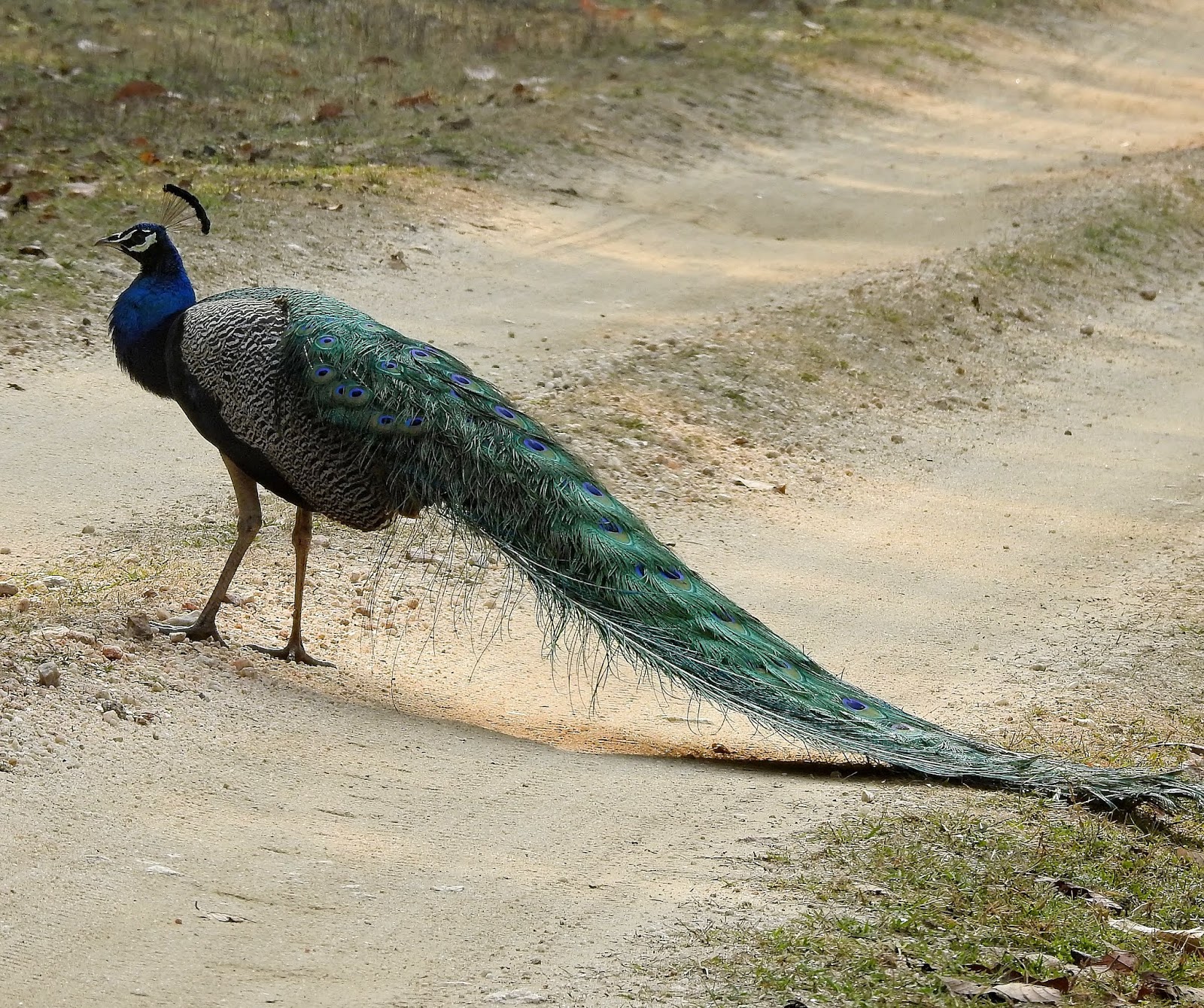
4-3-2020 KANHA NAT PARK, INDIA - INDIAN PEAFOWL (MALE) (Pavo cristatus)
The Indian peafowl is unmistakable within its range. The male has a metallic blue crown, a fan-shaped crest, and a spectacular train with eye-spot markings. The peahen is smaller, with a rufous-brown head, mottled upper body, and dark brown lower parts. The loud "pia-ow" or "may-awe" calls are distinctive and often indicate the presence of predators.
Indian peafowl are ground-dwelling birds that prefer open forest or land under cultivation. They are adaptable and can be found near water sources in both moist and dry-deciduous forests.
4-3-2020 KANHA NAT PARK, INDIA - GREAT EGRET (Ardea alba)
4-3-2020 KANHA NAT PARK, INDIA - RED VENTED BULBUL (Pycnonotus cafer)
Adult Red-vented Bulbuls have a black head, a prominent crest, and a dark brown body with a scaly pattern. The rump is white, and the vent is a vivid red. The Himalayan subspecies exhibit a more pronounced crest and streaking on the underside. The sexes are similar in plumage, but juveniles are generally duller.
This species is typically found in dry scrub, open forest, plains, and cultivated lands. It is not commonly seen in mature forests within its native range.
4-3-2020 KANHA NAT PARK, INDIA - INDIAN GREY HORNBILL (Dicrurus leucophaeus)
4-3-2020 KANHA NAT PARK, INDIA - ASHY DRONGO (Dicrurus leucophaeus)
5-3-2020 KANHA NAT PARK, INDIA - TAWNY COSTER BUTTERFLY (Acraea terpsicore)
5-3-2020 KANHA NAT PARK, INDIA - SCARLET DARTER DRAGONFLY (FEMALE) (Crocothemis erythraea)
The scarlet dragonfly is a common species in southern Europe and throughout Africa. It also occurs across western Asia as far as southern China. It is a very rare vagrant in Britain. Its first record in the country was at Hayle Kimbro Pool, The Lizard, Cornwall, on 7 August 1995. Since then there have been a few further records at scattered locations throughout Britain.
A wide range of both running and standing waters, except those that are shaded. Adults may be found some distance from water in habitats ranging from desert to open woodland; absent from dense forest.
Crocothemis erythraea can reach a length of 33–44 millimetres (1.3–1.7 in). These dragonflies haves a flattened and rather broad abdomen. The adult male scarlet dragonfly has a bright scarlet red, widened abdomen, with small amber patches at the bases of the hindwings. Also the veins on the leading edges of the wings are red. Females and immatures are yellow-brown and have a conspicuous pale stripe along the top of the thorax.
5-3-2020 KANHA NAT PARK, INDIA - PLAIN TIGER BUTTERFLY (Danaus chrysippus)
The plain tiger is believed to be one of the first butterflies depicted in art. A 3,500-year-old ancient Egyptian fresco in Luxor features the oldest known illustration of this species.
D. chrysippus is a medium-sized butterfly with a wingspan of about 7–8 cm (2.8–3.1 in). The body is black with white spots. The wings are a brownish orange, the upper side brighter and richer than the underside. The apical half of the forewing is black with a white band. The hindwing has three black spots in the centre. The wings are bordered in black and outlined with semicircular white spots. This species exhibits slight sexual dimorphism, as the male has large scent glands on his hindwings, which the female lacks. They appear as a large black spot with a white centre if viewed from the underside.
D. chrysippus is a polymorphic species, so the exact colouring and patterning vary within and between populations.
It is similar in appearance to the Indian fritillary (Argynnis hyperbius), which may coexist with it.
The plain tiger is found across the entirety of Africa, where the predominant subspecies is D. c. alcippus. Its range extends across the majority of Asia throughout Indian subcontinent, as well as many south Pacific islands. The plain tiger is even present in parts of Australia. D. c. chrysippus is most common throughout Asia and in some select regions in Africa, while D. c. orientis is present in more tropical African regions as well as some African islands, including Madagascar and the Seychelles.It is also found in Southern Europe and Kuwait. These insects are considered bioinvaders in North America.he plain tiger prefers arid, open areas, and is found in a variety of habitats, including deserts, mountains, deciduous forests, and human-tended gardens in cities and parks. It is comfortable at altitudes ranging from sea level to around 1,500 m (4,900 ft).


%2020.jpg)


%2020.jpg)
%2021.jpg)

%2020.jpg)


%2020.jpg)
%2022.jpg)
%2023.jpg)
%2020.jpg)
%2021.jpg)


%2020.jpg)
%2020.jpg)
%2020.jpg)
%2021.jpg)
%2021.jpg)
%20(Crocothemis%20erythraea)%2020.jpg)


%20(Cuon%20alpinus)%2020.jpg)
%2020.jpg)