TOTAL PAGEVIEWS

TRANSLATE

Thursday, 26 March 2020

4-3-2020 KANHA NAT PARK, INDIA - CHOCOLATE PANSY BUTTERFLY


Junonia iphita, the chocolate pansy or chocolate soldier, is a butterfly found in Asia.

The wingspan is about 5–6 cm (2.0–2.4 in) and the female can be told apart from the male by white markings on the oblique line on the underside of the hindwing. The wavy lines on the underside of the wings vary from wet- to dry-season forms.

Individuals maintain a territory and are usually found close to the ground level and often bask in the sun.

Upperside of both sexes brown, of varying depths of colour. Forewing: cell with one pair of subbasal and one pair of apical transverse sinuous fasciae, the outermost defining the discocellulars; a short, broad, dark, oblique fascia beyond to vein 4, its inner margin diffuse, its outer sinuous but sharply defined; below vein 4 a sinuous, transverse, fainter fascia, followed by a discal blackish fascia, very broad and diffuse below costa, bordered by a row of faint ocelli, and a postdiscal and a subterminal similar fascia following the outline of the termen. Hindwing with a slender blackish loop near apex of cellular area; a broad inwardly diffuse, outwardly well-defined short discal fascia in continuation of the one on the forewing; a series of postdiscal somewhat ochraceous ocelli with black pupils minutely centred with white; postdiscal and subterminal broad lines as on the forewing.


Underside brown, with very broad darker brown transverse fasciae; the interspaces between the markings irrorated (sprinkled) with purplish silvery scales. Forewing with two sinuous fasciae on the basal half, succeeded by a discal fascia, very broad at the costal margin and decreasing in width to the dorsum, bearing on its outer border a row of obscure ocelli. This is succeeded by a zigzag dark line, and sinuous subterminal and terminal lines; apex and tornal area suffused with purplish silvery. Hindwing: two irregular, very broad, dark brown, curved short fasciae near base; a straight, transverse, prominent, narrow ochreous-brown discal band defined outwardly by a black line; a transverse postdiscal dark brown fascia, widest in the middle and bearing outwardly a curved row of ochreous-brown white-centred ocelli, followed by a zigzag dark line in continuation of the one on the forewing; a subterminal somewhat diffuse dark fascia and a terminal dark line. Antennae, head, thorax, and abdomen dark brown.

Wednesday, 25 March 2020

4-3-2020 KANHA NAT PARK, INDIA - SKIPPER BUTTERFLY (Tribe Baorini)


Baorini is a widely distributed tribe of skipper butterflies (family Hesperiidae), primarily found in the Old World tropics, extending to the Afrotropical and Oriental regions. Often referred to as "swifts," these diurnal insects are known for their robust bodies, pointed forewings, and rapid darting flight.

Physical Characteristics

Appearance: Typically small to medium-sized (8–35 mm) with dark brown wings, often marked with translucent white (hyaline) spots.

Anatomy: They possess stout bodies supported by strong thoracic musculature, clubbed antennae tipped with a narrow, hooked apiculus, and a well-developed proboscis for nectar feeding.

Sexual Dimorphism: Males frequently feature unique sexual markings, such as a discal stigma on the upperside of the forewings or paintbrush-like structures.

4-3-2020 KANHA NAT PARK, INDIA - SKIMMER DRAGONFLY (Neurothemis intermedia ssp. atalanta)


25-3-2020 MONTE CORONA, VALENCIA - GREAT TIT (Parus major)


3-3-2020 KANHA NAT PARK, INDIA - INDIAN SPOTTED DOVE (Streptopelia chinensis ssp. suratensis)


The Spotted dove (Spilopelia chinensis) is a small pigeon that is a common across its native range on the Indian subcontinent and in Southeast Asia. These birds are also called the Mountain dove, Pearl-necked dove, Lace-necked dove, and Spotted turtle-dove.

The ground color of this long and slim dove is rosy buff below shading into grey on the head and belly. There is a half collar on the back and sides of the neck made of black feathers that bifurcate and have white spots at the two tips. The median coverts have brown feathers tipped with rufous spots in the Indian and Sri Lankan subspecies which are divided at the tip by a widening grey shaft streak. The wing feathers are dark brown with grey edges. The center of the abdomen and vent are white. The outer tail feathers are tipped in white and become visible when the bird takes off. The male and the female are similar, but juveniles are duller than adults and do not acquire the neck spots until they are mature.

2-3-2020 KANHA, INDIA - YELLOW FOOTED GREEN PIGEON (Treron phoenicopterus)


The yellow-footed green pigeon (Treron phoenicopterus), also known as yellow-legged green pigeon, is a common species of green pigeon found in the Indian subcontinent and parts of Southeast Asia. It is the state bird of Maharashtra. In Marathi, it is called Haroli or Hariyal. It is known as Haitha in Upper Assam and Haitol in Lower Assam. The species feeds on fruit, including many species of Ficus. They forage in flocks. They are habitat generalists: in the early morning, they are often seen sunning on the tops of emergent trees in dense forest areas, especially Banyan trees, but they have also been spotted in natural remnants in urban areas. Their population is currently increasing.

2-3-2020 KANHA, INDIA - DRIVER ANT (Genus Dorylus)


3-3-2020 KANHA, INDIA - COMMON HAWK CUCKOO (Hierococcyx varius)


The common hawk-cuckoo, known colloquially as the brainfever bird, is a medium-sized cuckoo roughly the size of a pigeon, measuring approximately 34 cm in length. Its plumage is a muted ashy grey on top, with a paler underside marked by brown cross-bars. The tail is conspicuously barred. Both sexes exhibit a distinctive yellow eye ring, and while they appear similar, males are generally larger.

Upon first glance, one might easily mistake the common hawk-cuckoo for a hawk due to its striking resemblance to the Shikra, particularly in flight behavior and landing. Subadults display streaked breasts akin to immature Shikras and bear large brown chevron marks on their bellies. The large hawk-cuckoo could be confused with this species, but it can be distinguished by dark streaks on its throat and breast, and young large hawk-cuckoos have a black chin, as opposed to the pale chin of the common hawk-cuckoo's young.

The common hawk-cuckoo favors arboreal habitats, seldom descending to the ground. It thrives in gardens, tree groves, and both deciduous and semi-evergreen forests.


This species is widespread across the Indian subcontinent, from Pakistan to the Himalayan foothills, and extends eastward to Nepal, Bhutan, Bangladesh, and Northeast India, reaching south into Sri Lanka. Some Indian populations migrate to Sri Lanka in the winter, while the subspecies in central Sri Lanka's hills is resident.

The common hawk-cuckoo is a brood parasite, laying its eggs in the nests of babblers, particularly those in the genus Turdoides. The breeding season aligns with that of its host species, from March to June. The hatchling often evicts the host's eggs and is raised by the foster parents, following them for nearly a month.

The male's call is a loud, repetitive three-note sound, reminiscent of the phrase "brain-fever," with the second note being longer and higher pitched. These calls, which can continue throughout the day and into moonlit nights, rise to a crescendo before ending abruptly. The female's call consists of a series of grating notes.


During the breeding season, the common hawk-cuckoo lays a single blue egg, mimicking the appearance of the host's eggs. The chick may evict the host's eggs and is reared to maturity by the foster parents.

The common hawk-cuckoo primarily feeds on insects, specializing in hairy caterpillars. It has developed a method to remove the caterpillar's guts, which often contain toxins, by pressing and rubbing the caterpillar on a branch before consumption. The ingested hairs are later regurgitated as a pellet.

The IUCN Red List has classified the common hawk-cuckoo as Least Concern, indicating that it currently faces no significant threat of extinction.

2-3-2020 KANHA NAT PARK, INDIA - CHITAL (SPOTTED DEER) (Axis axis)


2-3-2020 KANHA NAT PARK, INDIA - CHITAL (SPOTTED DEER) (JUVENILE) (Axis axis)


2-3-2020 KANHA NAT PARK, INDIA - PUFF THROATED BABBLER (Pellorneum ruficeps)


The puff-throated babbler or spotted babbler (Pellorneum ruficeps ) is a species of passerine bird found in Asia. They are found in scrub and moist forest mainly in hilly regions. They forage in small groups on the forest floor, turning around leaf litter to find their prey and usually staying low in the undergrowth where they can be hard to spot. However, they have loud and distinct calls, including a morning song, contact and alarm calls. It is the type species of the genus Pellorneum which may, however, currently include multiple lineages.

Puff-throated babblers are brown above, and white below with heavily brown streaks towards the breast and belly. They have a chestnut crown, long buff supercilium and dusky cheeks. The throat is white, and is sometimes puffed out giving it the English name. Puff-throated babblers have strong legs, and spend a lot of time on the forest floor. They can often be seen creeping through undergrowth in search of their insect food, looking at first glance like a song thrush. Some subspecies have streaks on the mantle while others, especially in Peninsular India, are unstreaked.


The widespread distribution with population variations has led to nearly thirty subspecies being described. The nominate population is found in peninsular India (excluding the Western Ghats). The population in the northern Eastern Ghats is paler and has been called pallidum while a well-marked dark form occurs in the southern Western Ghats, which has been named granti (includes olivaceum ). The western Himalayas population is punctatum (includes jonesi ) and in the east is mandellii, which has streaking on the back and nape as well as having call differences.

In the east of India, south of the Brahmaputra River occurs chamelum while ripley is found in a small region in eastern Assam (Margherita). Further east in Manipur is vocale and pectorale in Arunachal Pradesh and northern Burma with stageri further south, followed by hilarum, victoriae and minus. Further east are found shanense, subochraceum, insularum, indistinctum, chtonium, elbeli, acrum, oreum, dusiti, vividum, ubonense, euroum, deignani, dilloni and smithi. Several others have been described and many populations are difficult to assign to subspecies. This is the type species for the genus Pellorneum and its generic placement is assured, although other species currently included in the genus may be reassigned.

2-3-2020 KANHA NAT PARK, INDIA - LARGE CUCKOOSHRIKE (Coracina macei)


The Large Cuckooshrike (Coracina macei), also known as the Indian Cuckooshrike, is a large, stocky, slate-grey passerine bird of the Indian subcontinent and Southeast Asia. Favoring open woodlands and hill forests, it is easily recognized by its heavy hooked bill, black face mask, white-tipped tail, and habit of flicking its wings upon landing.

Quick biological and behavioral facts:

Size & Identification: Measuring 23 to 30 cm in length, males feature a darker grey plumage with an extensive black facial mask. Females are paler, lack the solid face mask, and possess fine grey barring on their underparts.Diet: Largely insectivorous, they hunt by perching high atop the forest canopy and scanning for insects. They also supplement their diet with figs and forest fruits.


Behavior: Usually seen in pairs or small family groups, they travel with a distinct, undulating (bounding) flight just above the canopy. A hallmark behavioral trait is the "wing-shrug"—a quick flicking of their closed wings shortly after landing.

Vocalizations: They are highly vocal, with a characteristic loud, nasal, two-noted "klu-eep" or "gii-yaak" call.

Breeding: They nest during the drier winter months, constructing a shallow saucer of twigs and grass in a horizontal tree fork, heavily decorated on the outside with cobwebs.

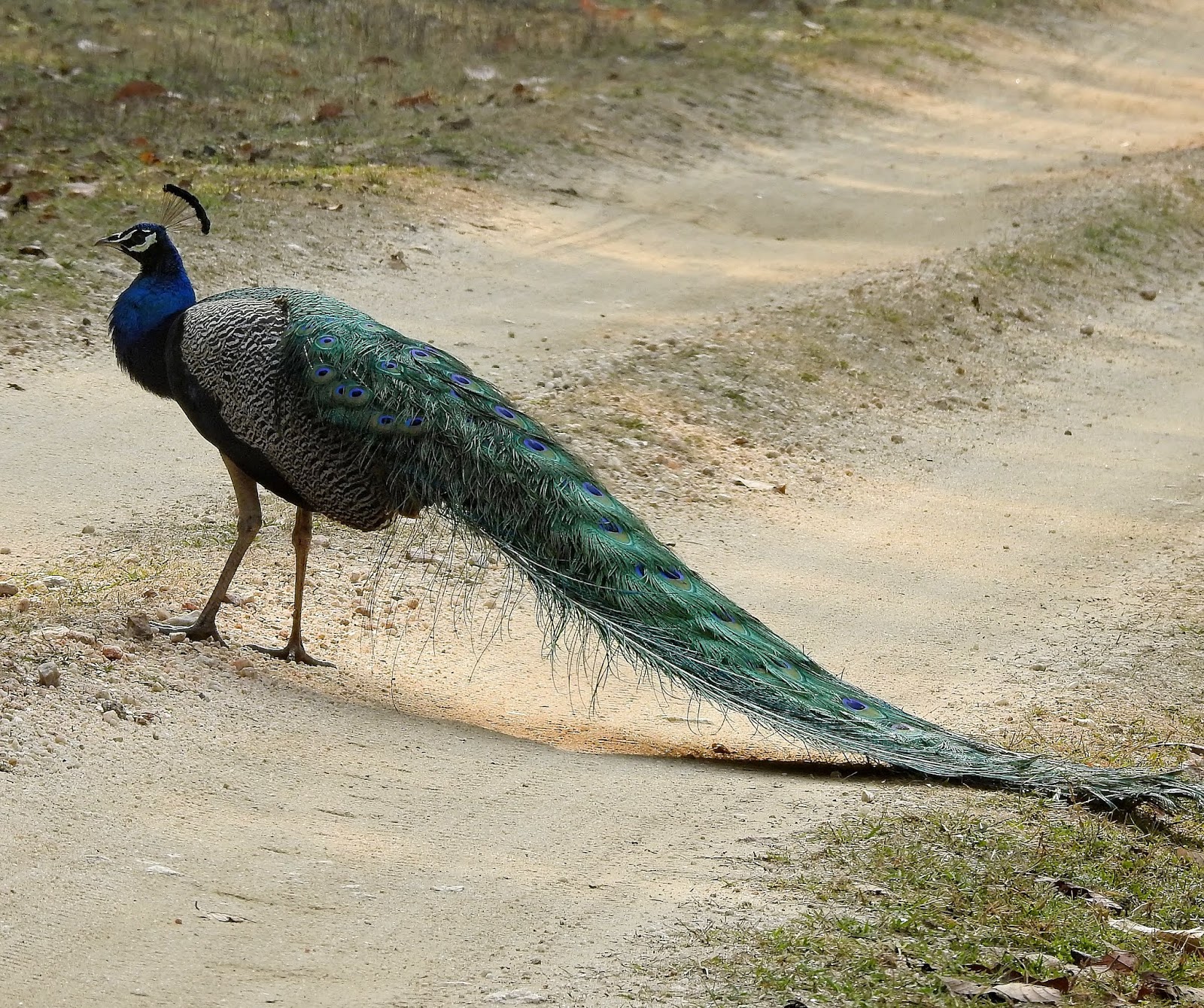
2-3-2020 KANHA NAT PARK, INDIA - INDIAN PEAFOWL (Pavo cristatus)


The Indian peafowl, also known as the common peafowl or blue peafowl, is a species native to the Indian subcontinent. It is a bird of resplendent beauty, with the male, or peacock, showcasing a spectacular array of iridescent colors. The peacock's most striking feature is its fan-like crest of spatula-tipped wire-like feathers and the long train made up of elongated upper-tail covert feathers adorned with colorful eyespots. These feathers can be raised into a fan and quivered during courtship displays. Despite their size, peacocks are capable of flight. The female, or peahen, is more subdued in coloration, with a white face, iridescent green lower neck, and overall dull brown plumage.


The Indian peafowl is unmistakable within its range. The male has a metallic blue crown, a fan-shaped crest, and a spectacular train with eye-spot markings. The peahen is smaller, with a rufous-brown head, mottled upper body, and dark brown lower parts. The loud "pia-ow" or "may-awe" calls are distinctive and often indicate the presence of predators.


Indian peafowl are ground-dwelling birds that prefer open forest or land under cultivation. They are adaptable and can be found near water sources in both moist and dry-deciduous forests.

Indian peafowl display a marked form of sexual dimorphism. The peacock is brightly coloured, with a predominantly blue fan-like crest of spatula-tipped wire-like feathers and is best known for the long train made up of elongated upper-tail covert feathers which bear colourful eyespots. These stiff feathers are raised into a fan and quivered in a display during courtship. Despite the length and size of these covert feathers, peacocks are still capable of flight. Peahens lack the train, have a white face and iridescent green lower neck, and dull brown plumage. 


The Indian peafowl lives mainly on the ground in open forest or on land under cultivation where they forage for berries, grains but also prey on snakes, lizards, and small rodents. Their loud calls make them easy to detect, and in forest areas often indicate the presence of a predator such as a tiger. They forage on the ground in small groups and usually try to escape on foot through undergrowth and avoid flying, though they fly into tall trees to roost.


The function of the peacock's elaborate train has been debated for over a century. In the 19th century, Charles Darwin found it a puzzle, hard to explain through ordinary natural selection. His later explanation, sexual selection, is widely but not universally accepted. In the 20th century, Amotz Zahavi argued that the train was a handicap, and that males were honestly signalling their fitness in proportion to the splendour of their trains. Despite extensive study, opinions remain divided on the mechanisms involved.

The bird is celebrated in Hindu and Greek mythology, and is the national bird of India. The Indian peafowl is listed as of Least Concern on the IUCN Red List.

2-3-2020 KANHA NAT PARK, INDIA - GREEN BEE-EATER (Merops orientalis)


2-3-2020 KANHA NAT PARK, INDIA - ARBOREAL BI-COLOURED SLENDER ANT (Tetraponera rufonigra)


Tetraponera rufonigra, is a species of ant belonging to the subfamily Pseudomyrmecinae. It is distributed across Southeast Asia Commonly called the bi-coloured arboreal ant, they are arboreal and build small nests which are excavated holes usually in dried parts of trees. They are active hunters and hunt small insects. They have a well developed sting and when stung can cause allergic reactions in human beings.

The ant is known as "Hath polayaa" in Sinhala.

4-3-2020 KANHA NAT PARK - INDIAN POND HERON (Ardeola grayii)


4-3-2020 KANHA NAT PARK, INDIA - INDIAN BOAR (Sus scrofa ssp. cristatus)


The Indian boar (Sus scrofa cristatus), also known as the Moupin pig, is a subspecies of wild boar native to India, Pakistan, Nepal, Myanmar, western Thailand, Bangladesh and Sri Lanka.

The Indian boar differs from the Central European Boar by its large mane which runs in a crest along its back from its head to lower body, larger, more sharply featured and straighter skull, its smaller, sharper ears and overall lighter build. It is slightly taller and more sparsely haired than the European form, though its back bristles are much more developed. The tail is also more tufted, and the cheeks hairier. Adults measure from 84 to 91 cm (33 to 36 in) in shoulder height (with one specimen in West Bengal having reached 97 cm (38 in)) and 152 cm (5 ft) in body length. Weight ranges from 91 to 136 kg (200 to 300 lb).

4-3-2020 KANHA NAT PARK, INDIA - WHITE THROATED KINGFISHER (Halcyon smyrnensis)


4-3-2020 KANHA NAT PARK, INDIA - BENGAL SACRED LANGUR MONKEY (Semnopithecus entellus)


The northern plains gray langur (Semnopithecus entellus), also known as the sacred langur, Bengal sacred langur and Hanuman langur, is a species of primate in the family Cercopithecidae.

The northern plains gray langur belongs to the genus Semnopithecus along with the other Indian langurs. The southern plains gray langur was once classified as a subspecies of S. entellus, i.e., S. entellus dussumieri and later regarded as a separate species, i.e., S. dussumieri, but is now regarded as an invalid taxon. Most of the specimens that had been regarded as Semnopithecus dussumieri fall within the revised range of Semnopithecus entellus.

The fur of adults is mostly light colored, with darker fur on the back and limbs, and the face, ears, hands and feet are all black. Infants are brown. Body size excluding tail ranges from 45.1 cm (17.8 in) to 78.4 cm (30.9 in) long, and the tail length is between 80.3 cm (31.6 in) and 111.8 cm (44.0 in). Adult males weigh between 16.9 kg (37 lb) and 19.5 kg (43 lb) while adult females weigh between 9.5 kg (21 lb) and 16.1 kg (35 lb).


The range of the northern plains gray langur covers a large portion of India south of the Himalayas south to the Tapti River and the Krishna River. They have also been reported from Tharparkar in Pakistan. It is thought to have been introduced to western Bangladesh by Hindu pilgrims on the bank of the Jalangi River.

The northern plains gray langur is diurnal, and is both terrestrial and arboreal. Its natural habitats are subtropical or tropical dry forests and subtropical or tropical dry shrubland. Females groom members of both sexes but males do not groom others.

The northern plains gray langur can live in several different types of groups. It can live in groups of multiple males and females, one male and multiple females or multiple males with no females, and males can also live alone without a group. Single male groups are most common. Group size can exceed 100 monkeys. Upon reaching maturity, males typically emigrate from their natal group while females typically remain. Young adult females are typically dominant over older females. When a new male takes over a group it may engage in infanticide of young fathered by the previous male or males, but this is less common when the takeover occurs slowly over several months.


The northern plains gray langur eats primarily fruits and leaves. It is able to survive on mature leaves, which is a key to its ability to survive throughout the dry season. It also eats seeds, flowers, buds, bark and insects, including caterpillars. It is also fed fruits and vegetables by humans, and some groups get a substantial portion of their diets from food provided by temples and from raiding crops.

Groups that have access to abundant food year-round, for example those that are provisioned by temples or are able to raid crops year-round, also breed throughout the year. Other groups, such as those living in forests, typically give birth between December and May. The gestation period is about 200 days. Females other than the mother alloparent the infant for the first month of its life. Weaning occurs at about 1 year and males reach maturity at about 6 to 7 year old.

The northern plains gray langur often associates with chital deer. Both species respond to each other's alarm calls. The chital seem to benefit from the vigilance of male langurs watching for predators in the trees, while the langurs seem to benefit from the chital's better senses of smell and hearing. It also has been observed engaging in grooming sessions with rhesus macaques.

3-3-2020 KANHA NAT PARK, INDIA - JUNGLE BABBLER (Turdoides striata)


The Jungle Babbler (Argya striata) is a bird of the Leiothrichidae family, native to the Indian subcontinent. It is a robust, non-migratory species with a general drab brownish-grey plumage and a distinctive yellow bill. Both sexes appear similar, and the bird is often seen in groups, which has led to its colloquial name "Seven Sisters" or "Seven Brothers" in various regional languages.

To identify the Jungle Babbler, look for its brownish-grey coloration, with the upper parts being slightly darker. The throat and breast may show some mottling. The yellow bill is a key distinguishing feature. The subspecies T. s. somervillei has a rufous tail and dark primary flight feathers. The Jungle Babbler can be differentiated from the White-headed Babbler by its dark loreal zone and the absence of a contrasting light crown. Its nasal calls are also distinct from the high-pitched calls of the White-headed Babbler.

The Jungle Babbler is commonly found in forests and areas of cultivation. It adapts well to urban environments and can be frequently observed in gardens within large cities.

This species is widespread across the Indian subcontinent, with several subspecies occupying geographically isolated regions. It ranges from the northern parts of India, extending to Himachal Pradesh, Uttar Pradesh, Bhutan, Assam, Odisha, and northeastern Andhra Pradesh.


Jungle Babblers are highly social and gregarious, often found in flocks of seven to ten birds or more. They are known for their noisy demeanor, characterized by harsh mewing calls, chattering, squeaking, and chirping. They exhibit territorial behavior, defending their area against neighboring groups. These birds also display sentinel behavior while foraging and are known to mob predators such as snakes.

The Jungle Babbler's calls are harsh and nasal, a cacophony that often betrays the presence of a flock.

Breeding occurs throughout the year, with peaks observed between March–April and July–September in northern India. The nest is built within dense foliage, and the clutch typically consists of three to four deep greenish-blue eggs. The species is known to be parasitized by the Pied Crested Cuckoo and sometimes by the Common Hawk-Cuckoo.

The diet of the Jungle Babbler includes insects, grains, nectar, and berries. They play a significant role in the ecosystem by controlling insect populations.

4-3-2020 KANHA NAT PARK, INDIA - INDIAN SCOPS OWL (Otus bakkamoena)


Tuesday, 24 March 2020

4-3-2020 KANHA NAT PARK, INDIA - RUSSET PERCHER DRAGONFLY (Neurothemis fulvia)


4-3-2020 KANHA NAT PARK, INDIA - RHESUS MACAQUE (Macaca mulatta)


The Rhesus macaque (Macaca mulatta) is a species of Old World monkey. It lives both in trees and on the ground. It mainly eats fruit, but will also include 100 different plant species in its diet. It spends most of its day feeding and resting, the rest is occupied with traveling, grooming, and playing.

Rhesus macaques are either pale brown or gray, usually with pink faces. Their tails are quite long, they have a rib cage that is wider than average, with dorsal scapulae, and they have thirty-two teeth. They are charismatic monkeys and like to have fun and can be cheeky. Their coats have faded undertones on the underside. Their faces are furless and in adults - bright red, and adults also have bright red rumps. They have large cheek pouches for storing food while out foraging.

Rhesus macaques are native to India, Bangladesh, Pakistan, Nepal, Myanmar, Thailand, Afghanistan, Vietnam, southern China, and some neighboring areas. They have the widest geographic ranges of any non-human primate, occupying a great diversity of altitudes throughout Central, South, and Southeast Asia. Rhesus macaques may be found in forests, mangroves, scrub, grasslands, and mountainous regions. They also adapt well to human presence and form larger troops in human-dominated landscapes than in forests.


Rhesus macaques are social, diurnal, and both terrestrial and arboreal animals. They walk using four limbs, walking on the ground on both their toes and on the soles of their feet. They are very active and loud. They like being in the water and can swim well. They form groups of as many as 200 individuals, and when the size of a group reaches 80 to 100, a subgroup of females can split off to create a new group. Generally, groups are made up of several unrelated males, with many closely related females. Males and females within a group demonstrate a preference for high-ranking individuals of the opposite sex. Rhesus monkeys are not territorial. Every group of individuals generally has its own sleeping area. Confrontations between different groups are rare. When groups meet, usually the weaker group avoids the stronger one.