TOTAL PAGEVIEWS

TRANSLATE

Monday, 8 November 2021

3-11-2021 BIOPARC, VALENCIA - EUROPEAN MOORHEN (Gallinula chloropus)


The common moorhen, known scientifically as Gallinula chloropus, is a bird of the rail family, Rallidae. It is a bird of striking appearance, with a mix of black and brown plumage, a white under-tail, and white streaks along its flanks. Its legs are a vibrant yellow, and it sports a distinctive red frontal shield. The bill is a matching red with a yellow tip. Juveniles are a duller brown and do not have the red shield.

Adult moorhens can be identified by their red frontal shield, which has a rounded top and fairly parallel sides. The tailward margin of the red unfeathered area is smoothly curved. Their yellow legs and the combination of their black and brown plumage with white markings make them quite distinctive. The young are browner and lack the red shield, making them less conspicuous.

The common moorhen is found in a variety of wetland habitats, including marshes, ponds, canals, and lakes that are rich in vegetation. It is also known to inhabit city parks with suitable water bodies.

This species has a broad distribution across many parts of the Old World. It is not found in polar regions or many tropical rainforests but is otherwise widespread, often being the most common rail species in its range.


24-10-2021 ATTICA ZOO ATHENS, GREECE - KRI-KRI (Capra hircus ssp. cretica)


24-10-2021 ATTICA ZOO ATHENS, GREECE - AFRICAN PENGUIN (Spheniscus demersus)


5-11-2021 MONTE CORONA, VALENCIA - GEOMETER MOTH (Compsoptera opacaria)


8-11-2021 MARXUQUERA, VALENCIA - CATALONIA WALL LIZARD (Podarcis liolepis)


Podarcis liolepis, the Columbretes wall lizard or Catalan wall lizard, is very similar to the other lizards in the genus Podarcis. This species was formerly described as a subspecies of the Iberian wall lizard, but has now been elevated to species status. These are slender lizards with long tails, narrow tapered heads and long thin toes, and stout legs. Colours are variable, although generally grey-brown. Often very subtle spots and stripes along the back and flanks can be seen and these can be more distinguished in the female. The underside is a much lighter cream or beige with sometimes a reddish tint. Adults grow 15–20 cm in length from the nose to tip of the tail. Body length can be a little as one third of the total body length, the tail making up the other two thirds.


Physical characteristics Size: Adults grow to about \(15-20\) cm long, with the tail making up two-thirds of the total length.Body shape: They are slender with a long tail, a narrow head, and long, thin toes.Color: Dorsal colors are typically grey-brown with varied patterns. Females tend to have more prominent longitudinal stripes, while males are often smaller. Some individuals also have ventral color variations, including yellow, orange/red, and white morphs. 

Habitat and behavior Habitat: The species is adaptable and can be found in various environments, including rocky areas, shrubby vegetation, and even human settlements.Distribution: Its range extends from the Rhône Valley in France to the Sierra Nevada in Spain.

Activity: They are diurnal and active, often seen basking, foraging, and hiding in vegetation.Diet: They feed on small invertebrates and sometimes fruit.Reproduction: As an oviparous (egg-laying) species, females lay an average of 2.80 eggs per clutch in continental populations. 

8-11-2021 MARXUQUERA, VALENCIA - RED ADMIRAL BUTTERFLY (Vanessa atalanta)


Sunday, 7 November 2021

3-11-2021 BIOPARC, VALENCIA - DAMA GAZELLE (Nanger dama)


The dama gazelle (Nanger dama), also known as the addra gazelle or mhorr gazelle, is a species of gazelle. It lives in Africa, in the Sahara desert and the Sahel. A critically endangered species, it has disappeared from most of its former range due to overhunting and habitat loss, and natural populations only remain in Chad, Mali, and Niger. Its habitat includes grassland, shrubland, semi-deserts, open savanna and mountain plateaus. Its diet includes shrubs, herbs, grasses, leaves (especially Acacia leaves), shoots, and fruit.

In Niger, the dama gazelle has become a national symbol. Under the Hausa name meyna or ménas, the dama gazelle appears on the badge of the Niger national football team, who are popularly called the Ménas.

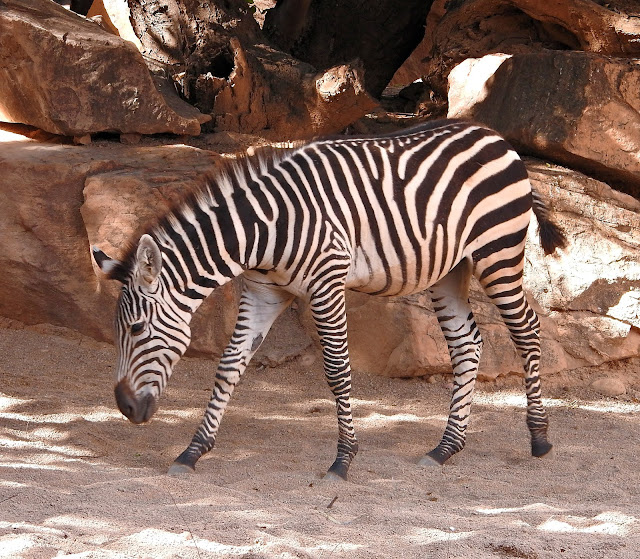
3-11-2021 BIOPARC, VALENCIA - GRANT'S ZEBRA (Equus quagga ssp. boehmi)


Grant's zebra (Equus quagga boehmi ) is the smallest of the seven subspecies of the plains zebra. This subspecies represents the zebra form of the Serengeti-Mara ecosystem.

This northern subspecies is vertically striped in front, horizontally on the back legs, and diagonally on the rump and hind flanks. Shadow stripes are absent or only poorly expressed. The stripes, as well as the inner spaces, are broad and well defined. Northerly specimens may lack a mane. Grant’s zebras grow to be about 182 to 243 cm (6-8 ft) long and 120 to 140 cm (3.9 to 4.6 ft) tall, and generally weigh about 300 kg (660 lb). The zebras live in family groups of up to 18 zebras, and they are led by a single stallion. Grant’s zebras typically live 20 years.


The distribution of this subspecies is in Zambia west of the Luangwa river and west to Kariba, Katanga Province of the Democratic Republic of the Congo, north to the Kibanzao Plateau, and in Tanzania north from Nyangaui and Kibwezi into southwestern Kenya as far as Sotik. It can also be found in eastern Kenya and east of the Great Rift Valley into southernmost Ethiopia. It also occurs as far as the Juba River in Somalia.

Zambia is an ideal place for zebras. These animals prefer living in savanna woodlands and grasslands; they are not found in deserts, wetlands, or rainforests. The mountain variety lives in rocky mountainous areas. Unfortunately, the availability of habitat for all species of zebras is shrinking, resulting in population decline.


Duncan (1992) recognized the Upper Zambezi zebra (Equus quagga zambeziensis Prazak, 1898[2]). Groves and Bell (2004) came to the conclusion that the zebras from West Zambia and Malawi cannot be distinguished cranially and that they differ only slightly from other northern plains zebras. The minor size difference does not justify a separate subspecific status for the Upper Zambezi zebra. Therefore, they combine these zebras with Grant's zebra (Equus quagga boehmi).

3-11-2021 BIOPARC, VALENCIA - WESTERN CATTLE EGRET (Bubulcus ibis ssp. ibis)


The western cattle egret (Bubulcus ibis) is a species of heron (family Ardeidae) found in the tropics, subtropics and warm temperate zones. Most taxonomic authorities lump this species and the eastern cattle egret together (called the cattle egret), but some (including the International Ornithologists' Union) separate them. Despite the similarities in plumage to the egrets of the genus Egretta, it is more closely related to the herons of Ardea. Originally native to parts of Asia, Africa and Europe, it has undergone a rapid expansion in its distribution and successfully colonised much of the rest of the world in the last century.

It is a white bird adorned with buff plumes in the breeding season. It nests in colonies, usually near bodies of water and often with other wading birds. The nest is a platform of sticks in trees or shrubs. Western cattle egrets exploit drier and open habitats more than other heron species. Their feeding habitats include seasonally inundated grasslands, pastures, farmlands, wetlands and rice paddies. They often accompany cattle or other large mammals, catching insect and small vertebrate prey disturbed by these animals. Some populations of the cattle egret are migratory and others show post-breeding dispersal.

3-11-2021 BIOPARC, VALENCIA - SPOTTED HYENA (Crocuta crocuta)


The spotted hyena (Crocuta crocuta), also known as the laughing hyena, is a hyena species, currently classed as the sole extant member of the genus Crocuta, native to sub-Saharan Africa. It is listed as being of least concern by the IUCN due to its widespread range and large numbers estimated between 27,000 and 47,000 individuals. The species is, however, experiencing declines outside of protected areas due to habitat loss and poaching. 

Populations of Crocuta, usually considered a subspecies of Crocuta crocuta, known as cave hyenas, roamed across Eurasia for at least one million years until the end of the Late Pleistocene. The spotted hyena is the largest extant member of the Hyaenidae, and is further physically distinguished from other species by its vaguely bear-like build, rounded ears, less prominent mane, spotted pelt, more dual-purposed dentition, fewer nipples, and pseudo-penis. It is the only placental mammalian species where females have a pseudo-penis and lack an external vaginal opening.

7-11-2021 MONTE CORONA, VALENCIA - SPECKLED WOOD BUTTERFLY (Pararge aegeria)


The average wingspan of both males and females is 5.1 cm (2 in), although males tend to be slightly smaller than females. Furthermore, males possess a row of grayish-brown scent scales on their forewings that is absent in the females. Females have brighter and more distinct markings than males. The subspecies P. a. tircis is brown with pale yellow or cream spots and darker upperwing eyespots. The subspecies P. a. aegeria has a more orange background and the hindwing underside eyespots are reddish brown rather than black or dark gray. The two forms gradually intergrade into each other.


Subspecies P. a. oblita is a darker brown, often approaching black with white rather than cream spots. The underside of its hindwings has a marginal pale purple band and a row of conspicuous white spots. The spots of subspecies P. a. insula are a tawny orange rather than a cream color. The underside of the forewings has patches of pale orange, and the underside of the hindwing has a purple-tinged band. Although there is considerable variation with each subspecies, identification of the different subspecies is manageable.

7-11-2021 MONTE CORONA, VALENCIA - MEDITERRANEAN MANTIS (FEMALE) (Iris oratoria)


Iris oratoria, known by the common name Mediterranean mantis (or less frequently iris mantis), due to humans first studying it in lands around the Mediterranean Sea, is a species of praying mantis. Its range is expanding in the Middle East, Western Asia and the United States.

Albania, Bulgaria, Brač Island, Korčula Island, France (Including Corsica), Greece (Including Ionian Islands, Crete, Cyclades Islands), Italy (Including Sardinia, Sicily), North Macedonia, Portugal, Spain (Including Balearic Islands), Yugoslavia (Including Serbia, Kosovo, Voivodina, Montenegro), North Africa (Morocco, Algeria, Tunisia, Libya, Egypt, North Chad), Cyprus, West, Central and South Asia (Asian Turkey, India, Israel, Iran, Jordan, Lebanon, Pakistan, Palestine, Syria, Turkestan Non-native to the Southwestern United States (Arizona, California, Nevada, Texas.


Two novel I. oratoria survival strategies may have contributed to the expansion of this species beyond its original range, and its success in areas formerly occupied by other mantids such as Stagmomantis carolina. Firstly, this species is capable of parthenogenic reproduction when males are scarce. Secondly, additional I. oratoria nymphs may emerge from their oothecae in the second season after the egg case is produced, i.e., when their siblings are already grown and are producing their own offspring.

The Mediterranean mantis is known for two distinctive behaviours, apart from the ambush hunting common to other mantids: cannibalism and deimatic or threat displays. The sexual cannibalism of mantids known in popular culture occurs in roughly one quarter of all intersexual encounters of I. oratoria.


I. oratoria is very pale when young but matures to grass green, and grows to about 6.5 cm (2.6 in) long. The species may be distinguished from Mantis religiosa and other mantids with which it shares a range and general size and shape by the red-orange spot on the ventral side of the fourth (second to last) abdominal segment; also, its cerci are shorter than those of M. religiosa. The species is distinctive in having two large startling violet-brown eyespots on its hind wings which are revealed when its wings are unfolded. The adult is more slender than Tenodera sinensis, more like Mantis religiosa in shape. Females have wings shorter than the abdomen, very similar to some Stagmomantis species, but easily distinguished if the hindwings are visible.

7-11-2021 EL PALMAR, VALENCIA - HOUSE SPARROW (FEMALE) (Passer domesticus)


7-11-2021 EL PALMAR, VALENCIA - EUROPEAN STONECHAT (MALE) (Saxicola rubicola)


The European stonechat, Saxicola rubicola, is a small, charming passerine bird, once thought to be a member of the thrush family but now placed within the Old World flycatcher family, Muscicapidae. This species exhibits a striking sexual dimorphism, with males donning a black plumage with vibrant orange throats and females wearing a more subdued brown.

Males in their summer plumage are unmistakable with their black heads, orange throats, and white bellies. They also sport a distinctive white half-collar and small white patches on the wings and rump. Females, on the other hand, are predominantly brown with less pronounced white wing patches. Both sexes have notably short wings, which are shorter than those of their migratory relatives.

The European stonechat favors heathlands, coastal dunes, and open grasslands dotted with shrubs, brambles, and heather. These habitats provide the perfect backdrop for their active foraging and breeding behaviors.

This species is widely distributed across Europe, reaching as far east as Ukraine and the South Caucasus, and can also be found in parts of North Africa.

Stonechats are known for their lively presence, often perching conspicuously as they keep a vigilant eye on their surroundings. They exhibit a partial migratory pattern, with some populations moving southward to escape the colder winters.

The male stonechat's song is a delightful, high-pitched twitter, reminiscent of a dunnock's melody. Both sexes communicate with a distinctive call that evokes the sound of two stones being tapped together.

European stonechats are monogamous during the breeding season and commence their reproductive efforts at one year of age. They raise two to three broods per season, with the female constructing the nest and both parents tending to the young.

The European stonechat can be confused with the Siberian stonechat and the African stonechat, but genetic evidence supports their distinction as separate species.

These birds are adept insectivores, gleaning a variety of invertebrates from their environment to sustain themselves and their offspring.

7-11-2021 EL PALMAR, VALENCIA - EUROPEAN STONECHAT (FEMALE) (Saxicola rubicola)


The female European Stonechat (Saxicola rubicola) is a small, perky songbird found across Europe. Unlike the striking, black-headed male, she has a mottled brown head and back with a subtle paler eyebrow and a warm, dull orange-tinged chest. Females are known for their habit of frequently flicking their wings while perched on low bushes or fences.

Physical Appearance & Identification

Size: Approximately 13 to 15 cm in length.

Head & Chest: Features a brown head (lacking the male's stark black hood) and a dull, washed-out orangey breast.

Plumage: Brown back, white patches on the wings and sides of the neck, and a paler rump in flight that contrasts with a solidly blackish tail.

Saturday, 6 November 2021

3-11-2021 BIOPARC, VALENCIA - RED CRESTED POCHARD (FEMALE) (Netta rufina)


The red-crested pochard (Netta rufina) is a large diving duck. The scientific name is derived from Greek Netta "duck", and Latin rufina, "golden-red" (from rufus, "ruddy"). Its breeding habitat is lowland marshes and lakes in southern Europe and it extends from the steppe and semi-desert areas on the Black Sea to Central Asia and Mongolia, wintering in the Indian subcontinent and Africa. It is somewhat migratory, and northern birds winter further south into north Africa.


The adult male is unmistakable. It has a rounded orange head, red bill and black breast. The flanks are white, the back brown, and the tail black. The female is mainly a pale brown, with a darker back and crown and a whitish face. Eclipse males are like females but with red bills. They are gregarious birds, forming large flocks in winter, often mixed with other diving ducks, such as common pochards. They feed mainly by diving or dabbling. They eat aquatic plants, and typically upend for food more than most diving ducks.

3-11-2021 BIOPARC, VALENCIA - RED CRESTED POCHARD (MALE) (Netta rufina)


3-11-2021 BIOPARC, VALENCIA - EGYPTIAN GOOSE (Alopochen aegyptiaca)


The Egyptian goose (Alopochen aegyptiaca) is a member of the duck, goose, and swan family Anatidae. It is native to Africa south of the Sahara and the Nile Valley.

Egyptian geese were considered sacred by the Ancient Egyptians, and appeared in much of their artwork. Because of their popularity chiefly as an ornamental bird, escapees are common and feral populations have become established in Western Europe, the United States, and New Zealand.


3-11-2021 BIOPARC, VALENCIA - SOUTHERN LION (MALE) (Panthera leo ssp. melanochaita)


The Southern lion (Panthera leo melanochaita) is a subspecies inhabiting Southern and East Africa, often characterized by large males with dark, extensive manes. As Africa's largest cat, they live in social prides, with females acting as primary hunters. They are classified as Vulnerable, facing threats from habitat loss and human conflict.Physical and Biological FactsAppearance: 

They are the largest of Africa's big cats, with males often weighing over 190kg (up to 225kg+ in some regions) and standing over 3 meters from nose to tail.Manes: Southern males often possess large, dark manes, though color varies from blond to black based on age and climate.Adaptability: They are found in diverse habitats, including savanna grasslands, open woodlands, and semi-arid deserts.


The Southern lion is a lion subspecies from Southern and East Africa. In this region, lion populations were referred to by several regional names, including Katanga lion, Transvaal lion, Kalahari lion, Southeast African lion, Southwest African lion, Masai lion, Serengeti lion, Tsavo lion, and Uganda lion. It has also been referred to as 'Eastern-Southern African lion', 'Southern lion', and as 'southern subspecies'.


The fur of Southern lions varies in color from light buff to dark brown. They have rounded ears and a black tail tuft. Mane color varies from sandy, tawny, isabelline, and light reddish yellow to dark brown and black. Mane length varies from short to extending to knee joints and under the belly. Lions without a mane were observed in the Tsavo area. Mane development is related to age: older males have more extensive manes than younger ones; manes continue to grow up to the age of four to five years, long after lions become reproductively mature. 

Males living in the Kenyan highlands develop heavier manes than lions in the more humid and warmer lowlands of eastern and northern Kenya. White lions have occasionally been encountered in and around South Africa's Kruger National Park and the adjacent Timbavati Private Game Reserve. Their whitish fur is a rare morph caused by a double recessive allele. It has normal pigmentation in the eyes and skin. They were removed from the wild in the 1970s, thus decreasing the white lion gene pool. 

Friday, 5 November 2021

3-11-2021 BIOPARC, VALENCIA - VULTURINE GUINEAFOWL (Acryllium Vulturinium)


The vulturine guinea fowl (Acryllium vulturinum) is the largest extant species of guinea fowl. Systematically, it is only distantly related to other guinea fowl genera. Its closest living relative, the white breasted guinea fowl, Agelastes meleagrides inhabit primary forests in Central Africa. It is a member of the bird family Numididae, and is the only member of the genus Acryllium. It is a resident breeder in northeast Africa, from southern Ethiopia and Somalia through Kenya and just into northern Tanzania.

The vulturine guinea fowl is a large (61–71 centimetres (24–28 in)) bird with a round body and small head. It's average weight is between 1kg to 1.6kg and it has longer wings, neck, legs and tail than other guinea fowl. The adult has a bare blue face and black neck, and although all other guinea fowl have unfeathered heads, this species looks particularly like a vulture because of the long bare neck and head.

3-11-2021 BIOPARC, VALENCIA - BLESBOK (Damaliscus pygargus ssp. phillipsi)


5-11-2021 MONTE CORONA, VALENCIA - GERMAN YELLOWJACKET (Vespula germanica)


5-11-2021 MONTE CORONA, VALENCIA - BLACK REDSTART (FEMALE) (Phoenicurus ochruros)


The Black Redstart (Phoenicurus ochruros) is a small, charismatic passerine bird, exhibiting a blend of dark and vibrant plumage. Males are distinguished by their dark grey to black upperparts and breast, with a striking orange-red rump and tail. Females and juveniles are more subdued in color, with grey to grey-brown feathers and the same vivid tail coloration that is the hallmark of the species.

Adult males are easily identified by their dark upperparts and black breast, contrasting with the orange-red lower rump and tail. The belly and undertail may vary from blackish-grey to orange-red, depending on the subspecies. Females and juveniles are less conspicuous, with overall greyer tones and a distinctive orange-red rump and tail. The presence of pale fringes on the secondaries forms a whitish wing panel in some subspecies.

The Black Redstart has adapted remarkably to urban environments, often found nesting in crevices or holes within buildings. Originally a dweller of stony mountainous regions, it now thrives in industrial areas with similar structural features.

This species is widely distributed across south and central Europe, Asia, and north-west Africa. It is a resident in milder regions, while populations in the northeast migrate to warmer areas during winter.

5-11-2021 MONTE CORONA, VALENCIA - WHITE WAGTAIL (Motacilla alba)


The White Wagtail (Motacilla alba) is a small, elegant passerine bird, a member of the family Motacillidae, which includes pipits and longclaws. This slender bird measures between 16.5 to 19 cm in length, with East Asian subspecies reaching up to 21 cm. It is characterized by its long, constantly wagging tail, a behavior that has become synonymous with the genus. Weighing an average of 25 g, the White Wagtail can live up to 12 years in the wild.

Adult White Wagtails exhibit a distinctive plumage with a combination of grey, black, and white. The bird's upper parts are generally grey, with a white face, belly, and breast. Males during the breeding season may show a darker back, and the species is known for its sharp, brisk call and more melodious song during courtship.

The White Wagtail is commonly found in open country, often in close proximity to human habitation and water sources. It shows a preference for bare areas which facilitate the sighting and pursuit of prey. This bird has adapted well to urban environments, utilizing paved areas such as parking lots for foraging.


This species has a vast breeding range across Europe, the Asian Palearctic, parts of North Africa, and has a presence in Alaska. It is a migratory bird, with populations moving to Africa and parts of Asia during the winter. In Great Britain and Ireland, the darker subspecies known as the Pied Wagtail is more prevalent.

The White Wagtail is known for its perpetual tail wagging, a behavior that remains somewhat enigmatic but is thought to be a signal of vigilance to predators. It is a monogamous bird that defends its breeding territory with determination.

The call of the White Wagtail is a sharp "chisick," softer than that of the Pied Wagtail. Its song is more structured and is used by males to attract females rather than to mark territory.