The Blog has Wildlife, Plant and Bird Photos from Walks, Safaris, Birding Trips, Webcams and Vacations. The pictures have been taken with Nikon P900 and P950X cameras. Click on any image for a larger picture. On the right column under Blog Archive are the entries by date. Below under Animal categories all the different species of Animals, Birds, Insects and Plants in the website are listed. Clicking on any entry will show all the entries for that species. Info by Wikipedia.
TOTAL PAGEVIEWS
TRANSLATE
Tuesday, 16 November 2021
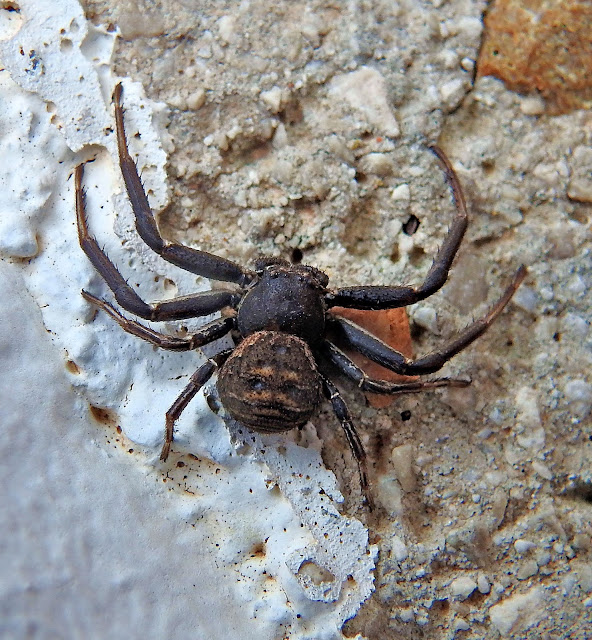
16-11-2021 MONTE CORONA, VALENCIA - CRAB SPIDER (Genus Bassaniodes)
16-11-2021 MONTE CORONA, VALENCIA - SPECKLED WOOD BUTTERFLY (Pararge aegeria)
15-11-2021 MONTE CORONA, VALENCIA - HOARY FOOTMAN MOTH (Eilema caniola)
This species can be found in North Africa, in western and southern Europe, in eastern Europe up to south-western Russia, in the Near East, in the eastern Palearctic realm, and in the Oriental realm. These thermophilic moths usually occur in urban areas and as a caterpillar on old walls, roofs, shingle beaches, and rocky areas.
The wingspan is 28–35 mm. It is almost the same in colouring as Eilema griseola and Eilema lurideola but the forewings are much smaller, the outer margin is oblique, only slightly excurved; the colour is much lighter, more yellowish grey, so that the pale yellow costal stripe is less prominent. Hindwings are very pale, scarcely darker at the costal margin, with the apex much more pointed than in the two species mentioned, with which it might be confounded.
Monday, 15 November 2021
15-11-2021 MONTE CORONA, VALENCIA - CUTWORM MOTH (Cerastis faceta)
15-11-2021 LORCA, VALENCIA - EUROPEAN MANTIS (MALE) (Mantis religiosa ssp. religiosa)
15-11-2021 LORCA, VALENCIA - STUBBLE ROSEGILL (Volvopluteus gloiocephalus)
15-11-2021 LORCA, VALENCIA - DOTTED STALKED SUILLUS (Suillus granulatus)
Suillus granulatus is a species of fungus in the genus Suillus. It has been commonly known as the weeping bolete or the granulated bolete. It is a pored mushroom similar to S. luteus, but can be distinguished by its ringless stalk.
15-11-2021 MONTE CORONA, VALENCIA - SHIELDBACK KATYDID (Thyreonotus corsicus)
Shieldbacks have a substantial pronotum that looks like a shield.
They look like tiny armored tanks – rounded, plump, sturdy - but they are not as invulnerable as they appear and can be seriously injured if dropped. It might be a good idea to leave them where you find them (should you be fortunate enough to locate one) and simply watch what they do - including catching and eating other insects. I observed a Protean Shieldback about to grab and eat a male Japanese beetle that was in the process of mating!
Their song is an electrical buzzing reminiscent of a humming wire. Although non-native, they mature earlier than our native meadow katydids and don’t seem to be a problem. Listen for them in grassy meadows from later June into July.
15-11-2021 MONTE CORONA, VALENCIA - TOAD CRAB SPIDER (Bassaniodes bufo)
This species is found in the Mediterranean.
Sunday, 14 November 2021
14-11-2021 LA FONT EN CARROS, VALENCIA - EUROPEAN GOLDFINCH (Carduelis carduelis)
14-11-2021 LA FONT EN CARROS, VALENCIA - BLACK REDSTART (FEMALE) (Phoenicurus ochruros)
Adult males are easily identified by their dark upperparts and black breast, contrasting with the orange-red lower rump and tail. The belly and undertail may vary from blackish-grey to orange-red, depending on the subspecies. Females and juveniles are less conspicuous, with overall greyer tones and a distinctive orange-red rump and tail. The presence of pale fringes on the secondaries forms a whitish wing panel in some subspecies.
The Black Redstart has adapted remarkably to urban environments, often found nesting in crevices or holes within buildings. Originally a dweller of stony mountainous regions, it now thrives in industrial areas with similar structural features.
This species is widely distributed across south and central Europe, Asia, and north-west Africa. It is a resident in milder regions, while populations in the northeast migrate to warmer areas during winter.
The Black Redstart's vocal repertoire includes a variety of calls, which differ among subspecies. The male's song is a rattling melody, while its call is a sharp 'tick', often heard during its active foraging.
Typically monogamous, the Black Redstart begins breeding in mid-April. Nests are built by females in sheltered nooks, lined with soft materials. Clutches consist of 4 to 6 eggs, incubated primarily by the female. Both parents tend to the fledglings, which leave the nest after 12 to 19 days.
The Common Redstart shares some similarities but can be distinguished by its different behavior, ecological requirements, and less dark plumage.
The Black Redstart's diet includes insects, which it often catches mid-flight. It is also known to forage in coastal areas for tiny crustaceans and flies.
The IUCN Red List classifies the Black Redstart as Least Concern, indicating a stable population across its extensive range.
14-11-2021 GANDIA, VALENCIA - EURASIAN COLLARED DOVE (Streptopelia decaocto)
The Eurasian collared dove, also known as the collared dove or Turkish dove (Streptopelia decaocto), is a bird of modest size, presenting a grey-buff to pinkish-grey plumage that is slightly darker above than below. It is recognized by its distinctive black half-collar edged with white on its nape, from which it derives its name. The species exhibits a blue-grey underwing patch and a tail that is grey-buff above, with dark grey and white-tipped feathers below. The sexes appear similar, with juveniles displaying a less developed collar and a brown iris.
To identify the Eurasian collared dove, look for its medium size, slimmer and longer-tailed body compared to a rock pigeon, and a shorter stature than the wood pigeon. The red legs, black bill, and red iris surrounded by a small area of bare skin, which may appear white or yellow, are key features. The bird's song, a three-part cooing "goo-GOO-goo," and a harsh screeching call are also distinctive identifiers.
Originally from warm temperate and subtropical Asia, the Eurasian collared dove has expanded its range dramatically, colonizing colder countries and becoming a permanent resident in many. Its range now includes Europe, North America, and the Caribbean.
Saturday, 13 November 2021
13-11-2021 MONTE CORONA, VALENCIA - CUTWORM MOTH (Cerastis faceta)
13-11-2021 MONTE CORONA, VALENCIA - MEDITERRANEAN MANTIS (FEMALE) (Iris oratoria)
Iris oratoria, known by the common name Mediterranean mantis (or less frequently iris mantis), due to humans first studying it in lands around the Mediterranean Sea, is a species of praying mantis. Its range is expanding in the Middle East, Western Asia and the United States.
The Mediterranean mantis is known for two distinctive behaviours, apart from the ambush hunting common to other mantids: cannibalism and deimatic or threat displays. The sexual cannibalism of mantids known in popular culture occurs in roughly one quarter of all intersexual encounters of I. oratoria.
When the mantis is under attack, it sets in motion a complex series of actions which combine to form a startling deimatic display. The mantis turns to face the aggressor, rears up by arching its back, curls its abdomen upwards (dorsiflexion), raises and waves its forelimbs, raises its wings to displays the large brightly coloured eyespots on the hindwings, and stridulates by scraping the edge of its hindwings against its tegmina, the leathery front wings.
%2020.jpg)

%20(Phoenicurus%20ochruros)%2020.jpg)
%20(Phoenicurus%20ochruros)%2021.jpg)
%2020.jpg)
%20(Iris%20oratoria)%2020.jpg)