The Blog has Wildlife, Plant and Bird Photos from Walks, Safaris, Birding Trips, Webcams and Vacations. The pictures have been taken with Nikon P900 and P950X cameras. Click on any image for a larger picture. On the right column under Blog Archive are the entries by date. Below under Animal categories all the different species of Animals, Birds, Insects and Plants in the website are listed. Clicking on any entry will show all the entries for that species. Info by Wikipedia.
TOTAL PAGEVIEWS
TRANSLATE
Saturday, 4 December 2021
2-6-2019 LINYANTI CAMP, BOTSWANA - SOUTHERN CORDONBLEU (MALE) (Uraeginthus angolensis)
4-12-2021 BENIARBEIG, ALICANTE - COMMON CHIFFCHAFF (Phylloscopus collybita)
In the field, look for the Common Chiffchaff's short whitish supercilium, fine dark bill, and dark legs. Its primary projection is short, and the plumage may appear duller and browner as it wears. Juveniles are browner above with yellow-white underparts, but they soon acquire brighter plumage after their first moult.
The Common Chiffchaff breeds in open woodlands with a mix of taller trees and ground cover across northern and temperate Europe, Asia, and parts of north Africa. It prefers woodland with trees at least 5 meters high and an undergrowth of grasses and nettles.
The male Common Chiffchaff is fiercely territorial during the breeding season, defending its core territory against rivals. It exhibits a fearless nature, even attacking predators that threaten its nest. Outside the breeding season, these birds may form small flocks with other warblers.
The song is a cheerful "chiff-chaff," which heralds the arrival of spring. Calls include a "hweet" sound, less disyllabic than the calls of closely related warblers. The song is a key distinguishing feature from similar species, such as the Iberian Chiffchaff.
The female constructs a domed nest on or near the ground, lined with feathers. Clutches typically consist of 2-7 cream-colored eggs, which hatch after 13-14 days. The female assumes most of the responsibility for brooding and feeding the chicks, with the male playing a minimal role.
The Common Chiffchaff is insectivorous, feeding on a variety of insects and other small invertebrates. It is known to be an active forager, often seen flitting through foliage or hovering briefly to snatch prey.
The Common Chiffchaff is classified as "Least Concern" by the IUCN, with an extensive range and large population. While one subspecies is likely extinct, the overall species does not face significant threats at present, and populations in some areas are increasing.
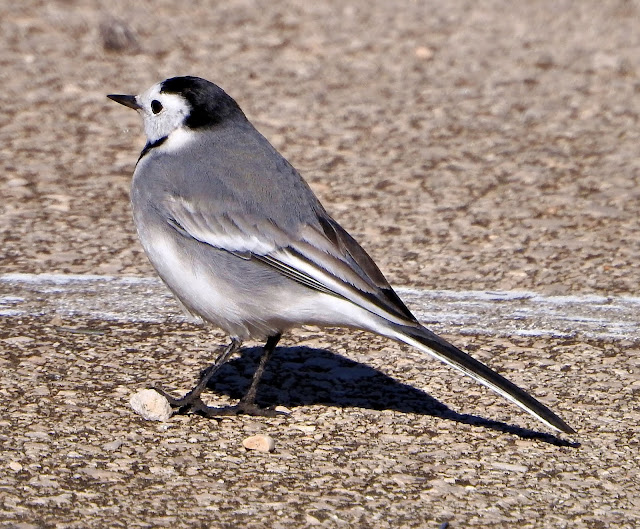
4-12-2021 RIO SERPIS GANDIA, VALENCIA - WHITE WAGTAIL (Motacilla alba)
Adult White Wagtails exhibit a distinctive plumage with a combination of grey, black, and white. The bird's upper parts are generally grey, with a white face, belly, and breast. Males during the breeding season may show a darker back, and the species is known for its sharp, brisk call and more melodious song during courtship.
The White Wagtail is commonly found in open country, often in close proximity to human habitation and water sources. It shows a preference for bare areas which facilitate the sighting and pursuit of prey. This bird has adapted well to urban environments, utilizing paved areas such as parking lots for foraging.
This species has a vast breeding range across Europe, the Asian Palearctic, parts of North Africa, and has a presence in Alaska. It is a migratory bird, with populations moving to Africa and parts of Asia during the winter. In Great Britain and Ireland, the darker subspecies known as the Pied Wagtail is more prevalent.
The White Wagtail is known for its perpetual tail wagging, a behavior that remains somewhat enigmatic but is thought to be a signal of vigilance to predators. It is a monogamous bird that defends its breeding territory with determination.
The call of the White Wagtail is a sharp "chisick," softer than that of the Pied Wagtail. Its song is more structured and is used by males to attract females rather than to mark territory.
Friday, 3 December 2021
2-6-2019 LINYANTI, BOTSWANA - NILE MONITOR (Varanus niloticus)
3-12-2021 MARXUQUERA, VALENCIA - BLACK REDSTART (FEMALE) (Phoenicurus ochruros)
3-12-2021 MONTE CORONA, VALENCIA - WESTERN HONEY BEE ( Apis mellifera)
Like all honey bee species, the western honey bee is eusocial, creating colonies with a single fertile female (or "queen"), many normally non-reproductive females or "workers", and a small proportion of fertile males or "drones". Individual colonies can house tens of thousands of bees. Colony activities are organized by complex communication between individuals, through both pheromones and the dance language.
3-12-2021 MONTE CORONA, VALENCIA - WESTERN CONIFER SEED BUG (Leptoglossus occidentalis)
2-6-2019 LINYANTI, BOTSWANA - AFRICAN JACANA (Actophilornis africanus)
Thursday, 2 December 2021
2-6-2019 LINYANTI, BOTSWANA - LITTLE BEE-EATER (Merops pasillas)
2-6-2019 LINYANTI CAMP, BOTSWANA - BURCHELL'S STARLING (Lamprotornis australis)
2-6-2019 LINYANTI CAMP, BOTSWANA - NAMIBIAN GIRAFFE (Giraffa camelopardalis ssp. angolensis)
1-12-2021 EL PALMAR, VALENCIA - EUROPEAN STONECHAT (MALE) (Saxicola rubicola)
Males in their summer plumage are unmistakable with their black heads, orange throats, and white bellies. They also sport a distinctive white half-collar and small white patches on the wings and rump. Females, on the other hand, are predominantly brown with less pronounced white wing patches. Both sexes have notably short wings, which are shorter than those of their migratory relatives.
The European stonechat favors heathlands, coastal dunes, and open grasslands dotted with shrubs, brambles, and heather. These habitats provide the perfect backdrop for their active foraging and breeding behaviors.
1-12-2021 EL PALMAR, VALENCIA - EUROPEAN STONECHAT (FEMALE) (Saxicola rubicola)
Males in their summer plumage are unmistakable with their black heads, orange throats, and white bellies. They also sport a distinctive white half-collar and small white patches on the wings and rump. Females, on the other hand, are predominantly brown with less pronounced white wing patches. Both sexes have notably short wings, which are shorter than those of their migratory relatives.
The European stonechat favors heathlands, coastal dunes, and open grasslands dotted with shrubs, brambles, and heather. These habitats provide the perfect backdrop for their active foraging and breeding behaviors.
1-12-2021 EL PALMAR, VALENCIA - GLOSSY IBIS (Plegadis falcinellus)
When identifying the Glossy Ibis, look for its unique glossy feathers and the distinct shape of its bill. The bird's flight pattern is also a telltale sign, as it flies with its neck outstretched, unlike herons. Listen for its various croaks and grunts, particularly the hoarse grrrr sound during the breeding season.
The Glossy Ibis favors freshwater or brackish wetlands with tall, dense emergent vegetation such as reeds, papyrus, or rushes, and low trees or bushes. It can also be found in lagoons, floodplains, wet meadows, swamps, reservoirs, sewage ponds, rice paddies, and irrigated farmland. Coastal habitats like estuaries and salt marshes are less common for this species.
Wednesday, 1 December 2021
1-12-2021 EL PALMAR, VALENCIA - LITTLE EGRET (Egretta garzetta)
1-12-2021 MARJAL DE INTERIOR, ALBUFERA - WESTERN CATTLE EGRET (MALE) (Bubulcus ibis)
1-12-2021 MARJAL DE INTERIOR, ALBUFERA - LITTLE EGRET (Egretta garzetta)
Adult Little Egrets measure between 55–65 cm in length with a wingspan of 88–106 cm, and weigh 350–550 g. Their plumage is predominantly white, though some may exhibit bluish-grey coloration. Breeding adults boast ornate nape plumes reaching about 150 mm, along with distinctive feathers on the breast and elongated scapulars. The bill and lores are black, with greenish-grey skin at the base of the lower mandible and around the eye, which houses a yellow iris. Legs are black with contrasting yellow feet, though juveniles may have greenish-black legs and duller feet. The subspecies E. g. nigripes is distinguished by yellow skin between the bill and eye, and blackish feet.
1-12-2021 RACO DE OLLA, VALENCIA - COMMON DARTER DRAGONFLY (FEMALE) (Sympetrum striolatum)
The common darter (Sympetrum striolatum) is a dragonfly of the family Libellulidae native to Eurasia. It is one of the most common dragonflies in Europe, occurring in a wide variety of water bodies, though with a preference for breeding in still water such as ponds and lakes. In the south of its range adults are on the wing all year round.
Sympetrum species are not easy to tell apart and in most areas more than one Sympetrum species will occur. Females and teneral individuals have light yellow thorax and abdomen. Males turn red as they mature. Females darken with age, becoming a dark chocolate brown, and sometimes develop a blue colouration to the bottom of the abdomen. The wings also develop a brown tinge with age. In all cases the legs have a cream or yellow stripe on a black background - this is a diagnostic feature of this species. The pterostigma of the females can be red, blue, pale blue or brown.
1-12-2021 EL PALMAR, VALENCIA - EUROPEAN ROBIN (Erithacus rubecula)
1-12-2021 SOLLANA, VALENCIA - EURASIAN KESTREL (Falco tinnunculus)
This species occurs over a large range. It is widespread in Europe, Asia, and Africa, as well as occasionally reaching the east coast of North America. It has colonized a few oceanic islands, but vagrant individuals are generally rare; in the whole of Micronesia for example, the species was only recorded twice each on Guam and Saipan in the Marianas.
%20(Uraeginthus%20angolensis)%2023.jpg)
%20(Uraeginthus%20angolensis)%2020.jpg)
%2020.jpg)
%2020.jpg)
%2020.jpg)
%2021.jpg)
%2024.jpg)
%2025.jpg)
%2020.jpg)
%2021.jpg)
%2020.jpg)
%2020.jpg)