TOTAL PAGEVIEWS

TRANSLATE

Saturday, 18 December 2021

9-12-2021 CITY OF ARTS AND SCIENCES, VALENCIA - NORTHERN SHOVELER (MALE) (Spatula clypeata)


The Northern shoveler (Spatula clypeata) is a widespread species of duck unmistakable in the northern hemisphere due to its large spatulate bill. In Britain, it is known simply as the shoveler. One part of its scientific name Spatula is the Latin for a "spoon" or "spatula"; the other part is derived from the Latin clypeata and can be translated as "shield-bearing".

During the breeding season, the male of this species has an iridescent dark green head, white breast, and chestnut belly and flanks. In flight, pale blue forewing feathers are revealed, separated from the green speculum by a white border. In early fall the male will have a white crescent on each side of the face. In non-breeding (eclipse) plumage, the male resembles the female. The female is a drab mottled brown like other dabblers, with plumage much like a female mallard, but easily distinguished by the long broad bill, which is gray-tinged with orange on the cutting edge and lower mandible. The female's forewing is gray.


Northern shovelers breed in wide areas across Eurasia, western North America, and the Great Lakes region of the United States. They are strongly migratory and winter in southern Europe, Africa, the Indian Subcontinent, the Caribbean, northern South America, the Malay Archipelago, Japan, and other areas. In North America, they winter south of a line from Washington to Idaho, from New Mexico east to Kentucky, and along the Eastern Seaboard as far north as Massachusetts. Northern shovelers are birds of open wetlands, such as wet grassland or marshes with some emergent vegetation. Preferred feeding areas include lakes, estuaries, coastal shorelines, salt marshes, flooded fields, and agricultural ponds.


Northern shovelers are social ducks that live in small flocks and coexist peacefully with many other species. They feed during the day by dabbling for plant food, often by swinging their bill from side to side and using the bill to strain food from the water. Their wide-flat bill is equipped with well-developed lamellae; these are small, comb-like structures on the edge of the bill that act like sieves, allowing the birds to skim crustaceans and plankton from the water's surface. This adaptation gives them an advantage over other puddle ducks, with which they do not have to compete for food resources during most of the year. Thus, mud-bottomed marshes rich in invertebrate life are their habitat of choice. During the midday heat, the birds usually rest on land near the water. Northern shovelers are fairly quiet and communicate with each other only in certain situations; males have a low clunking call, whereas females have a light Mallard-like quack.

Friday, 17 December 2021

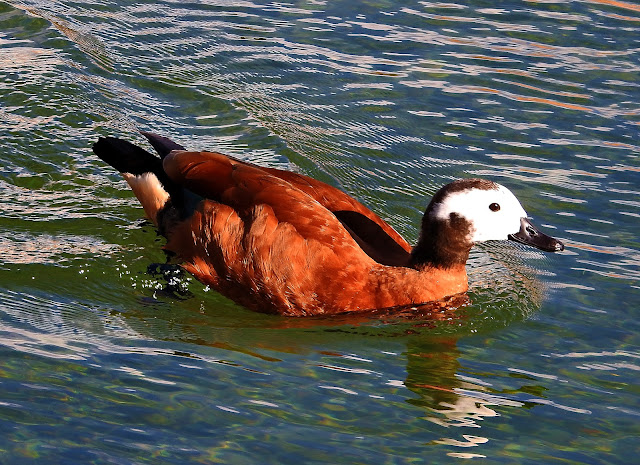
9-12-2021 CITY OF ARTS AND SCIENCES, VALENCIA - SOUTH AFRICAN SHELDUCK (MALE) (Tadorna cana)


The South African shelduck or Cape shelduck (Tadorna cana) is a species of shelduck, a group of large goose-like birds in the bird family Anatidae, which includes the swans, geese and ducks. This is a common species native to southern Africa.

This is a 64 cm (25 in) long bird which breeds mainly in Namibia and South Africa. In the austral winter, many birds move north-east from the breeding range to favoured moulting grounds, where sizable concentrations occur.

This species is mainly associated with lakes and rivers in fairly open country, breeding in disused mammal holes, usually those of the aardvark. Pairs tend to be very nomadic when not in breeding season.


Adult South African shelducks have ruddy bodies and wings strikingly marked with black, white and green. The male has a grey head, and the female has a white face and black crown, nape and neck sides. In flight they can be hard to distinguish from Egyptian geese. Juveniles are duller in appearance. Young females lack the white on the head, excluding white eye circles. The colour on the females head is highly variable, with the extent of white increasing with age, and can become almost fully white-headed. Males make a deep honk or hoogh call while the female tends to produce a louder, sharper hark.

South African shelduck is one of the species to which the Agreement on the Conservation of African-Eurasian Migratory Waterbirds (AEWA) applies.


The South African shelduck was formally described in 1789 by the German naturalist Johann Friedrich Gmelin in his revised and expanded edition of Carl Linnaeus's Systema Naturae. He placed it with all the other geese, ducks and swans in the genus Anas and coined the binomial name Anas cana. Gmelin based his description on the "Grey-headed goose" from the Cape of Good Hope that the English ornithologist John Latham had described in 1785 in his A General Synopsis of Birds. The South African shelduck is now placed with five other species in the genus Tadorna that was described by the German zoologist Friedrich Boie in 1822. The genus name comes from the French name Tadorne for the common shelduck. The specific epithet cana is from Latin canus meaning "grey". The species is monotypic; no subspecies are recognised.

9-12-2021 CITY OF ARTS AND SCIENCES, VALENCIA - SOUTH AFRICAN SHELDUCK (FEMALE) (Tadorna cana)


9-12-2021 CITY OF ARTS AND SCIENCES, VALENCIA - COMMON BOTTLENOSE DOLPHIN (Tursiops truncatus)


The common bottlenose dolphin or Atlantic bottlenose dolphin (Tursiops truncatus) is a wide-ranging marine mammal of the family Delphinidae. The common bottlenose dolphin is a very familiar dolphin due to the wide exposure it gets in captivity in marine parks and dolphinariums, and in movies and television programs. It is the largest species of the beaked dolphins. It inhabits temperate and tropical oceans throughout the world, and is absent only from polar waters. While formerly known simply as the bottlenose dolphin, this term is now applied to the genus Tursiops as a whole. As considerable genetic variation has been described within this species, even between neighboring populations, many experts think additional species may be recognized.

9-12-2021 CITY OF ARTS AND SCIENCES, VALENCIA - EURASIAN GREAT CORMORANT (Phalacrocorax carbo)


Great cormorants are monogamous, with pairs sometimes reuniting in subsequent years. The male chooses the nest site, displaying to attract the female by waving his wings up and down and flashing his white rump patch. He will also swing his head from side to side while holding his tail erect and calling loudly. The female responds by swinging her head slightly and “purring”. This species breeds at any time, depending on food resources. Breeding takes place in colonies of as many as 2,000 pairs, although colonies of a smaller size are typical. Colonies are often located close to other species, like darters, herons, and spoonbills. The parents build their nest with reeds, sticks, and seaweeds on a cliff, in a tree, or in a bush, according to the region. Often a nest is reused. 2 to 6 eggs are laid, with an average of 3-4. The parents share the incubation for 27 to 31 days. The altricial chicks hatch at intervals and fledge at about 50 days old. They remain with their parents for 50 or more days, relying on them for food. The young start to breed between 2 and 4 years old, typically when 3 years old.


Great cormorants have large populations and are widespread, although surveys are not complete across their range. Being an important fish competitor, in the past, they were almost extinct in Europe. However, in recent years increases have been observed, thanks to intensive protection. But in some countries, expanding conflicts with fish farms and fisheries lead to new persecution. Another threat is that hatchlings may be eaten by raptors before fledging.


The IUCN Red List reports that the global population of Great cormorants is about 1,400,000-2,100,000 individuals. The European population is estimated at 401,000-512,000 pairs, which equates to 803,000-1,020,000 mature individuals. Overall, currently, Great cormorants are classified as Least Concern (LC) on the IUCN Red List and their numbers today are increasing.

9-12-2021 CITY OF ARTS AND SCIENCES, VALENCIA - BAY NETTLE (Chrysaora chesapeakei)


Chrysaora chesapeakei is a sea nettle from the family Pelagiidae.[1] It was shown to be a distinct species from Chrysaora quinquecirrha in 2017. Since then, it is also commonly known as the bay nettle. It is found mainly in estuaries of the eastern coast of the U.S.A and is especially known from the Chesapeake Bay, but can also be found in the open Gulf of Mexico.

Similar to other species of sea nettle, C. chesapeakei has a centrally located mouth surrounded by oral arms. It has a vaguely saucer-like shaped bell and typically has four long, lacy oral arms hanging from the bell. They usually have around twenty-four tentacles. The tentacles do contain a toxin that is capable of stinging and causing pain to humans. However, the toxin is not strong enough to prove fatal to a human, unless the toxin were to cause an allergic reaction.


In 2017, C. chesapeakei was differentiated as a separate species from C. quinquecirrha based on genetic and morphological differences. Compared to C. quinquecirrha, C. chesapeakei has a bell size that is on average half as small, usually around 10 centimeters (3.9 in). It also has fewer tentacles and longer oral arms.

When the eggs of C. chesapeakei are developed, the mother jellyfish will carry them on her oral arms until the ciliated planulae develop. They will then swim until they find some sort of substrate on which to attach themselves. Typically, that substrate would be something hard and rough with plenty of shade, but mostly they will attach to the shells of oysters. In either case, they begin to develop into polyps. From this point, if conditions are favorable, they will undergo a process known as strobilation. This is when the polyp asexually produces the ephyrae into the water, which then develop into the medusae. If conditions are not favorable, the polyps will continue in their benthic stage where they will wait for the return of favorable conditions.


Individuals of the C. chesapeakei species are carnivorous. They generally feed on plankton and small marine invertebrates such as crustaceans and ctenophores. They can also act as a food source for several types of sea turtle.

Due to their feeding habits, C. chesapeakei have become an important species in the Chesapeake Bay. A species of ctenophore, Mnemiopsis leidei, has had a negative impact on many of the economically important fishing industries in the Chesapeake Bay. 


However, due to the fact that C. chesapeakei regularly feeds on the ctenophores, this species has been kept in check and the predatory impact of ctenophores subsides once bay nettles reach high numbers in the summertime. It is possible that as climate change becomes a greater issue, there may be fluctuations in the availability of the populations of both species.

C. chesapeakei can be found in several different types of water, including the open ocean, brackish water, bays, and estuaries. It is most commonly found in the Chesapeake Bay, which is how it got its name, but it can also be found in many bays and estuaries along the U.S. east coast and even in the Gulf of Mexico.

CARPET MOTH (Catarhoe basochesiata)


17-12-2021 MONTE CORONA, VALENCIA - CARPET MOTH (Catarhoe basochesiata)

Catarhoe basochesiata is a moth of the family Geometridae. It is found in Europe. It was first described by Philogène Duponchel in 1831 as Cidaria basochesiata. 

Catarhoe basochesiata has a wingspan of 23–27 mm (0.91–1.06 in). The forewings vary in colour from reddish brown to greyish brown, with some moths having very dark brown forewings that poorly contrast with the patterns on them. The moth can be found across the western Mediterranean, from the Iberian Peninsula across France and into Italy and from Morocco to Tunisia. The moth prefers hot, dry conditions in low coastal regions, from 0–500 m (0–1,640 ft) above sea level and occasionally higher.

Thursday, 16 December 2021

16-12-2021 OLIVA CANAL LES FONTS, VALENCIA - WHITE WAGTAIL (Motacilla alba)


The White Wagtail (Motacilla alba) is a small, elegant passerine bird, a member of the family Motacillidae, which includes pipits and longclaws. This slender bird measures between 16.5 to 19 cm in length, with East Asian subspecies reaching up to 21 cm. It is characterized by its long, constantly wagging tail, a behavior that has become synonymous with the genus. Weighing an average of 25 g, the White Wagtail can live up to 12 years in the wild.

Adult White Wagtails exhibit a distinctive plumage with a combination of grey, black, and white. The bird's upper parts are generally grey, with a white face, belly, and breast. Males during the breeding season may show a darker back, and the species is known for its sharp, brisk call and more melodious song during courtship.


The White Wagtail is commonly found in open country, often in close proximity to human habitation and water sources. It shows a preference for bare areas which facilitate the sighting and pursuit of prey. This bird has adapted well to urban environments, utilizing paved areas such as parking lots for foraging.

This species has a vast breeding range across Europe, the Asian Palearctic, parts of North Africa, and has a presence in Alaska. It is a migratory bird, with populations moving to Africa and parts of Asia during the winter. In Great Britain and Ireland, the darker subspecies known as the Pied Wagtail is more prevalent.

The White Wagtail is known for its perpetual tail wagging, a behavior that remains somewhat enigmatic but is thought to be a signal of vigilance to predators. It is a monogamous bird that defends its breeding territory with determination.

The call of the White Wagtail is a sharp "chisick," softer than that of the Pied Wagtail. Its song is more structured and is used by males to attract females rather than to mark territory.

White Wagtails are monogamous breeders, with both sexes contributing to nest building. The nest is often placed in crevices or holes near water or in human-made structures. The species lays three to eight cream-colored, speckled eggs, which both parents incubate. Chicks fledge after 12 to 15 days and continue to be fed for a week thereafter.

The Pied Wagtail, particularly the subspecies M. a. yarrellii, is similar but has a darker back and is found in Great Britain and Ireland. Other subspecies vary in wing, back, and head coloration.

16-12-2021 CANAL LES FONTS OLIVA, VALENCIA - LITTLE EGRET (Egretta garzetta)


The little egret (Egretta garzetta) is a species of small heron in the family Ardeidae. It is a white bird with a slender black beak, long black legs and, in the western race, yellow feet. As an aquatic bird, it feeds in shallow water and on land, consuming a variety of small creatures. It breeds colonially, often with other species of water birds, making a platform nest of sticks in a tree, bush or reed bed. A clutch of three to five bluish-green eggs is laid and incubated by both parents for about three weeks. The young fledge at about six weeks of age.

Its breeding distribution is in wetlands in warm temperate to tropical parts of Asia, Africa, Australia, and Europe. A successful colonist, its range has gradually expanded north, with stable and self-sustaining populations now present in the United Kingdom.


In warmer locations, most birds are permanent residents; northern populations, including many European birds, migrate to Africa and southern Asia to over-winter there. The birds may also wander north in late summer after the breeding season, and their tendency to disperse may have assisted in the recent expansion of the bird's range. At one time common in Western Europe, it was hunted extensively in the 19th century to provide plumes for the decoration of hats and became locally extinct in northwestern Europe and scarce in the south. Around 1950, conservation laws were introduced in southern Europe to protect the species and their numbers began to increase. By the beginning of the 21st century the bird was breeding again in France, the Netherlands, Ireland and Britain. Its range is continuing to expand westward, and the species has begun to colonise the New World; it was first seen in Barbados in 1954 and first bred there in 1994. The International Union for Conservation of Nature has assessed the bird's global conservation status as being of "least concern".


16-12-2021 OLIVA CANAL LES FONTS, VALENCIA - MALLARD (MALE & FEMALE) (Anas platyrhynchos)


16-12-2021 OLIVA CANAL LES FONTS, VALENCIA - COMMON CHIFFCHAFF (Phylloscopus collybita)


The Common Chiffchaff, Phylloscopus collybita, is a diminutive and sprightly leaf warbler known for its distinctive, onomatopoeic song. This small, migratory passerine is characterized by its greenish-brown upperparts and off-white underparts, with a weight ranging from 6 to 8 grams and a length of 10-12 centimeters.

In the field, look for the Common Chiffchaff's short whitish supercilium, fine dark bill, and dark legs. Its primary projection is short, and the plumage may appear duller and browner as it wears. Juveniles are browner above with yellow-white underparts, but they soon acquire brighter plumage after their first moult.


The Common Chiffchaff breeds in open woodlands with a mix of taller trees and ground cover across northern and temperate Europe, Asia, and parts of north Africa. It prefers woodland with trees at least 5 meters high and an undergrowth of grasses and nettles.

This species has a vast breeding range, extending from Europe to eastern Siberia and northward to about 70 N. It winters in southern and western Europe, southern Asia, and north Africa. The Common Chiffchaff is one of the earliest spring migrants to return to its breeding grounds and one of the last to depart in autumn.

The male Common Chiffchaff is fiercely territorial during the breeding season, defending its core territory against rivals. It exhibits a fearless nature, even attacking predators that threaten its nest. Outside the breeding season, these birds may form small flocks with other warblers.

The song is a cheerful "chiff-chaff," which heralds the arrival of spring. Calls include a "hweet" sound, less disyllabic than the calls of closely related warblers. The song is a key distinguishing feature from similar species, such as the Iberian Chiffchaff.

The female constructs a domed nest on or near the ground, lined with feathers. Clutches typically consist of 2-7 cream-colored eggs, which hatch after 13-14 days. The female assumes most of the responsibility for brooding and feeding the chicks, with the male playing a minimal role. 

16-12-2021 OLIVA CANAL LES FONTS, VALENCIA - BLACK REDSTART (MALE) (Phoenicurus ochruros)


The Black Redstart (Phoenicurus ochruros) is a small, charismatic passerine bird, exhibiting a blend of dark and vibrant plumage. Males are distinguished by their dark grey to black upperparts and breast, with a striking orange-red rump and tail. Females and juveniles are more subdued in color, with grey to grey-brown feathers and the same vivid tail coloration that is the hallmark of the species.

Adult males are easily identified by their dark upperparts and black breast, contrasting with the orange-red lower rump and tail. The belly and undertail may vary from blackish-grey to orange-red, depending on the subspecies. Females and juveniles are less conspicuous, with overall greyer tones and a distinctive orange-red rump and tail. The presence of pale fringes on the secondaries forms a whitish wing panel in some subspecies.


The Black Redstart has adapted remarkably to urban environments, often found nesting in crevices or holes within buildings. Originally a dweller of stony mountainous regions, it now thrives in industrial areas with similar structural features.

This species is widely distributed across south and central Europe, Asia, and north-west Africa. It is a resident in milder regions, while populations in the northeast migrate to warmer areas during winter.

16-12-2021 CANAL CAMI LES FONTS OLIVA, VALENCIA - EUROPEAN MOORHEN (Gallinula chloropus)


The common moorhen, known scientifically as Gallinula chloropus, is a bird of the rail family, Rallidae. It is a bird of striking appearance, with a mix of black and brown plumage, a white under-tail, and white streaks along its flanks. Its legs are a vibrant yellow, and it sports a distinctive red frontal shield. The bill is a matching red with a yellow tip. Juveniles are a duller brown and do not have the red shield.

Adult moorhens can be identified by their red frontal shield, which has a rounded top and fairly parallel sides. The tailward margin of the red unfeathered area is smoothly curved. Their yellow legs and the combination of their black and brown plumage with white markings make them quite distinctive. The young are browner and lack the red shield, making them less conspicuous.


The common moorhen is found in a variety of wetland habitats, including marshes, ponds, canals, and lakes that are rich in vegetation. It is also known to inhabit city parks with suitable water bodies.

This species has a broad distribution across many parts of the Old World. It is not found in polar regions or many tropical rainforests but is otherwise widespread, often being the most common rail species in its range.


Moorhens are known for their secretive nature but can become quite tame in certain areas. They exhibit territorial behavior during the breeding season and are known to aggressively defend their territory against intruders.

The common moorhen emits a variety of gargling calls and will hiss loudly when threatened.

Breeding season sees moorhens becoming territorial. They construct a basket-like nest on the ground within dense vegetation. Egg-laying typically begins in spring, with clutches ranging from 5 to 8 eggs. Both parents are involved in incubation and rearing the young, which fledge after 40-50 days.


The common gallinule (Gallinula galeata) of the Americas is closely related but can be distinguished by the shape of its frontal shield and the coloration of its plumage.

Moorhens have a varied diet that includes vegetable matter and small aquatic organisms. They forage in and around water bodies, sometimes upending in the water or walking on lilypads to feed.

Globally, the common moorhen is abundant and classified as Least Concern by the IUCN. However, localized populations may be vulnerable to extinction due to habitat loss and hunting.


Wednesday, 15 December 2021

9-12-2021 CITY OF ARTS AND SCIENCES, VALENCIA - FRINGED CERIANTHID (Pachycerianthus fimbriatus)


The Fringed Cerianthid (Pachycerianthus fimbriatus) is a tube-dwelling sea anemone belonging to the order Ceriantharia.

Key Characteristics

• Appearance: Features a bright orange, red, cream, or purple coloration. It grows up to 35 cm in length with a tentacle spread of around 30 cm.
• Tentacles: Possesses two distinct rings of tentacles:
• Marginal (outer) tentacles: Long, fine, and flowing; used for defense and catching prey.
• Labial (inner) tentacles: Short and tightly packed around the mouth; used to handle and ingest food.
• Tube Dwelling: Lives inside a long, semi-rigid, and slimy tube made of mucus and specialized stinging threads called ptychocysts. The tube is buried vertically in soft mud, sand, or gravel.
• Toxicity: Contains stinging cells (nematocysts), but they are not toxic to humans.


Habitat and Distribution

• Range: Found along the Pacific coast of North America (from Southern Alaska to Baja California) and parts of the Indo-Pacific/Indonesia.
• Depth: Typically found in subtidal zones down to 54 meters or more, inhabiting soft mud banks, bays, and harbors.
• Diet & Predators: Feeds on small crustaceans and zooplankton; it is known to be preyed upon by the giant nudibranch Dendronotus iris.


14-12-2021 ULLAL DE BALDOVI, ALBUFERA - EURASIAN COOT (Fulica atra)


14-12-2021 CREU DE LONGA, ALBUFERA - GREY HERON (Ardea cinerea)


14-12-2021 EL PALMAR, ALBUFERA - WHITE WAGTAIL (Motacilla alba)


The White Wagtail (Motacilla alba) is a small, elegant passerine bird, a member of the family Motacillidae, which includes pipits and longclaws. This slender bird measures between 16.5 to 19 cm in length, with East Asian subspecies reaching up to 21 cm. It is characterized by its long, constantly wagging tail, a behavior that has become synonymous with the genus. Weighing an average of 25 g, the White Wagtail can live up to 12 years in the wild.

Adult White Wagtails exhibit a distinctive plumage with a combination of grey, black, and white. The bird's upper parts are generally grey, with a white face, belly, and breast. Males during the breeding season may show a darker back, and the species is known for its sharp, brisk call and more melodious song during courtship.


The White Wagtail is commonly found in open country, often in close proximity to human habitation and water sources. It shows a preference for bare areas which facilitate the sighting and pursuit of prey. This bird has adapted well to urban environments, utilizing paved areas such as parking lots for foraging.

This species has a vast breeding range across Europe, the Asian Palearctic, parts of North Africa, and has a presence in Alaska. It is a migratory bird, with populations moving to Africa and parts of Asia during the winter. In Great Britain and Ireland, the darker subspecies known as the Pied Wagtail is more prevalent.

The White Wagtail is known for its perpetual tail wagging, a behavior that remains somewhat enigmatic but is thought to be a signal of vigilance to predators. It is a monogamous bird that defends its breeding territory with determination.


The call of the White Wagtail is a sharp "chisick," softer than that of the Pied Wagtail. Its song is more structured and is used by males to attract females rather than to mark territory.

White Wagtails are monogamous breeders, with both sexes contributing to nest building. The nest is often placed in crevices or holes near water or in human-made structures. The species lays three to eight cream-colored, speckled eggs, which both parents incubate. Chicks fledge after 12 to 15 days and continue to be fed for a week thereafter.

The Pied Wagtail, particularly the subspecies M. a. yarrellii, is similar but has a darker back and is found in Great Britain and Ireland. Other subspecies vary in wing, back, and head coloration.

14-12-2021 EL PALMAR, ALBUFERA - EUROPEAN STONECHAT (JUVENILE) (Saxicola rubicola)


The European stonechat (Saxicola rubicola) is a small passerine bird that was formerly classed as a subspecies of the common stonechat. Long considered a member of the thrush family, Turdidae, genetic evidence has placed it and its relatives in the Old World flycatcher family, Muscicapidae. It is found across Europe, as far east as Ukraine and the South Caucasus, and in parts of North Africa.

European stonechats breed in heathland, coastal dunes and rough grassland with scattered small shrubs and bramble, open gorse, tussocks or heather. They are short-distance migrants or non-migratory, with part of the population (particularly from northeastern parts of the range, where winters are colder) moving south to winter further south in Europe and more widely in north Africa.


European stonechats first breed when they are one year old. They are monogamous during the breeding season but do not pair for life. The nest is built entirely by the female and is placed in dense vegetation close to the ground. It is a loose unwoven cup of dried grass lined with hair and feathers. The eggs are laid in early morning at daily intervals. The clutch is typically 4–6 eggs, which are pale blue to greenish-blue with red-brown freckles that are more numerous at the larger end. The average size of an egg is 18.7 mm × 14.4 mm (0.74 in × 0.57 in) with a weight of 2.0 g (0.071 oz). They are incubated for 13–14 days by the female beginning after the last egg is laid. Both parents care for and feed the chicks. They are brooded by the female. The nestlings fledge 12–16 days after hatching but continue to be fed by both parents for a further 4–5 days after which the female begins building a new nest for another brood while the male continues to feed the young for another 5–10 days. The parents raise two or three broods in a season.

14-12-2021 EL PALMAR, ALBUFERA - EUROPEAN STONECHAT (MALE) (Saxicola rubicola)

The European stonechat, Saxicola rubicola, is a small, charming passerine bird, once thought to be a member of the thrush family but now placed within the Old World flycatcher family, Muscicapidae. This species exhibits a striking sexual dimorphism, with males donning a black plumage with vibrant orange throats and females wearing a more subdued brown.

Males in their summer plumage are unmistakable with their black heads, orange throats, and white bellies. They also sport a distinctive white half-collar and small white patches on the wings and rump. Females, on the other hand, are predominantly brown with less pronounced white wing patches. Both sexes have notably short wings, which are shorter than those of their migratory relatives.

The European stonechat favors heathlands, coastal dunes, and open grasslands dotted with shrubs, brambles, and heather. These habitats provide the perfect backdrop for their active foraging and breeding behaviors.

This species is widely distributed across Europe, reaching as far east as Ukraine and the South Caucasus, and can also be found in parts of North Africa.

Stonechats are known for their lively presence, often perching conspicuously as they keep a vigilant eye on their surroundings. They exhibit a partial migratory pattern, with some populations moving southward to escape the colder winters.

The male stonechat's song is a delightful, high-pitched twitter, reminiscent of a dunnock's melody. Both sexes communicate with a distinctive call that evokes the sound of two stones being tapped together.

European stonechats are monogamous during the breeding season and commence their reproductive efforts at one year of age. They raise two to three broods per season, with the female constructing the nest and both parents tending to the young.