TOTAL PAGEVIEWS

TRANSLATE

Tuesday, 18 February 2020

12-2-2020 BIOPARC, VALENCIA - AFRICAN FISH EAGLE (Haliaeetus vocifer)


The African fish eagle, or African sea eagle, is a majestic bird of prey that graces the skies of sub-Saharan Africa. It is a symbol of national pride, being the national bird of Malawi, Namibia, Zambia, and Zimbabwe. This raptor is known for its striking appearance, with a mostly brown body contrasted by a snow-white head, breast, and tail. The face is featherless and a vivid yellow, matching the color of its formidable, hooked beak, tipped in black. The African fish eagle's eyes are a deep, dark brown, and its powerful black wings carry it effortlessly over open waters.

Adult African fish eagles are unmistakable with their white heads and chests, brown bodies, and large black wings. Females are larger than males, with wingspans reaching up to 2.4 meters, compared to the 2-meter span of males. Juveniles can be identified by their overall brown plumage and paler eyes. The species exhibits sexual dimorphism, with females being heavier, weighing between 3.2 to 3.6 kilograms, while males weigh between 2.0 to 2.5 kilograms.


These eagles are typically found near freshwater lakes, reservoirs, rivers, and sometimes along coastlines at river mouths or lagoons. They thrive in a variety of habitats, including grasslands, swamps, marshes, tropical rainforests, and even desert-bordering coastlines.

The African fish eagle is indigenous to sub-Saharan Africa, with a presence in most areas south of the Sahara Desert. It is commonly seen in regions like the Orange River, the Okavango Delta, and around Lake Victoria and other large Rift Valley lakes.

The African fish eagle is known for its iconic, evocative call, which many consider the essence of Africa. It is a territorial bird, often seen perched high in a tree, surveying its domain. When hunting, it exhibits remarkable prowess, swooping down to snatch fish from the water with its taloned feet.

The call of the African fish eagle is a high-pitched and clear "weee-ah, hyo-hyo" or "heee-ah, heeah-heeah," with the male's call being particularly shrill.


Breeding occurs during the dry season, with pairs believed to mate for life. They maintain and reuse multiple nests, which can grow quite large over time. The female lays one to three eggs, primarily white with reddish speckles, and both parents share incubation duties. Chicks fledge at around 70 to 75 days old and remain dependent on their parents for up to three months.

The African fish eagle primarily feeds on fish, which it catches by swooping from a perch. It has specialized structures on its toes called spiricules to help grasp slippery prey. While fish are the mainstay of its diet, it also consumes waterbirds, small turtles, baby crocodiles, frogs, insects, and occasionally mammals. It is also known to engage in kleptoparasitism, stealing prey from other birds.


The African fish eagle is classified as Least Concern by the IUCN, with an estimated population size of around 300,000 individuals and a wide distribution area.

The African fish eagle may be superficially similar to the bald eagle, but they are found on different continents and can be distinguished by their calls and habitat preferences.

Mummified African fish eagles have been discovered at the Necropolis at Elkab, indicating the bird's significance in ancient cultures.

12-2-2020 BIOPARC, VALENCIA - DAMA GAZELLE (Nanger dama)


The dama gazelle (Nanger dama), also known as the addra gazelle or mhorr gazelle, is a species of gazelle. It lives in Africa, in the Sahara desert and the Sahel. A critically endangered species, it has disappeared from most of its former range due to overhunting and habitat loss, and natural populations only remain in Chad, Mali, and Niger. Its habitat includes grassland, shrubland, semi-deserts, open savanna and mountain plateaus. Its diet includes shrubs, herbs, grasses, leaves (especially Acacia leaves), shoots, and fruit.

In Niger, the dama gazelle has become a national symbol. Under the Hausa name meyna or ménas, the dama gazelle appears on the badge of the Niger national football team, who are popularly called the Ménas.


The dama gazelle is white with a reddish-brown head and neck. Both sexes usually have medium-length ringed horns curved like an "S". Males' horns are about 35 cm (14 in) long, while females' horns are much shorter. The head is small with a narrow muzzle, and the eyes are relatively large. It has a longer neck and longer legs than most gazelles. It is between 90 and 95 cm (35 and 37 in) tall at the shoulder, weighs between 35 and 75 kg (77 and 165 lb), and has a lifespan up to 12 years in the wild or 18 in captivity. A few days following birth, dama young are strong enough to follow the herd, and after a week, they are able to run as fast as the adults. The dama gazelle is considered the largest species of gazelle, with incredibly long legs, which provide extra surface area to dissipate heat, one of the many ways it stays cool in its hot desert environment. It also tends to need more water than some of its desert relatives, but it can withstand fairly long periods of drought. Unlike many other desert mammals, the dama gazelle is a diurnal species, meaning it is active during the day. Always on the alert, the dama gazelle uses a behavior called pronking to warn herd members of danger. Pronking involves the animal hopping up and down with all four of its legs stiff, so that its limbs all leave and touch the ground at the same time. Males also establish territories, and during breeding season, they actively exclude other mature males. They mark their territories with urine and dung piles and secretions from glands near their eyes.


The Dama gazelle does not need a lot of water, but it needs more than other desert animals. It is not as resistant and perishes from a lack of water during the drought season. The environment has become ill-suited for it. Habitat pressure from pastoral activity is another reason for decline, as are introduced diseases from livestock.

Another reason for the decline of the dama gazelle is habitat destruction. Humans cut down the branches of the trees on which this gazelle feeds. As a result, the trees die and the gazelle cannot eat. Human threats are the most dangerous of threats to the dama gazelle. The main reason this species of gazelle is endangered is because of mechanized hunting; hunters using vehicles increase its decline. Civil unrest, for instance in Sudan, also negatively affects the life of the dama gazelle. Since the gazelle is already having a hard time surviving, these conditions have made its habitat unsuitable. A potential threat the dama gazelle faces is tourism. Tourists want to take pictures of this endangered species, and in doing so, may be perceived as a threat, especially during the hot season. Gazelles will run away from perceived danger, and in the hot season may overheat and die of stress.


The dama gazelle's historical range included the desert and arid zones of Chad (eastern), and the Darfur and Kordofan Provinces of Sudan. Due to wars in their range, habitat destruction, desertification, overhunting, and human and livestock population expansion, they are now extremely rare, occurring only as vagrants or in pockets

The life span of the dama gazelle is unknown in the wild. In human care, individual males have lived up to 15 years and individual females have lived up to 19 years.

Dama gazelles obtain most of their water from the plants they consume. Their diet includes various desert shrubs and acacias, along with rough desert grasses.

At the Zoo, they eat orchard grass hay and alfalfa hay — about a flake each per day. In addition they eat roughly 2.5 pounds of herbivore pellet per day, with leaf eater biscuits and browse as treats.

12-2-2020 BIOPARC, VALENCIA - ADDAX (MALE) (Addax nasomaculatus)


In its tenth anniversary year, BIOPARC Valencia is taking another step in its conservation efforts for the most threatened species. This time, it is joining the important European Endangered Species Programme (EEP) for the unique Addax antelope ( Addax nasomaculatus ), which is listed as critically endangered on the International Union for Conservation of Nature (IUCN) Red List , with fewer than 100 mature individuals estimated to remain in the wild. The arrival of two females from Nuremberg and Hanover (Germany) is the first step towards establishing a breeding group and also introduces a new species to the park's animal collection. These two young females, born in 2016 and 2017, will be on display in the Savannah area after an acclimatization period in their indoor enclosure. 


This African species is the largest desert ungulate , a rounded antelope with long legs and a straight profile, distinguished by its large, vertically growing horns, present in both sexes, which curl in a spiral pattern. Also known as the "white antelope" due to the color of its coat, which darkens to grayish and brownish tones in winter, it has a characteristic white "X"-shaped mask that contrasts with its dark forehead. It is not a fast runner, making it easy prey for quicker predators such as lions, cheetahs, leopards, caracals, hyenas, and servals (which particularly prey on calves).


Adapted to the most arid and extreme terrains, the Addax inhabited the deserts of North Africa , from vast sand dune systems to compacted desert plains. They could go months without water and even years without drinking, obtaining moisture only from the plants they ate. Their acclimatization to survive in these inhospitable areas also allowed the Addax to allow their body temperature to rise during the day and lower during the cool of the night without losing water. Their nasal passage cooled arterial blood as it flowed through the nasal membrane before reaching the brain, protecting this vital organ from overheating.

12-2-2020 BIOPARC, VALENCIA - COMMON DWARF MONGOOSE (Helogale parvula)


The common dwarf mongoose ranges from East to southern Central Africa, from Eritrea and Ethiopia to the provinces of Limpopo and Mpumalanga in the Republic of South Africa. It inhabits primarily dry grassland, open forests and bushland up to an elevation of 2,000 m (6,600 ft). It is especially common in areas with many termite mounds, its favorite sleeping place. It avoids dense forests and deserts.

The common dwarf mongoose is a diurnal animal. It is a highly social species that lives in extended family groups of two to thirty animals. There is a strict hierarchy among same-sexed animals within a group, headed by the dominant pair (normally the oldest group members). All group members cooperate in helping to rear the pups and in guarding the group from predators.

Young mongooses attain sexual maturity by one year of age but delay dispersal, with males usually emigrating (in the company of their brothers) at 2–3 years old. Dispersing males may join other established groups, either as subordinates or by ousting the resident males, or they may found new groups with unrelated dispersing females. In contrast, females normally remain in their home group for life, queuing for the dominant position. They will, however, emigrate to found a new group if they lose their place in the hierarchy to a younger sister.

12-2-2020 BIOPARC, VALENCIA - GREAT WHITE PELICAN (Pelecanus onocrotalus)

The great white pelican, known scientifically as Pelecanus onocrotalus, is a gargantuan bird, surpassed in size only by its cousin, the Dalmatian pelican. With a body length ranging from 140 to 180 cm and a wingspan stretching from 226 to 360 cm, it is one of the largest flying birds. The pelican's bill is an impressive 28.9 to 47.1 cm long, colored in hues of pink and yellow, and is accompanied by a pale-yellow gular pouch. Males are generally larger than females and exhibit a pronounced sexual dimorphism, with males averaging more than 30% heavier than females.

Adult great white pelicans are predominantly white with black flight feathers and a faint pink tinge on the neck. The bill is bluish-grey with a red tip and a yellowish gular pouch. During the breeding season, males display pinkish facial skin, while females exhibit a more orangey hue. Juveniles are distinguishable by their darker, brownish underparts and patterned underwings. 

These pelicans favor shallow, warm freshwater environments, such as lakes, swamps, and lagoons, often with dense reed beds nearby for nesting. They are also found in coastal estuarine areas and occasionally at elevations up to 1,372 m in East Africa and Nepal.

12-2-2020 BIOPARC, VALENCIA - CHIMPANZEE (Pan troglodytes)


The chimpanzee (/tʃɪmpænˈzi/; Pan troglodytes), or simply known as the chimp, is a species of great ape native to the forests and savannahs of tropical Africa. It has four confirmed subspecies and a fifth proposed one. When its close relative the bonobo was more commonly known as the pygmy chimpanzee, this species was often called the common chimpanzee or the robust chimpanzee. The chimpanzee and the bonobo are the only species in the genus Pan. Evidence from fossils and DNA sequencing shows that Pan is a sister taxon to the human lineage and is thus humans' closest living relative. The chimpanzee is covered in coarse black hair, but has a bare face, fingers, toes, palms of the hands, and soles of the feet. It is larger and more robust than the bonobo, weighing 40–70 kg (88–154 lb) for males and 27–50 kg (60–110 lb) for females and standing 150 cm (4 ft 11 in).


The chimpanzee lives in groups that range in size from 15 to 150 members, although individuals travel and forage in much smaller groups during the day. The species lives in a strict male-dominated hierarchy, where disputes are generally settled without the need for violence. Nearly all chimpanzee populations have been recorded using tools, modifying sticks, rocks, grass and leaves and using them for hunting and acquiring honey, termites, ants, nuts and water. The species has also been found creating sharpened sticks to spear small mammals. Its gestation period is eight months. The infant is weaned at about three years old but usually maintains a close relationship with its mother for several years more.


The chimpanzee is listed on the IUCN Red List as an endangered species. Between 170,000 and 300,000 individuals are estimated across its range. The biggest threats to the chimpanzee are habitat loss, poaching, and disease. Chimpanzees appear in Western popular culture as stereotyped clown-figures and have featured in entertainments such as chimpanzees' tea parties, circus acts and stage shows. Although many chimpanzees have been kept as pets, their strength, aggressiveness, and unpredictability makes them dangerous in this role. Some hundreds have been kept in laboratories for research, especially in the United States. Many attempts have been made to teach languages such as American Sign Language to chimpanzees, with limited success.


Chimpanzees are highly intelligent, social great apes native to African forests and savannas, sharing roughly 98%–99% of their DNA with humans. Known for using tools, having complex emotional lives, and living in fission-fusion communities, they are our closest living relatives. They are endangered, with populations threatened by habitat loss and hunting. 
Key Facts About Chimpanzees
Intelligence & Tools: Chimpanzees are among the most intelligent species, known for using sticks to "fish" for termites and leaves to soak up water. They can recognize themselves in mirrors, a sign of self-awareness.

Monday, 17 February 2020

12-2-2020 BIOPARC, VALENCIA - CAPE PORCUPINE (Hystrix africaeaustralis)


The Cape porcupine (Hystrix africaeaustralis), Cape crested porcupine or South African porcupine, is a species of Old World porcupine native to central and southern Africa.

Cape porcupines are the largest rodents in Africa and also the world's largest porcupines. Cape porcupines are amongst the largest living rodents in the world; a few other rodents appear to be larger in body mass such as the capybara and the Eurasian and North American beavers. They are similar in appearance to, the slightly smaller and close relatives, the crested porcupines. They can most easily be distinguished from them by the presence of a band of short white spines along the midline of the rump. Indian porcupines are almost the same size on average as well, being slightly heavier on average than crested porcupine but slightly lighter than Cape porcupines. 


Cape porcupines measure 63 to 81 centimetres (25 to 32 inches) long from the head to the base of the tail, with the tail adding a further 11–20 centimetres (4.3–7.9 inches). They weigh from 10 to 24 kilograms (22 to 53 pounds), with exceptionally large specimens weighing up to 30 kg (66 lb); males and females are not significantly different in size. The average weight of males from Zimbabwe was 16.9 kg (37 lb) and while the average for females there was 18.4 kg (41 lb) while in the Orange river valley of South Africa males averaged 12.3 kg (27 lb) and females averaged 13 kg (29 lb).

They are heavily-built animals, with stocky bodies, short limbs, and an inconspicuous tail. The body is covered in long spines up to 50 centimetres (20 in) in length, interspersed with thicker, sharply pointed, defence quills up to 30 centimetres (12 in) long, and with bristly, blackish or brownish fur. The spines on the tail are hollow, and used to make a rattling sound to scare away predators. An erectile crest of long, bristly hairs runs from the top of the head down to the shoulders. The spines and quills cover the back and flanks of the animal, starting about a third of the way down the body, and continuing onto the tail. The quills have multiple bands of black and white along their length, and grow from regularly spaced grooves along the animal's body; each groove holding five to eight quills. The remainder of the animal, including the undersides, is covered with dark hair.

The eyes and ears are relatively small, and the mobile whiskers are short. The feet have five clawed toes, although the first toes on the forefeet are vestigial. Females have two pairs of teats.

12-2-2020 BIOPARC, VALENCIA - VERREAUX'S EAGLE OWL (Bubo lacteus)


Verreaux's eagle-owl (Ketupa lactea), also commonly known as the milky eagle owl or giant eagle owl, is a member of the family Strigidae. This species is widespread in sub-Saharan Africa. A member of the genus Ketupa, it is the largest African owl, measuring up to 66 cm (26 in) in total length. This eagle-owl is a resident primarily of dry, wooded savanna. Verreaux's eagle-owl is mainly grey in color and is distinguishable from other large owls by its bright pink eyelids, a feature shared with no other owl species in the world.


Verreaux's eagle-owl is a highly opportunistic predator equipped with powerful talons. Just over half of its known diet is composed of mammals but equal or even greater numbers of birds and even insects may be hunted locally, along with any other appropriately sized prey that is encountered. This species is considered of Least Concern by IUCN as it occurs over a wide range and has shown some adaptability to human-based alterations and destruction of habitat and adaptability to diverse prey when a primary prey species declines in a region. As a large, highly territorial species of owl, it does, however, occur at fairly low densities and some regional declines have been reported.


Verreaux's eagle-owl is found through most of sub-Saharan Africa, though it is absent from most of the deep rainforests. The species is found at the highest densities in eastern and southern Africa. As this species avoids primary forests, it is found very spottily in west Africa. Their western distribution includes The Gambia, Senegal, Guinea and Sierra Leone.

Eastward from those countries to the Central African Republic, the species is distributed in a narrow transitional zone between the Sahara and rainforests. Seemingly isolated populations occur in central Nigeria and central Mali. In south-western Africa, they range up to as far north as the southern parts of the Republic of the Congo and the Democratic Republic of the Congo, through most of Namibia (excluding the coastal regions) and northern South Africa. In east Africa, their distribution is more or less continuous from southern Sudan, Eritrea and inland Somalia down to South Africa as far as the region of the city of Durban.

12-2-2020 BIOPARC, VALENCIA - PYGMY HIPPOPOTAMUS (Choeropsis liberiensis)


The pygmy hippopotamus or pygmy hippo (Choeropsis liberiensis) is a small hippopotamid which is native to the forests and swamps of West Africa, primarily in Liberia, with small populations in Sierra Leone, Guinea, and Ivory Coast. It has been extirpated from Nigeria and possibly Guinea-Bissau.

The pygmy hippopotamus is reclusive and nocturnal. It is one of only two extant species in the family Hippopotamidae, the other being its much larger relative, the common hippopotamus (Hippopotamus amphibius) or Nile hippopotamus. The pygmy hippopotamus displays many terrestrial adaptations, but like the common hippopotamus, it is semiaquatic and relies on water to keep its skin moist and its body temperature cool. Behaviors such as mating and giving birth may occur in water or on land. The pygmy hippopotamus is herbivorous, feeding on ferns, broad-leaved plants, grasses, and fruits it finds in the forests.


A rare nocturnal forest creature, the pygmy hippopotamus is a difficult animal to study in the wild. Pygmy hippos were unknown outside West Africa until the 19th century. Introduced to zoos in the early 20th century, they breed well in captivity and the vast majority of research is derived from zoo specimens.

The survival of the species in captivity is more assured than in the wild; in a 2015 assessment, the International Union for Conservation of Nature estimated that fewer than 2,500 pygmy hippos remain in the wild.

Pygmy hippos are primarily threatened by loss of habitat, as the forests are logged and converted to farm land, and are also vulnerable to poaching, hunting for bushmeat, natural predators and war. Pygmy hippos are among the species illegally hunted for food in Liberia.


Like the common hippopotamus, the pygmy hippopotamus emerges from the water at dusk to feed. It relies on game trails to travel through dense forest vegetation. It marks trails by vigorously waving its tail while defecating to further spread its feces. The pygmy hippopotamus spends about six hours a day foraging for food.

Pygmy hippos are herbivorous. They do not eat aquatic vegetation to a significant extent and rarely eat grass because it is uncommon in the thick forests they inhabit. The bulk of a pygmy hippo's diet consists of herbs, ferns, broad-leaved plants, herbaceous shoots, forbs, sedges and fruits that have fallen to the forest floor. The wide variety of plants pygmy hippos have been observed eating suggests that they will eat any plants available. This diet is of higher quality than that of the common hippopotamus.

17-2-2020 SALEM, VALENCIA - PINE PROCESSIONARY CATERPILLAR (Thaumetopoea pityocampa)


The pine processionary (Thaumetopoea pityocampa) is a moth of the subfamily Thaumetopoeinae in the family Notodontidae, known for the irritating hairs of its caterpillars, their processions, and the economic damage they cause in coniferous forests. The species was first described scientifically by Michael Denis and Ignaz Schiffermüller in 1775, though it was known to the ancients, with remedies described by Theophrastus, Dioscorides and Pliny the Elder. Its processionary behaviour was described in 1916 by the French entomologist Jean-Henri Fabre. It is one of the most destructive species to pines and cedars in Central Asia, North Africa and southern Europe.

The species is notable for the behaviour of its caterpillars, which overwinter in tent-like nests high in pine trees, and which proceed through the woods in nose-to-tail columns, protected from predators by their severely irritating hairs.

The species is one of the few insects where the larva develops in winter in temperate zones. Global warming is causing the species to affect forests progressively further north. The urticating hairs of the caterpillar larvae cause harmful (and in some cases allergic) reactions, in humans and other mammals.

17-2-2020 SALEM, VALENCIA - SMALL WHITE BUTTERFLY (Pieris rapae)


Pieris rapae is a small-to-medium-sized butterfly species of the whites-and-yellows family Pieridae. It is known in Europe as the small white, in North America and the United Kingdom as the cabbage white or cabbage butterfly, on several continents as the small cabbage white, and in New Zealand as the white butterfly. The butterfly is recognizable by its white color with small black dots on its wings, and it can be distinguished from P. brassicae by the latter's larger size and black band at the tip of the forewings.

The caterpillar of this species, often referred to as the "imported cabbageworm", is a pest to crucifer crops such as cabbage, kale, bok choy and broccoli. Pieris rapae is widespread in Europe and Asia; it is believed to have originated in the Eastern Mediterranean region of Europe and to have spread across Eurasia thanks to the diversification of brassicaceous crops and the development of human trade routes. Over the past two centuries, it spread to North Africa (about 1800), North America (1860s), Hawaii (1897), New Zealand (1930), and Australia (1937), as a result of accidental introductions.

BUFF TAILED BUMBLE BEE (Bombus terrestris)


Sunday, 16 February 2020

12-2-2020 BIOPARC, VALENCIA - ABDIM'S STORK (Ciconia abdimii)


Abdim's stork (Ciconia abdimii), also known as the white-bellied stork, is a stork belonging to the family Ciconiidae. It is the smallest species of stork, feeds mostly on insects, and is found widely in open habitats in Sub-Saharan Africa and in Yemen. The common name commemorates the Turkish Governor of Wadi Halfa in Sudan, Bey El-Arnaut Abdim (1780–1827).

Abdim's stork is found widely in open habitats throughout Sub-Saharan Africa, from the Sahel to South Africa, being absent mainly from forests, dense woodlands and deserts. A smaller populations occurs in Yemen. It breeds colonially in trees, on cliffs or rooftops in the northern half of its range (north of the Equator) during the wet season from May to August, migrating to eastern and southern Africa for the remainder of the year. This stork has escaped or been deliberately released into Florida, U.S., but there is no evidence that the population is breeding and may only persist due to continuing releases or escapes.


Widespread and common throughout its large range, Abdim's stork is evaluated as Least Concern on the IUCN Red List of Threatened Species. It is the subject of several nationally coordinated breeding programs: in the United States, the plan for this species is administered by the Association of Zoos and Aquariums and in Europe by the European Association of Zoos and Aquaria.

The Abdim's stork is mostly insectivorous, feeding on locusts, caterpillars and other large insects, although these birds will also eat small reptiles, amphibians, mice, crabs and eggs] The female lays two to three eggs and is slightly smaller than the male.

12-2-2020 BIOPARC, VALENCIA - HELMETED GUINEA FOWL (Numida meleagris)


The helmeted guineafowl (Numida meleagris) is the best known of the guineafowl bird family, Numididae, and the only member of the genus Numida. It is native to Africa, mainly south of the Sahara, and has been widely introduced, as a domesticated species, into the West Indies, North America, Colombia, Brazil, Australia and Europe.

The helmeted guineafowl is a large, 53 to 58 cm (21 to 23 in) bird with a round body and small head. They weigh about 1.3 kg (2.9 lb). The body plumage is gray-black speckled with white. Like other guineafowl, this species has an unfeathered head, which in this species is decorated with a dull yellow or reddish bony knob, and bare skin with red, blue, or black hues. The wings are short and rounded, and the tail is likewise short. Various subspecies are proposed, differences in appearance being mostly a large variation in shape, size, and colour of the casque and facial wattles.


This is a gregarious species, forming flocks outside the breeding season typically of about 25 birds that also roost communally. Guineafowl are particularly well-suited to consuming massive quantities of ticks, which might otherwise spread Lyme disease. These birds are terrestrial, and prone to run rather than fly when alarmed. Like most gallinaceous birds, they have a short-lived, explosive flight and rely on gliding to cover extended distances. Helmeted guineafowl can walk 10 km and more in a day. Their bodies are well-suited for running and they are remarkably successful in maintaining dynamic stability over rough terrain at speed. They make loud harsh calls when disturbed.

12-2-2020 BIOPARC, VALENCIA - SADDLE BILLED STORK (Ephippiorhynchus senegalensis)


The Saddle-billed Stork, known scientifically as Ephippiorhynchus senegalensis, is a magnificent and large wading bird belonging to the stork family, Ciconiidae. It stands tall, reaching heights of 145 to 150 cm (4 ft 9 in to 4 ft 11 in), with a wingspan stretching an impressive 2.4 to 2.7 m (7 ft 10 in to 8 ft 10 in). The male of the species is typically larger and heavier than the female, with weights ranging from 5.1 to 7.52 kg (11.2 to 16.6 lb).

Distinguishing between the sexes is straightforward; the female boasts golden yellow irises, while the male has brown irises complemented by dangling yellow wattles. Both sexes share a striking plumage, with iridescent black covering the head, neck, back, wings, and tail, and the rest of the body along with primary flight feathers being white. The juvenile birds wear a more subdued brownish-grey attire. The stork's bill is a vivid red adorned with a black band and a distinctive yellow frontal shield, the namesake "saddle." Their legs and feet are black with pink hocks, and a bare red patch of skin can be found on the chest, which intensifies in color during the breeding season.


Saddle-billed Storks have a preference for protected areas abundant in open water, such as national parks and protected swamps, which provide safer environments for both the birds and ornithologists.

This species is a resident breeder in sub-Saharan Africa, with its range extending from Sudan, Ethiopia, and Kenya in the east, down to South Africa, and also found in The Gambia, Senegal, Côte d'Ivoire, and Chad in West Africa.

These storks are adept hunters, stabbing their bills into water, mud, and vegetation to catch a variety of prey. They primarily feed on aquatic creatures like lungfish and catfish, which can weigh up to 1.3 kg (2.9 lb). They also consume frogs, snails, small mammals, birds, snakes, and various insects.

The Saddle-billed Stork is currently listed as Least Concern on the IUCN Red List, although it is considered endangered in South Africa.

The Saddle-billed Stork is closely related to the Black-necked Stork, the only other member of the genus Ephippiorhynchus, which is widespread across Asia and Australia.

12-2-2020 BIOPARC, VALENCIA - GREY CROWNED CRANE (Balearica regulorum)


The Grey Crowned Crane, known scientifically as Balearica regulorum, stands as a majestic figure approximately 1 meter tall, with a wingspan stretching to 2 meters. This bird's plumage is predominantly grey, accented with a variety of colors on the wings and a striking black patch at the top. Its head is adorned with a crown of stiff golden feathers, setting it apart from its avian companions. The face is white, highlighted by a bright red inflatable throat pouch, and the bill is a modest grey. Black legs support its graceful frame, and its large, slender feet are designed for balance as it wades through grasslands.

Observers should note the Grey Crowned Crane's unique combination of features: the golden crown, white face, red throat pouch, and the black patch on the wings. Males and females are similar in appearance, though males may be slightly larger. Juveniles present a greyer complexion with a feathered buff face.


The Grey Crowned Crane favors the dry savannahs of Sub-Saharan Africa but is also comfortable in marshes, cultivated lands, and grassy flatlands near rivers and lakes.

This species is widespread across eastern and southern Africa, with a presence from the Democratic Republic of the Congo and Uganda, through Kenya, down to South Africa.

The Grey Crowned Crane is known for its elaborate breeding display, which includes dancing, bowing, and jumping. It is a social bird, often found in flocks ranging from 30 to 150 individuals.

The crane's call is a distinctive booming sound, produced with the help of its red gular sac. It also emits a honking noise, quite unlike the trumpeting calls of other crane species.


Breeding seasons are timed with the rains, varying by region. The Grey Crowned Crane builds a large nest in wetland vegetation, where it lays a clutch of 2-5 glossy, dirty-white eggs. Both parents share incubation duties over a period of 28–31 days. Chicks are precocial and fledge in 56–100 days.

An omnivorous bird, the Grey Crowned Crane feeds on plants, seeds, grain, insects, frogs, worms, snakes, small fish, and eggs of aquatic animals. It employs a foot-stamping technique to flush out insects and often follows grazing herbivores to catch disturbed prey.

The Grey Crowned Crane is currently classified as Endangered, with an estimated global population between 58,000 and 77,000 individuals. It faces threats from habitat destruction, overgrazing, and pesticide pollution.

The Grey Crowned Crane holds a place of honor as the national bird of Uganda, gracing the country's flag and coat of arms.

17-2-2020 MONTE CORONA, VALENCIA - GARDEN CARPET MOTH (Xanthorhoe fluctuata)


The garden carpet (Xanthorhoe fluctuata) is a moth of the family Geometridae. It is an abundant and familiar species across its huge range which covers the whole Palearctic region from Ireland to Japan and including the Near East and North Africa. It was first described by Carl Linnaeus in his 1758 10th edition of Systema Naturae.

It has a wingspan of 27–31 mm (1.1–1.2 in). The wings are greyish white with three irregular black blotches along the costa of the forewing, the largest in the middle. Occasionally, much darker (melanic) forms occur. "Easy to recognize, in spite of its variability. In the typical form the ground colour is dirty whitish and the median band is almost or altogether obsolete in its posterior half.

– ab. ochreata Prout has the ground colour ochreous.
– In ab. neapolisata Mill, the ground colour is much darkened with brown-grey.
– ab. costovata Haw. has the median band much narrowed and somewhat shortened,
– deleta Ckll. is merely a rather extreme development of this and need not be separated.
– ab.immaculata Tutt is a much rarer aberration with the median band entirely wanting.
– ab. abstersata H.-Sch. shows the opposite extreme of development of the band, which is here darkened completely across the wing; distal area also sometimes darkened.
– thules Prout is a dark race from the Shetland Islands. The less extreme forms intergrade into ab. neapolisata, but the name strictly applies to specimens in which both the forewings and hindwing are entirely infuscated so that the markings are almost obliterated.
– sempionaria Rätzer is a small race from the Simplon, of a rather purer white than the type and with the median half-band rather small but rather sharply marked.

12-2-2020 BIOPARC, VALENCIA - CAPE TEAL (Anas capensis)


The Cape teal (Anas capensis) also Cape wigeon or Cape widgeon is a 44–46 cm long dabbling duck of open wetlands in sub-Saharan Africa.

Like many southern ducks, the sexes are similar. It is very pale and mainly grey, with a browner back and pink on the bill (young birds lack the pink). This is a generally quiet species, except during mating displays. The breeding male has a clear whistle, whereas the female has a feeble "quack". The Cape teal cannot be confused with any other duck in its range.

This species is essentially non-migratory, although it moves opportunistically with the rains. It is a thinly distributed but widespread duck, rarely seen in large groups except the moulting flocks, which may number up to 2000.

The Cape teal feeds on aquatic plants and small creatures (invertebrates, crustaceans and amphibians) obtained by dabbling. The nest is on the ground under vegetation and near water.

The Cape teal is one of the species to which the Agreement on the Conservation of African-Eurasian Migratory Waterbirds (AEWA) applies.

15-2-2020 MONTE CORONA, VALENCIA - SPECKLED WOOD BUTTERFLY (Pararge aegeria)

The speckled wood (Pararge aegeria) is a butterfly found in and on the borders of woodland areas throughout much of the Palearctic realm. The species is subdivided into multiple subspecies, including Pararge aegeria aegeria, Pararge aegeria tircis, Pararge aegeria oblita, and Pararge aegeria insula. The color of this butterfly varies between subspecies. The existence of these subspecies is due to variation in morphology down a gradient corresponding to a geographic cline. 

The background of the wings ranges from brown to orange, and the spots are either pale yellow, white, cream, or a tawny orange. The speckled wood feeds on a variety of grass species. The males of this species exhibit two types of mate locating behaviors: territorial defense and patrolling. The proportion of males exhibiting these two strategies changes based on ecological conditions. The monandrous female must choose which type of male can help her reproduce successfully. Her decision is heavily influenced by environmental conditions.

15-2-2020 MONTE CORONA, VALENCIA - GREAT TIT (Parus major)


The great tit (Parus major) is a small passerine bird, easily recognized by its black head and neck, striking white cheeks, olive upperparts, and vibrant yellow underparts. This bird is the most widespread species in the genus Parus, found across Europe, the Middle East, Central Asia, and parts of North Africa.
Males are characterized by their bright plumage, with a black bib that extends down the belly, bordered by a lemon-yellow breast. Females and juveniles are similar but have duller coloration. The black line down the belly is also narrower and sometimes broken in these birds.

Great tits favor a variety of woodland habitats, including deciduous and mixed forests, forest edges, and even urban parks and gardens. They are also found in riverine woodlands and, in some regions, boreal taiga.


This species is resident throughout its range, which extends from the Iberian Peninsula to the Amur Valley, and from Scandinavia to the Middle East. It is generally non-migratory, except in harsh winters when it may move to more temperate areas.
Great tits are known for their intelligence and adaptability. They exhibit a range of foraging behaviors and can solve problems with insight learning. They are also cavity nesters and are monogamous, with both parents involved in raising the chicks.

The great tit has a repertoire of up to 40 calls and songs, with the male being particularly vocal. A common call resembles the phrase "teacher, teacher," which is used to proclaim territory.

Breeding occurs once a year, with the female laying up to 12 eggs in a cavity nest. The female incubates the eggs alone, but both parents feed the chicks. In most years, the pair will raise two broods.

In summer, the diet is predominantly insectivorous, while in winter, it expands to include seeds and berries. Great tits are adept at handling large food items and are known to visit bird feeders in urban areas.

15-2-2020 MONTE CORONA, VALENCIA - SEVEN SPOTTED LADYBIRD (Coccinella septempunctata)


Coccinella septempunctata, the common ladybug, the seven-spot ladybird (or, in North America, seven-spotted ladybug or "C-7"[1]), is a carnivorous beetle native to the Old World and is the most common ladybird in Europe. The beetle is also found in North America, Central and Eastern Asia and regions with a temperate climate.[citation needed] Its elytra are of a red colour, but each punctuated with three black spots, with one further spot being spread over the junction of the two, making a total of seven spots, from which the species derives both its common and scientific names (from the Latin septem = "seven" and punctus = "spot").

C. septempunctata has been designated the national insect of Finland. In the United States, it is also the official state insect of five different states (Delaware, Massachusetts, New Hampshire, Ohio, and Tennessee).

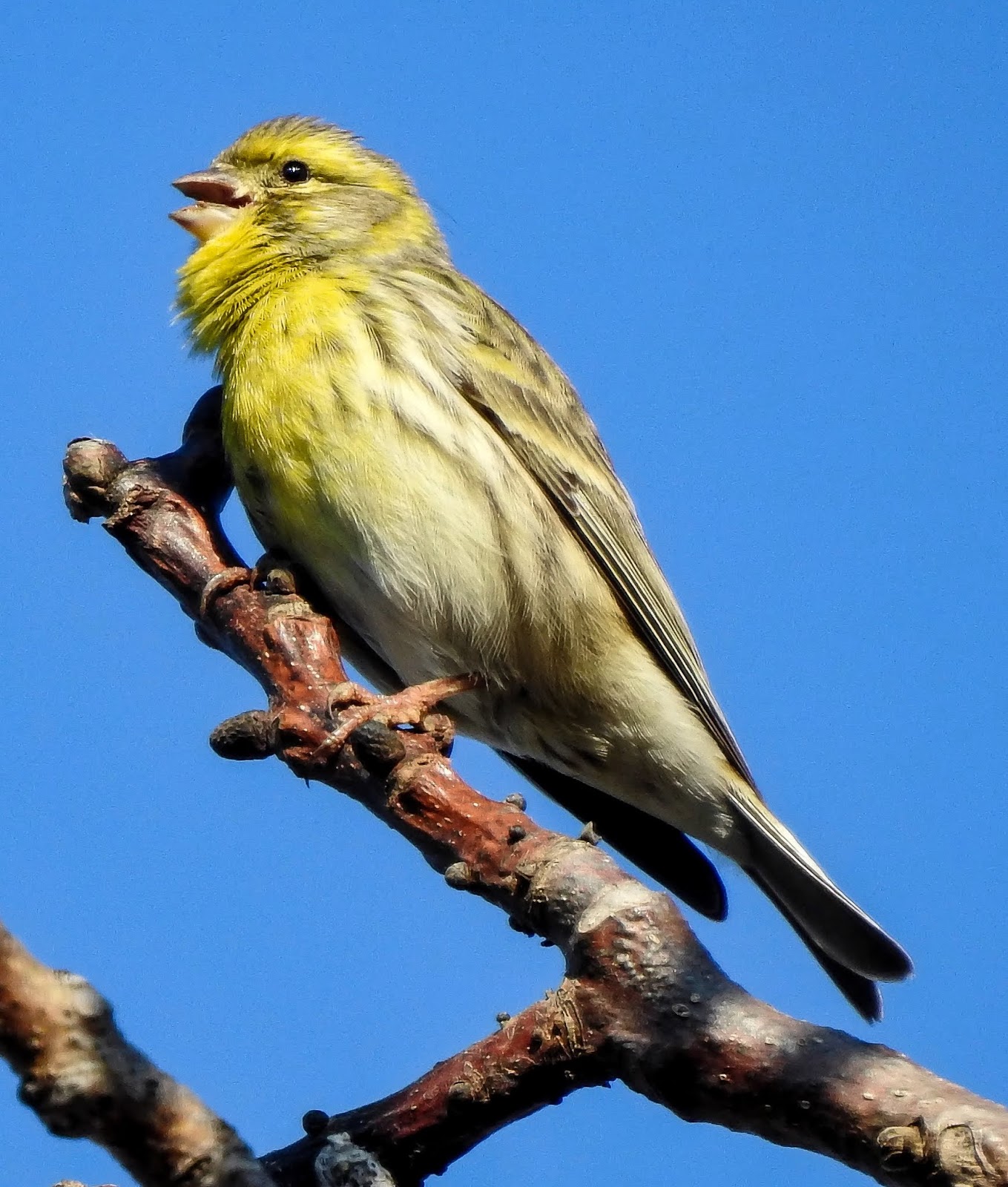
16-2-2020 RAFELCOFER, VALENCIA - EUROPEAN SERIN (MALE) (Serinus serinus)


The European serin, or simply the serin (Serinus serinus), is a diminutive member of the finch family, Fringillidae. This sprightly bird is the smallest within its family, closely related to the Atlantic canary. It is characterized by its short tail and a length that spans a mere 11 to 12 centimeters. The serin's plumage is a tapestry of nature's palette, with upper parts dappled in dark-streaked greyish green and a conspicuous yellow rump. The underparts are a canvas of yellow breast and white belly, both adorned with heavy streaks.

When attempting to identify the European serin, look for the male's radiant yellow face and breast, which stand out against the greenish backdrop of its feathers. The male also boasts yellow wing bars and yellow tail sides, which can be quite helpful in distinguishing it from similar species. Both sexes share a buzzing trill of a song that resonates through their Mediterranean habitats.


The European serin is partial to open woodland and cultivated areas, often with a sprinkling of conifers. These environments provide the perfect backdrop for breeding and foraging.

This species has a breeding range that extends across southern and central Europe and into North Africa. Populations along the southern and Atlantic coasts tend to be resident, while those in the north are migratory, seeking warmer climates in southern Europe during the winter months.

Outside of the breeding season, the European serin is a sociable creature, forming flocks that may sometimes mingle with other finch species. It is an active and often conspicuous bird, its presence easily announced by its distinctive trill.


The serin's song is a distinctive buzzing trill, a sound that becomes part of the ambient music in regions where these birds are common.

The European serin weaves its nest within the shelter of a shrub or tree, where it lays a clutch of 3 to 5 eggs. The chosen breeding habitats are often areas of open woodland and cultivation, with a preference for some conifers.

The diet of the European serin is predominantly seeds, but it does not shy away from including insects during the breeding season, providing essential protein for its young.


The European serin is a small short-tailed bird, 11–12 cm in length. The upper parts are dark-streaked greyish green, with a yellow rump. The yellow breast and white belly are also heavily streaked. The male has a brighter yellow face and breast, yellow wing bars and yellow tail sides. The song of this bird is a buzzing trill, very familiar in Mediterranean countries.

It breeds across southern and central Europe and North Africa. Southern and Atlantic coast populations are largely resident, but the northern breeders migrate further south in Europe for the winter. Open woodland and cultivation, often with some conifers, is favoured for breeding. It builds its nest in a shrub or tree, laying 3–5 eggs. It forms flocks outside the breeding season, sometimes mixed with other finches.

The food is mainly seeds, and, in the breeding season, insects. This small serin is an active and often conspicuous bird.