
Monday, 5 April 2021
5-4-2021 TANCAT DE MILLA, VALENCIA - PAINTED LADY BUTTERFLY (Vanessa cardui)

Vanessa cardui is the most widespread of all butterfly species. It is commonly called the painted lady, or formerly in North America the cosmopolitan.
V. cardui occurs in any temperate zone, including mountains in the tropics. The species is resident only in warmer areas, but migrates in spring, and sometimes again in autumn. It migrates from North Africa and the Mediterranean to Britain and Europe in May and June, occasionally reaching Iceland, and from the Red Sea basin, via Israel and Cyprus, to Turkey in March and April. The occasional autumn migration made by V. cardui is likely for the inspection of resource changes; it consists of a round trip from Europe to Africa.


5-4-2021 ALCOY, ALICANTE - BONELLI'S EAGLE (Aquila fasciata)

Typically rugged environment with mixed vegetation that the Bonelli's eagle is often at home in. Here in Andalusia's Sierra de las Nieves.
Bonelli's eagle have a spotty and sparse worldwide distribution currently. The species is distributed in northwestern Africa from the Anti-Atlas in Morocco northeasterly through the lower parts of the Atlas mountains in northern Algeria and northern Tunisia (and probably formerly northern Libya). Beyond its African breeding range, the IUCN and others have mapped out a semi-regular wintering range for Bonelli's eagles, in coastal west Africa from southern Morocco down through Western Sahara, Mauritania and northwestern Senegal (rarely also east to Mali), although little more is reportedly known about this population and its origins and altogether the species is considered largely non-migratory. Additionally, the species has been recorded as a vagrant in east Africa in Somalia as well. In southern Europe, they range patchily through different parts of Portugal and Spain into southern France as far north as the department of Drôme. Discontinuously, they are now seemingly solely left as breeding bird in Italy on the islands of Sardinia and Sicily. In southeastern Europe, an isolated population possibly persists in Croatia as well as in northern and southern Macedonia (with the further possibility of spilling over into Kosovo) and spottily through different areas of Greece (possibly spilling over the borders in the west in Albania and in the east in Bulgaria), as well as Crete. Out of Europe, they may be found in western and southern Turkey, Syria (possibly but most likely extirpated), the isle of Cyprus, Lebanon, Israel, western Jordan, northeastern Egypt (rarely in northern half of Sinai Peninsula) possibly but not certainly in spots in the west and south of Saudi Arabia and elsewhere in the Arabian Peninsula to Yemen, Oman and the United Arab Emirates. Elsewhere in the Middle East, their range includes eastern Iraq and west, south and northeastern Iran, extending somewhat into Turkmenistan in the Kopet Dag range.
Further east into Asia, their distribution includes eastern Afghanistan and Pakistan through most of the Indian subcontinent, where generally it is uncommon but more locally common near Nepal. On the other hand, they are absent in eastern India and only occurring as a vagrant to Sri Lanka and Bangladesh. In India, they are most regularly occur in certain area such as Chambal ravines, Ranthambore National Park, Chir zone of lower Kumaun Himalayas and in winter in the Keoladeo National Park of Bharatpur, Rajasthan. From central Myanmar they range across into northwestern Thailand and northern Laos (though possibly only as a visitor rather than breeding in the latter two). In southern China their resident range includes Yunnan, Guangxi and Guangdong north to Yangtze river as well as rarely into Hong Kong. Their isolated Indonesian population ranges is in the Lesser Sunda Islands, including at least Sumbawa, Timor, Wetar, Luang and Flores, however records show they've turned up on as many as 20 islands in the Lesser Sundas.
Bonelli's eagles are mostly residential throughout their range but juvenile can disperse up to over several hundred kilometers. Sometimes, they are recorded at migration sites and at spots where not known to breed in winter. Wanderings include around 700 km (430 mi) north of their regular range in France near the coast of English Channel, far from their normal haunts in Regensburg, Germany and, probably both from the Italian island populations, to northwestern Italy and Slovenia. From their Iberian peninsula range presumably, vagrants have been reported in the Canary islands. Beyond Sri Lanka, other areas the species has been known to vagrate (or perhaps rarely winter) in Asia have included Kazakhstan, the Korean peninsula, Malaysia and Cochinchina in Vietnam, as well as a record in winter 1996 on the isle of Yamdena, the latter presumably from the Lesser Sunda population.
Sunday, 4 April 2021
29-3-2021 BIOPARC, VALENCIA - FULVOUS WHISTLING DUCK (Dendrocygna bicolor)


The fulvous whistling duck feeds in wetlands by day or night on seeds and other parts of plants. It is sometimes regarded as a pest of rice cultivation, and is also shot for food in parts of its range. Despite hunting, poisoning by pesticides and natural predation by mammals, birds, and reptiles, the large numbers and huge range of this duck mean that it is classified as least concern by the International Union for Conservation of Nature.

The fulvous whistling duck is 45–53 cm (18–21 in) long; the male weighs 748–1,050 g (26.4–37.0 oz), and the female averages marginally lighter at 712–1,000 g (25.1–35.3 oz). The wingspan ranges from 85 to 93 cm.
It is a long-legged duck, mainly different shades of brown; head, neck and breast are particularly rich buff (fulvous) with a darker back. The mantle is more darker shade of brown with buff-tipped feathers, the flight feathers and tail are dark brown, and a dark brown to black stripe runs through the center of the crown down the back of the neck to the base of the mantle. It has whitish stripes on its flanks, a long grey bill and grey legs. In flight, the wings are brown above and black below, with no white markings, and a white crescent on the rump contrasts with the black tail. All plumages are fairly similar, but the female is slightly smaller and duller-plumaged than the male.

The juvenile has paler underparts, and appears generally duller, especially on the flanks. There is a complete wing moult after breeding, and birds then seek the cover of dense wetland vegetation while they are flightless. Body feathers may be moulted throughout the year; each feather is replaced only once annually.
These are noisy birds with a clear whistling kee-wee-ooo call given on the ground or in flight, frequently heard at night. Quarrelling birds also have a harsh repeated kee. In flight, the beating wings produce a dull sound.[20] The calls of males and females show differences in structure and an acoustic analysis on 59 captive birds demonstrated 100% accuracy in sexing when compared with molecular methods.


The fulvous whistling duck feeds in wetlands by day or night on seeds and other parts of plants. It is sometimes regarded as a pest of rice cultivation, and is also shot for food in parts of its range. Despite hunting, poisoning by pesticides and natural predation by mammals, birds, and reptiles, the large numbers and huge range of this duck mean that it is classified as least concern by the International Union for Conservation of Nature.


29-3-2021 BIOPARC, VALENCIA - GREY HERON (Ardea cinerea)

Large wader (approx 102 cm or 3.5 ft) with an also large wingspan (approx 175 cm or 5.5 ft). Stylized silhouette and long neck. Greyish plumage in general. White head in adults with black forelock and long, black feathers like a plume. Light neck with dark lines. Ashen back and dark spot on the shoulders. Lighter belly. Long, sharp, yellow bill. Yellow legs. Silhouette in flight with neck folded in the shape of an "s" and stretched legs.
Its habitats are principally Wetlands, River and Riverside
It lives in all types of wetlands with salty or fresh water in winter. In the breeding season it needs wetlands with nearby tree vegetation. Also in Reservoirs, lagoons, ditches and irrigation ponds, stream banks, coast line.
29-3-2021 BIOPARC, VALENCIA - PINK BACKED PELICAN (Pelecanus rufescens)

The pink-backed pelican (Pelecanus rufescens) is a bird of the pelican family. It is a resident breeder in the swamps and shallow lakes of Africa and southern Arabia; it has also been extirpated from Madagascar.
It is a relatively small pelican, although by no means is it a small bird. Its length is from 125 to 155 cm (49 to 61 in), wingspan is 2.15–2.9 m (7.1–9.5 ft) and body mass is from 4 to 7 kg (8.8 to 15.4 lb). The bill is 30 to 38 cm (12 to 15 in) in length.[7][8] The plumage is grey and white, with a pinkish hue on the back occasionally apparent (never in the deep pink of a flamingo). The top of the bill is yellow and the pouch is usually greyish. Breeding adults have long feather plumes on the head.

It shares its habitat with the great white pelican, which is generally larger and has white instead of greyish plumage.
The pink-backed pelican is found in a range of aquatic habitats, but prefers quiet backwaters with shallow water, avoiding steep, vegetated lake banks. It prefers for freshwater lakes, swamps, large slow-flowing rivers, and seasonal pools but also frequents reservoirs, seasonally flooded land and flood-plains near river mouths. It may occur on alkaline and saline lakes and lagoons, and can sometimes be found along the coast in bays and estuaries (although seldom on open seashore). The species tends to roost and breed in trees (e.g. mangroves), but will also roost on sandy islands, cliffs, coral reefs and sand-dunes.

Nesting trees have many nests built close together. These nests are re-used every year until the trees collapse, although the birds will normally remain in the area. The species nests colonially in trees, reeds or low bushes along waterfronts as well as (less often) on the ground on sandy islands and in mangroves.
Its nest is a large heap of sticks and may be 10–50 m (33–164 ft) above the ground. The female lays two to three large white eggs and later the chicks feed by plunging their heads deep into the adult's pouch and taking the partially digested regurgitated fish.

This species thrives in a variety of aquatic environments, favoring tranquil backwaters with shallow waters. It is commonly found in freshwater lakes, swamps, large rivers with gentle currents, and seasonal pools. It can also be seen in reservoirs, seasonally flooded lands, and floodplains near river mouths, as well as alkaline and saline lakes and lagoons. Coastal presence is limited to bays and estuaries, as it seldom ventures onto the open seashore.
The Pink-backed Pelican is a resident breeder across Africa and southern Arabia. Historically, it was also found in Madagascar, but it has since been extirpated from the island.
29-3-2021 BIOPARC, VALENCIA - WESTERN CATTLE EGRET (Bubulcus ibis ssp. ibis)

The western cattle egret (Bubulcus ibis) is a species of heron (family Ardeidae) found in the tropics, subtropics and warm temperate zones. Most taxonomic authorities lump this species and the eastern cattle egret together (called the cattle egret), but some (including the International Ornithologists' Union) separate them. Despite the similarities in plumage to the egrets of the genus Egretta, it is more closely related to the herons of Ardea. Originally native to parts of Asia, Africa and Europe, it has undergone a rapid expansion in its distribution and successfully colonised much of the rest of the world in the last century.
It is a white bird adorned with buff plumes in the breeding season. It nests in colonies, usually near bodies of water and often with other wading birds. The nest is a platform of sticks in trees or shrubs. Western cattle egrets exploit drier and open habitats more than other heron species. Their feeding habitats include seasonally inundated grasslands, pastures, farmlands, wetlands and rice paddies. They often accompany cattle or other large mammals, catching insect and small vertebrate prey disturbed by these animals. Some populations of the cattle egret are migratory and others show post-breeding dispersal.

The adult cattle egret has few predators, but birds or mammals may raid its nests, and chicks may be lost to starvation, calcium deficiency or disturbance from other large birds. This species maintains a special relationship with cattle, which extends to other large grazing mammals; wider human farming is believed to be a major cause of their suddenly expanded range. The cattle egret removes ticks and flies from cattle and consumes them. This benefits both species, but it has been implicated in the spread of tick-borne animal diseases.
The cattle egret has undergone one of the most rapid and wide reaching natural expansions of any bird species. It was originally native to parts of Southern Spain and Portugal, tropical and subtropical Africa and humid tropical and western Asia. In the end of the 19th century it began expanding its range into southern Africa, first breeding in the Cape Province in 1908. Cattle egrets were first sighted in the Americas on the boundary of Guiana and Suriname in 1877, having apparently flown across the Atlantic Ocean. It was not until the 1930s that the species is thought to have become established in that area.


29-3-2021 BIOPARC, VALENCIA - WHITE NAPED MANGABEY (Cercocebus lunulatus)

The white-naped mangabey (Cercocebus lunulatus) is a species of Old World monkey in the subfamily Cercopithecinae. The species is found in the forest of Burkina Faso, Ghana and Ivory Coast. The species population has been declining due to deforestation and hunting and has thus been put as an endangered species by the International Union for Conservation of Nature. The species was once considered a subspecies of the sooty mangabey but is now a separate species.

Key Characteristics
Physical features: They have soft grayish-brown fur, a creamy white belly, and a distinctive white, crescent-shaped patch on the nape of their neck.
Visual communication: They possess strikingly white upper eyelids that they flash against their dark faces to communicate with group members.
Habitat: They inhabit primary and secondary rainforests, mangroves, and swampy areas in Ghana, Côte d'Ivoire, and Burkina Faso.

Behavior: Highly terrestrial, they spend about 70% of their day on the forest floor. They live in multi-male, multi-female social groups called troops.Diet: They are omnivores with powerful jaws capable of cracking open hard seeds, nuts, and tough-skinned fruits.
The species is facing a severe population collapse, with an estimated fewer than 1,000 individuals left in the wild. Their numbers have declined by over 50% in recent decades due to unregulated bushmeat hunting and habitat fragmentation caused by logging, mining, and agriculture. Conservation groups like West African Primate Conservation Action are currently working on captive breeding and protection programs to prevent their extinction.


29-3-2021 BIOPARC, VALENCIA - VULTURINE GUINEAFOWL (Acryllium Vulturinium)

The vulturine guinea fowl (Acryllium vulturinum) is the largest extant species of guinea fowl. Systematically, it is only distantly related to other guinea fowl genera. Its closest living relative, the white breasted guinea fowl, Agelastes meleagrides inhabit primary forests in Central Africa. It is a member of the bird family Numididae, and is the only member of the genus Acryllium. It is a resident breeder in northeast Africa, from southern Ethiopia and Somalia through Kenya and just into northern Tanzania.
The vulturine guinea fowl is a large (61–71 centimetres (24–28 in) bird with a round body and small head. It's average weight is between 1kg to 1.6kg and it has longer wings, neck, legs and tail than other guinea fowl. The adult has a bare blue face and black neck, and although all other guinea fowl have unfeathered heads, this species looks particularly like a vulture because of the long bare neck and head.

The vulturine guinea fowl is a gregarious species, forming flocks outside the breeding season typically of about 25 birds. This species' food are seeds and small invertebrates. This guinea fowl is terrestrial and will run rather than fly when alarmed. Despite the open habitat, it tends to keep to cover, and roosts in trees. It makes loud chink-chink-chink-chink-chink calls.
It breeds in dry and open habitats with scattered bushes and trees, such as savannah or grassland. It usually lays 4–8 cream-coloured eggs in a well-hidden grass-lined scrape.
These birds will feed on seeds, roots, tubers, grubs, rodents, small reptiles and insects. They will also occasionally feed on vegetation and fruits.
29-3-2021 BIOPARC, VALENCIA - DRILL (Mandrillus leucophaeus)

The drill (Mandrillus leucophaeus) is a primate of the family Cercopithecidae (Old World monkeys), related to baboons and even more closely to mandrills.
Drills are found only in Cross River State in Nigeria, southwestern Cameroon (south to the Sanaga River), and on Bioko Island, part of Equatorial Guinea, in rainforest habitats. Their entire global range is less than 40,000 km2.
Drills are among Africa’s most endangered mammals, and are listed by the IUCN as the highest conservation priority of all African primates. Drill numbers have been declining in all known habitat areas for decades as a result of illegal commercial hunting, habitat destruction, and human development; as few as 3,000 drills may remain in the wild, with the highest population estimate only 8,000. A total of 174 drills recovered from illegal capture are in semicaptivity at the Drill Rehabilitation and Breeding Centre in Nigeria, with high success rates in breeding recorded there, and about 40 in other zoos internationally.
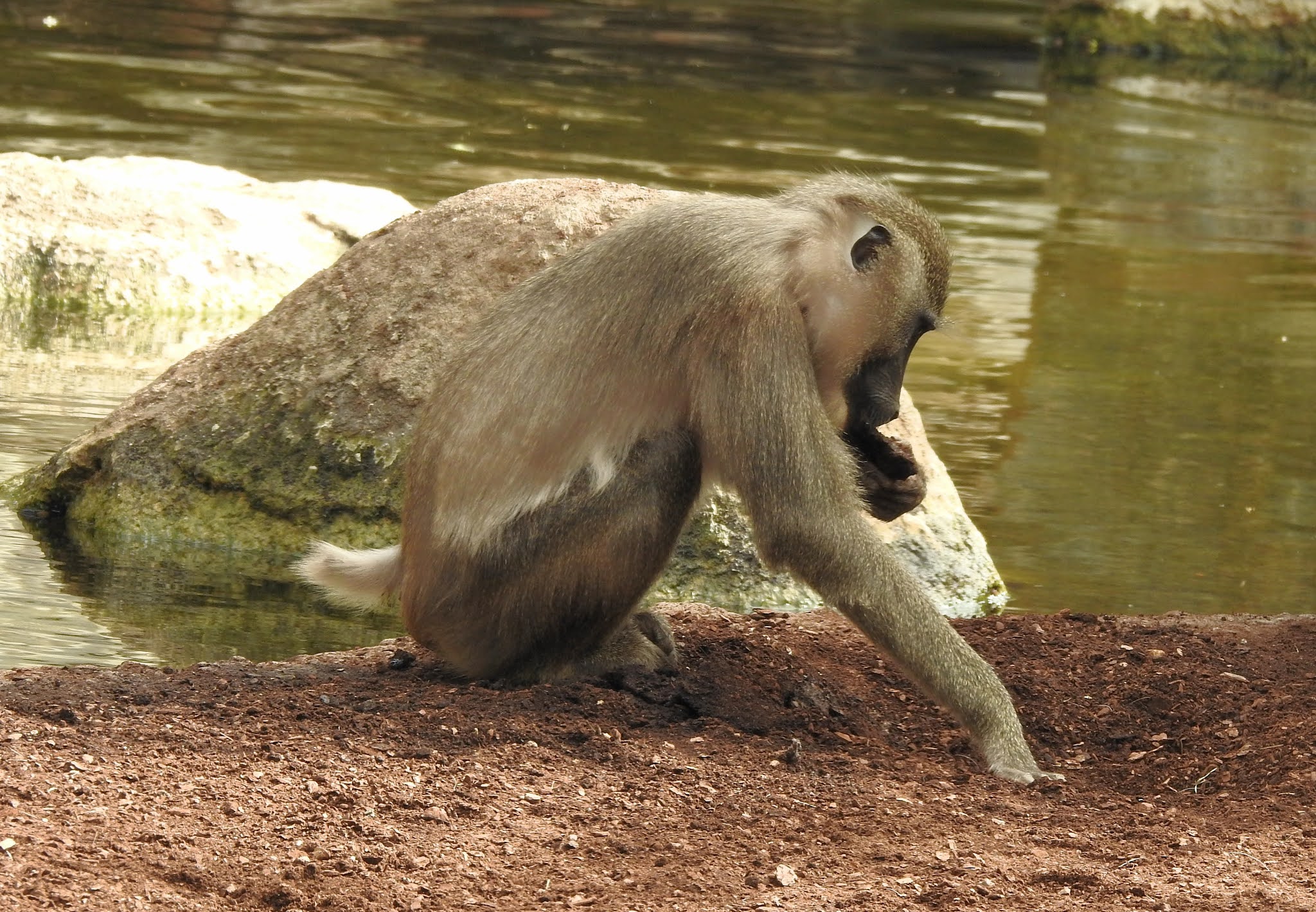
The drill (Mandrillus leucophaeus) is a highly endangered Old World monkey native to the tropical rainforests of Nigeria, Cameroon, and Bioko Island. Closely related to the mandrill, this striking primate is easily recognized by its jet-black face, crimson lower lip, and vividly colored purple and red buttocks.
Key Characteristics
Appearance: The drill has a short tail and stout body. Males are significantly larger, weighing around 25 kg, which is more than double the average size of females (11.5 kg).

Social Structure: They are gregarious and diurnal omnivores, living in groups (troops) that range from a single male and several females to aggregations of over 100 individuals.
Habitat: They are primarily terrestrial foragers but are adept climbers that forage for fruit, insects, and small prey.
Conservation StatusThe drill is considered one of the most threatened primates in the world. Its wild populations face severe decline due to intensive hunting for bushmeat and widespread deforestation.


Saturday, 3 April 2021
29-3-2021 BIOPARC, VALENCIA - CAPE TEAL (Anas capensis)

The Cape teal (Anas capensis) also Cape wigeon or Cape widgeon is a 44–46 cm long dabbling duck of open wetlands in sub-Saharan Africa.
The Cape teal was formally described in 1789 by the German naturalist Johann Friedrich Gmelin in his revised and expanded edition of Carl Linnaeus's Systema Naturae. He placed it with all the ducks, geese and swans in the genus Anas and coined the binomial name Anas capensis. Gmelin based his description on the "Cape widgeon" that had been described in 1785 by the English ornithologist John Latham in his A General Synopsis of Birds. The naturalist Joseph Banks had provided Latham with a water-colour drawing of the teal by Georg Forster who had accompanied James Cook on his second voyage to the Pacific Ocean. His picture was drawn in 1773 at the Cape of Good Hope. This picture is now the holotype for the species and is held by the Natural History Museum in London. The genus name Anas is the Latin word for a duck. The specific epithet capensis indicates the Cape of Good Hope. The species is monotypic: no subspecies are recognised.

Like many southern ducks, the sexes are similar. It is very pale and mainly grey, with a browner back and pink on the bill (young birds lack the pink). This is a generally quiet species, except during mating displays. The breeding male has a clear whistle, whereas the female has a feeble "quack". The Cape teal cannot be confused with any other duck in its range.
This species is essentially non-migratory, although it moves opportunistically with the rains. It is a thinly distributed but widespread duck, rarely seen in large groups except the moulting flocks, which may number up to 2000.
The Cape teal feeds on aquatic plants and small creatures (invertebrates, crustaceans and amphibians) obtained by dabbling. The nest is on the ground under vegetation and near water.
The Cape teal is one of the species to which the Agreement on the Conservation of African-Eurasian Migratory Waterbirds (AEWA) applies.
29-3-2021 BIOPARC, VALENCIA - HELMETED GUINEA FOWL (Numida meleagris)

Helmeted guinea fowl are seasonal breeders. Summer is the peak breeding season in which the testes could weigh up to 1.6 gm, while during winter no breeding activity takes place. The serum testosterone level is up to 5.37 ng/ ml during the breeding season.
They breed in warm, fairly dry and open habitats with scattered shrubs and trees such as savanna or farmland.

Subscribe to:
Posts (Atom)