TOTAL PAGEVIEWS

TRANSLATE

Sunday, 3 October 2021

3-10-2021 PEGO MARJAL, ALICANTE - LAMENTING GRASSHOPPER (Eyprepocnemis plorans)


Eyprepocnemis plorans, the lamenting grasshopper, is a species of insect in the family Acrididae. It is the type species of the genus Eyprepocnemis, and is found in Africa, parts of the Middle East, and southern Europe. It typically inhabits wetlands and other moist habitats.

This is a medium-sized grasshopper, with females growing to a length of about 4.5 cm (1.8 in), while males are slightly smaller. The general colour is greyish-brown. The head and prothorax have a central dark band edged with paler stripes. The eye has a longitudinal dark streak, a characteristic shared by Anacridium aegyptium, Heteracris annulosa and Heteracris adspersa. The femurs of the hind legs have greenish, blue and yellow striations, and the hind tibia have reddish or bluish iridescence, and black and white spines.

Eyprepocnemis plorans is native to much of Africa, parts of the Middle East such as Iran, and southern Europe, where it is present in southern Greece, southern Italy, Sicily, Sardinia and southern Spain. It seems to be expanding its range northwards in Italy, possibly as a result of putative climate change. It usually occurs in wetlands, reed beds, freshwater and salt marshes, riverside vegetation, coastal vegetation and man-made habitats. It appreciates vertical-growing stems such as reeds, and habitats with tall forbs mixed with lower-growing plants.

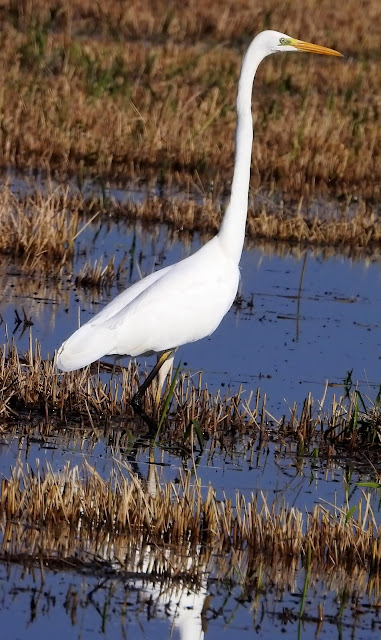
3-10-2021 PEGO MARJAL, ALICANTE - GREAT EGRET (Ardea alba)


3-10-2021 PEGO MARJAL, ALICANTE - OSPREY (Pandion haliaetus)


Friday, 1 October 2021

30-9-2021 MONTE CORONA, VALENCIA - SCARCE CRIMSON AND GOLD MOTH (Pyrausta sanguinalis)


30-9-2021 MONTE CORONA, VALENCIA - CURVED HORN MOTH (Superfamily Gelechioidea)


Curved-horn moths (superfamily Gelechioidea) are a massive, diverse group of primarily "micro-moths" comprising 15–21 families and over 18,000 described species worldwide. Defined by their distinct,, up-curved labial palps, they occupy varied habitats as leaf miners, case-bearers, or pests, with many larvae feeding on plants, fungi, or stored products. 

Key Facts About Curved-Horn Moths (Gelechioidea)

Distinctive Appearance: The name comes from their well-developed, upward-curved labial palps, which resemble horns. They are generally small ("micro-moths").

Massive Diversity: With over 18,000 described species, it is one of the largest Lepidoptera superfamilies, and experts estimate only 25% of their total diversity has been described.

Etymology: The name Gelechioidea is derived from the type genus Gelechia, meaning "resting on the ground".

30-9-2021 MONTE CORONA, VALENCIA - ROSY TABBY MOTH (Endotricha flammealis)


1-10-2021 MONTE CORONA, VALENCIA - WAVE MOTH (Scopula submutata)


Wednesday, 29 September 2021

29-9-2021 CREU DE LONGA, VALENCIA - EUROPEAN MOORHEN (MALE) (Gallinula chloropus)


The common moorhen, known scientifically as Gallinula chloropus, is a bird of the rail family, Rallidae. It is a bird of striking appearance, with a mix of black and brown plumage, a white under-tail, and white streaks along its flanks. Its legs are a vibrant yellow, and it sports a distinctive red frontal shield. The bill is a matching red with a yellow tip. Juveniles are a duller brown and do not have the red shield.

Adult moorhens can be identified by their red frontal shield, which has a rounded top and fairly parallel sides. The tailward margin of the red unfeathered area is smoothly curved. Their yellow legs and the combination of their black and brown plumage with white markings make them quite distinctive. The young are browner and lack the red shield, making them less conspicuous.


The common moorhen is found in a variety of wetland habitats, including marshes, ponds, canals, and lakes that are rich in vegetation. It is also known to inhabit city parks with suitable water bodies.

This species has a broad distribution across many parts of the Old World. It is not found in polar regions or many tropical rainforests but is otherwise widespread, often being the most common rail species in its range.


Сommon moorhens are monogamous and territorial. They form pair-bonds that may last for several years. Pairs nest solitarily usually on top of thick mats of aquatic plants but may also nest in trees, shrubs, or on the ground in dense vegetation. Their nest is a wide shallow cup made with dead vegetation and lined with grass and leaves. Laying starts in spring, between mid-March and mid-May in Northern Hemisphere temperate regions. About 8 eggs are usually laid per female early in the season. Incubation lasts about three weeks. The chicks are precocial; they are hatched with eyes open and are covered in blackish down. Both parents incubate and feed the young. They fledge after 40-50 days, become independent usually a few weeks thereafter, and may raise their first brood the next spring.

29-9-2021 CREU DE LONGA, VALENCIA - EUROPEAN MOORHEN (JUVENILE) (Gallinula chloropus)


29-9-2021 PORTAL DE SOLLANA, VALENCIA - VIOLET DROPWING DRAGONFLY (MALE) (Trithemis annulata)


29-9-2021 PORTAL DE SOLLANA, VALENCIA - VIOLET DROPWING DRAGONFLY (FEMALE) (Trithemis annulata)


29-9-2021 TANCAT DE MILLA, VALENCIA - PAINTED LADY BUTTERFLY (Vanessa cardui)


29-9-2021 SOLLANA, VALENCIA - WESTERN MARSH HARRIER (Circus aeruginosus)


Tuesday, 28 September 2021

26-9-2021 EL SALER. VALENCIA - LITTLE EGRET (Egretta garzetta)


26-9-2021 DEVESA. VALENCIA - COMMON RINGED PLOVER (Charadrius hiaticula)


26-9-2021 EL SALER. VALENCIA - GREAT EGRET (Ardea alba)


Great Egrets usually stay in habitats that have areas of either saltwater or freshwater nearby. They are seen near marshes, ditches, canals, ponds, tidal flats, rivers, streams, swamps, lakes, estuaries (or water passages where the ocean tide meets a river current), and flooded farm fields. Great Egrets are usually solitary birds when not nesting. But they also can gather together from surrounding areas to form a place where a large group can rest or sleep, called a communal roost. Frequently, several pairs build nests in the same tree and form a colony; but occasionally a pair may nest alone. Great Egrets often share colonial nesting sites, or rookeries, with other egret species, herons, and other wading birds as well.

They build their nests in trees, thickets, or shrubs 10-90 feet above water or ground. Nesting colonies are usually located in extremely tall trees. Great Egrets build large platform-style nests using sticks and line the nests with plant material. Both parents help to build the nest, incubate (to sit on and keep the eggs warm) the eggs, and feed their young. The young will be able to fly in 6-7 weeks after hatching.

Within the colony, Great Egrets are territorial and aggressive, defending their space with sharp bill jabs and harsh calls.

The great egret is generally a very successful species with a large and expanding range, occurring worldwide in temperate and tropical habitats. It is ubiquitous across the Sun Belt of the United States and in the Neotropics. In the Nordic countries, it was historically a rare visitor. 

26-9-2021 CREU DE LONGA. VALENCIA - LITTLE EGRET (Egretta garzetta)


28-9-2021 VILLALONGA RESERVOIR, VALENCIA - EPAULET SKIMMER DRAGONFLY (MALE) (Orthetrum chrysostigma)


28-9-2021 VILLALONGA RESERVOIR, VALENCIA - GREAT CRESTED GREBE (Podiceps cristatus)


The great crested grebe, Podiceps cristatus, is a water bird of the grebe family, notable for its striking black and white plumage and elaborate courtship displays. It is the largest grebe species found in the Old World, with some larger species in the Americas.

Adults are unmistakable in summer with ornate head and neck decorations. In winter, they are whiter than most grebes, with a distinctive white above the eye and a pink bill. Juveniles can be identified by their black and white striped heads, which they lose upon reaching adulthood.

This species prefers vegetated areas of freshwater lakes for breeding.

The great crested grebe has three subspecies: P. c. cristatus in Eurasia, P. c. infuscatus in Africa, and P. c. australis in Australia, Tasmania, and the South Island of New Zealand. The European subspecies migrates from colder regions, while the African and Australasian subspecies are mainly sedentary.

The great crested grebe is an excellent swimmer and diver, pursuing fish underwater. Its mating display is particularly elaborate, involving synchronized dances and poses.