This Blog contains Wildlife, Plants and Bird Photos from Walks, Safaris, Birding Trips and Vacations. Most of the pictures have been taken with my Nikon P900 and P950X cameras. Just click on any image for a larger picture. On the right column under the Blog Archive are the entries by date. Below that under Animal categories all the diffent species of Animals, Birds, Insects and Plants contained in the website are listed. Clicking on any entry will show all the entries for that species.
TOTAL PAGEVIEWS
TRANSLATE
Thursday, 7 October 2021
7-10-2021 MONTE CORON, VALENCIA - WAVE MOTH (Idaea filicata)
1-4-2021 EL PALMAR, VALENCIA - GREY HERON (Ardea cinerea)
Its habitats are principally Wetlands, River and Riverside
It lives in all types of wetlands with salty or fresh water in winter. In the breeding season it needs wetlands with nearby tree vegetation. Also in Reservoirs, lagoons, ditches and irrigation ponds, stream banks, coast line.
6-10-2021 MONTE CORONA, VALENCIA - BURNT PINE LONGHORN BEETLE (Arhopalus ferus)
Adult beetles are 8–30 mm long reddish-brown to black, while males are generally smaller and lighter in colour.
The body is elongated and oval, typical for longhorn beetles. The head angles forward, showing most of the mouth parts. The thread-like antennae are half to three-quarters of the body length, longer in males. The prothorax is smoothly curved with no spines, narrower than the elytra. The elytra have four ridges and slightly tapering sides.
Eggs are white, opaque, and cigar-shaped, measuring about 0.5 by 1.8 mm. Creamy white larvae are cylindrical, with noticeable legs and pointed jaws. Larvae are active when removed from their tunnels.
Arhopalus ferus prefers dead or dying Pinus and Picea injured by fire or other damage but rarely it will develop in healthy trees. Females are attracted to volatiles from burnt trees or sawmills.
6-10-2021 MONTE CORONA, VALENCIA - WAVE MOTH (Scopula minorata)
The wingspan is 15–20 millimetres (0.59–0.79 in).
Subspecies
Scopula minorata minorata
Scopula minorata corcularia (Rebel, 1894)
Scopula minorata ochroleucaria (Herrich-Schäffer, 1847)
Scopula minorata tripolitana (Sterneck, 1933)
22-3-2020 MONTE CORONA, VALENCIA - FUNGI (Genus Stereum)
Wednesday, 6 October 2021
6-10-2021 CANAL LES FONTS OLIVA , VALENCIA - LITTLE EGRET (Egretta garzetta)
Adult Little Egrets measure between 55–65 cm in length with a wingspan of 88–106 cm, and weigh 350–550 g. Their plumage is predominantly white, though some may exhibit bluish-grey coloration. Breeding adults boast ornate nape plumes reaching about 150 mm, along with distinctive feathers on the breast and elongated scapulars. The bill and lores are black, with greenish-grey skin at the base of the lower mandible and around the eye, which houses a yellow iris. Legs are black with contrasting yellow feet, though juveniles may have greenish-black legs and duller feet. The subspecies E. g. nigripes is distinguished by yellow skin between the bill and eye, and blackish feet.
The species has a broad breeding distribution across warm temperate to tropical regions of Asia, Africa, Australia, and Europe. Northern populations are migratory, wintering in Africa and southern Asia, while others remain as permanent residents in warmer areas.
6-10-2021 MONTE CORONA, VALENCIA - COMMON HAIRY FIELD SPIDER (Neoscona subfusca)
Tuesday, 5 October 2021
Sunday, 3 October 2021
22-8-2021 SPACE MUSEUM, CUENCA - LYSIMNIA TIGERWING BUTTERFLY (Mechanitis lysimnia)
2-10-2021 MONTE CORONA, VALENCIA - MOORISH GECKO (JUVENILE) (Tarentola mauritanica)
The species was first described by Carl Linnaeus in 1758. It is also known as moorish gecko, crocodile gecko, European common gecko, and, regionally, as osga (in Portuguese), salamanquesa (in Spanish) and dragó (in Catalan).
3-10-2021 PEGO MARJAL, ALICANTE - LAMENTING GRASSHOPPER (Eyprepocnemis plorans)
This is a medium-sized grasshopper, with females growing to a length of about 4.5 cm (1.8 in), while males are slightly smaller. The general colour is greyish-brown. The head and prothorax have a central dark band edged with paler stripes. The eye has a longitudinal dark streak, a characteristic shared by Anacridium aegyptium, Heteracris annulosa and Heteracris adspersa. The femurs of the hind legs have greenish, blue and yellow striations, and the hind tibia have reddish or bluish iridescence, and black and white spines.
Eyprepocnemis plorans is native to much of Africa, parts of the Middle East such as Iran, and southern Europe, where it is present in southern Greece, southern Italy, Sicily, Sardinia and southern Spain. It seems to be expanding its range northwards in Italy, possibly as a result of putative climate change. It usually occurs in wetlands, reed beds, freshwater and salt marshes, riverside vegetation, coastal vegetation and man-made habitats. It appreciates vertical-growing stems such as reeds, and habitats with tall forbs mixed with lower-growing plants.
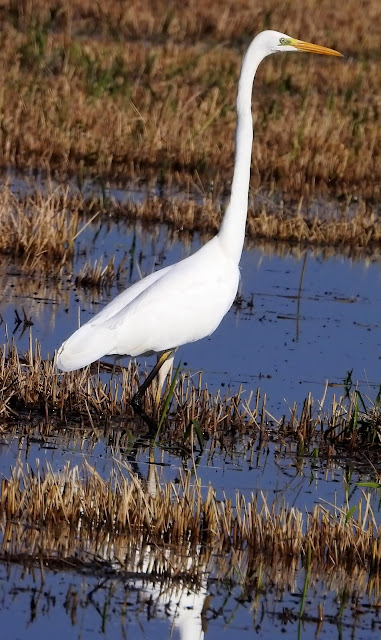
3-10-2021 PEGO MARJAL, ALICANTE - GREAT EGRET (Ardea alba)
Within the colony, Great Egrets are territorial and aggressive, defending their space with sharp bill jabs and harsh calls.
The great egret is generally a very successful species with a large and expanding range, occurring worldwide in temperate and tropical habitats. It is ubiquitous across the Sun Belt of the United States and in the Neotropics. In the Nordic countries, it was historically a rare visitor.
They primarily feed on aquatic animals like fish, frogs, and crustaceans. Small mammals, birds, and insects are also part of their diet. Great Egrets hunt by wading in shallow water, using their sharp bills to catch prey. Their diet varies depending on the season and location, adapting to available food sources.
Nests are made of sticks and twigs; the nests are large — up to a yard across and a foot deep. They are often built in trees above water. A clutch has up to 6 eggs, which are incubated for 23–27 days; after hatching the young stay at the nest for 21–25 days. Great egrets can live to be at least 22 years old.
Great Egrets are usually solitary birds when not nesting. But they also can gather together from surrounding areas to form a place where a large group can rest or sleep, called a communal roost. Frequently, several pairs build nests in the same tree and form a colony; but occasionally a pair may nest alone.
Saturday, 2 October 2021
28-9-2021 MONTE CORONA, VALENCIA - COMMON MAQUIS GRASSHOPPER (Pezotettix giornae)
This very little grasshopper is present in Southern Europe (and parts of Central Europe), North Africa and in the Near East.
Pezotettix giornae, mating couple
This species inhabits meadows of lowlands, forest edges, xerotherm areas of plains and southern slopes of stony mountains.
The adult males grow up to 11–14 millimetres (0.43–0.55 in) long, while the females reach 12–18 millimetres (0.47–0.71 in) of length. The basic coloration of the body varies from light brown to greyish. The eyes are relatively large and the sides of thorax sometimes show a white or darker longitudinal stripe. The wings are scaly, oval, very short, reaching only the middle of the second rear segment, so they are unable to fly and resemble nymphs (brachyptery). Nymphs are usually green in the early stages.
This immature stages of this species develop in summer, passing through six instars. Adults can be encountered from June through November in the Mediterranean. They mate in autumn and in winter and often overwinter as adults. In this case they can be found by March.
%2020.jpg)
%2020.jpg)
%2020.jpg)
.jpg)