TOTAL PAGEVIEWS

TRANSLATE

Monday, 15 November 2021

15-11-2021 MONTE CORONA, VALENCIA - CUTWORM MOTH (Cerastis faceta)


The Cutworm Moth (Cerastis faceta) is a species of noctuid moth belonging to the family Noctuidae, first described by German entomologist Georg Friedrich Treitschke in 1835.

Key Characteristics & Biology

Appearance & Flight: Medium-sized (30–32 mm wingspan) with camouflaged gray-brown forewings. Adults fly early in the season, from February to April.

Larval Behavior: Nocturnal feeders on various low-growing plants that hide underground during the day.

Habitat & DistributionThis Mediterranean species is found across North Africa and Southern Europe, including regions such as Spain, Portugal, Italy, and various islands.

15-11-2021 LORCA, VALENCIA - EUROPEAN MANTIS (MALE) (Mantis religiosa ssp. religiosa)


15-11-2021 LORCA, VALENCIA - STUBBLE ROSEGILL (Volvopluteus gloiocephalus)


15-11-2021 LORCA, VALENCIA - DOTTED STALKED SUILLUS (Suillus granulatus)


15-11-2021 MONTE CORONA, VALENCIA - SHIELDBACK KATYDID (Thyreonotus corsicus)


Thyreonotus corsicus is a species belonging to the family Tettigoniidae subfamily Tettigoniinae. It is found in the western Mediterranean from the Iberian Peninsula over the south of France to the southwestern Alps. Isolated populations are found in Corsica and Sardinia.

Shieldbacks have a substantial pronotum that looks like a shield. 

They look like tiny armored tanks – rounded, plump, sturdy - but they are not as invulnerable as they appear and can be seriously injured if dropped. It might be a good idea to leave them where you find them (should you be fortunate enough to locate one) and simply watch what they do - including catching and eating other insects. I observed a Protean Shieldback about to grab and eat a male Japanese beetle that was in the process of mating!


They live in woodland edges and shrubby meadows, and their shades of brown blend very well with bark, shrub stems, and dry leaves. These katydids are generally nocturnal and are predators on smaller insects. Although I seldom see or hear them, they seem to mature in the beginning of July.

Their song is an electrical buzzing reminiscent of a humming wire. Although non-native, they mature earlier than our native meadow katydids and don’t seem to be a problem. Listen for them in grassy meadows from later June into July.


Habitat:

Thyreonotus corsicus inhabits most often areas with strongly developed vegetation (bushes, dwarf shrubs, grasses) like garigues, scrub, maquis or dry open woodland.

Life cycle:

The adults appear between late June/July and November. The adults often rest in elevated position in bushes such as Buxus or Juniperus.

Remarks:

Thyreonotus corsicus occurs in SW-Europe (Iberian Peninsula, S-France, Corsica and Sardinia).

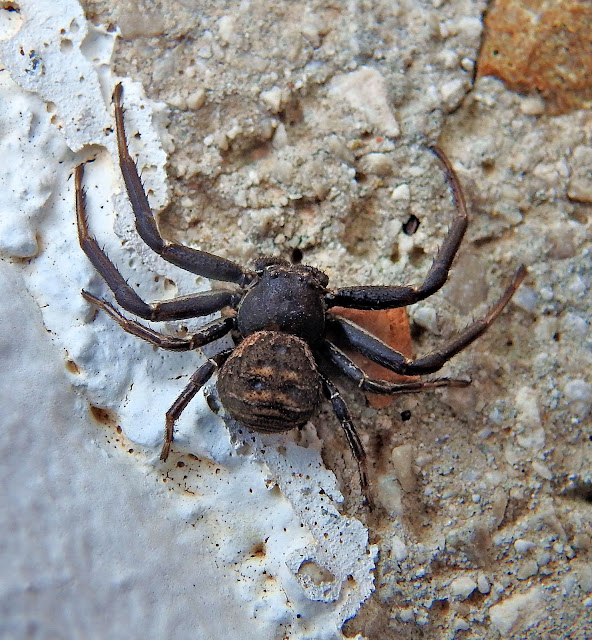
15-11-2021 MONTE CORONA, VALENCIA - TOAD CRAB SPIDER (Bassaniodes bufo)


Sunday, 14 November 2021

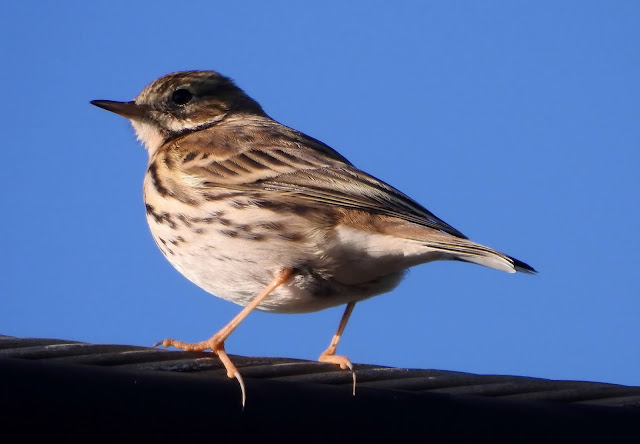
14-11-2021 LA FONT EN CARROS, VALENCIA - MEADOW PIPIT (Anthus pratensis)


14-11-2021 LA FONT EN CARROS, VALENCIA - COMMON CHIFFCHAFF (Phylloscopus collybita)


14-11-2021 LA FONT EN CARROS, VALENCIA - EUROPEAN GOLDFINCH


14-11-2021 LA FONT EN CARROS, VALENCIA - BLACK REDSTART (FEMALE) (Phoenicurus ochruros)


14-11-2021 GANDIA, VALENCIA - EURASIAN COLLARED DOVE (Streptopelia decaocto)


The Eurasian collared dove, also known as the collared dove or Turkish dove (Streptopelia decaocto), is a bird of modest size, presenting a grey-buff to pinkish-grey plumage that is slightly darker above than below. It is recognized by its distinctive black half-collar edged with white on its nape, from which it derives its name. The species exhibits a blue-grey underwing patch and a tail that is grey-buff above, with dark grey and white-tipped feathers below. The sexes appear similar, with juveniles displaying a less developed collar and a brown iris.

To identify the Eurasian collared dove, look for its medium size, slimmer and longer-tailed body compared to a rock pigeon, and a shorter stature than the wood pigeon. The red legs, black bill, and red iris surrounded by a small area of bare skin, which may appear white or yellow, are key features. The bird's song, a three-part cooing "goo-GOO-goo," and a harsh screeching call are also distinctive identifiers.


This species is often found in proximity to human habitation, particularly where food is plentiful and trees are available for nesting. It is not uncommon to see these doves frequenting bird tables and farms.

Originally from warm temperate and subtropical Asia, the Eurasian collared dove has expanded its range dramatically, colonizing colder countries and becoming a permanent resident in many. Its range now includes Europe, North America, and the Caribbean.

14-11-2021 POTRIES, VALENCIA - EUROPEAN ROBIN (Erithacus rubecula)


14-11-2021 POTRIES, VALENCIA - PAINTED LADY BUTTERFLY 1


Saturday, 13 November 2021

13-11-2021 MONTE CORONA, VALENCIA - CUTWORM MOTH (Cerastis faceta)


The Cutworm Moth (Cerastis faceta) is a species of noctuid moth belonging to the family Noctuidae, first described by German entomologist Georg Friedrich Treitschke in 1835.

Key Characteristics & Biology

Appearance & Flight: Medium-sized (30–32 mm wingspan) with camouflaged gray-brown forewings. Adults fly early in the season, from February to April.

Larval Behavior: Nocturnal feeders on various low-growing plants that hide underground during the day.

Habitat & DistributionThis Mediterranean species is found across North Africa and Southern Europe, including regions such as Spain, Portugal, Italy, and various islands.

22-8-2021 SPACE MUSEUM, CUENCA - VARIABLE CATTLEHEART BUTTERFLY (Parides erithalion)


13-11-2021 MONTE CORONA, VALENCIA - MEDITERRANEAN MANTIS (FEMALE) (Iris oratoria)

Iris oratoria, known by the common name Mediterranean mantis (or less frequently iris mantis), due to humans first studying it in lands around the Mediterranean Sea, is a species of praying mantis. Its range is expanding in the Middle East, Western Asia and the United States.

The Mediterranean mantis is known for two distinctive behaviours, apart from the ambush hunting common to other mantids: cannibalism and deimatic or threat displays. The sexual cannibalism of mantids known in popular culture occurs in roughly one quarter of all intersexual encounters of I. oratoria.

When the mantis is under attack, it sets in motion a complex series of actions which combine to form a startling deimatic display. The mantis turns to face the aggressor, rears up by arching its back, curls its abdomen upwards (dorsiflexion), raises and waves its forelimbs, raises its wings to displays the large brightly coloured eyespots on the hindwings, and stridulates by scraping the edge of its hindwings against its tegmina, the leathery front wings.

3-11-2021 BIOPARC, VALENCIA - FOREST BUFFALO (MALE) (Syncerus caffer ssp. nanus)


3-11-2021 BIOPARC, VALENCIA - DRILL (Mandrillus leucophaeus)


The drill (Mandrillus leucophaeus) is a primate of the family Cercopithecidae (Old World monkeys), related to baboons and even more closely to mandrills.

Drills are found only in Cross River State in Nigeria, southwestern Cameroon (south to the Sanaga River), and on Bioko Island, part of Equatorial Guinea, in rainforest habitats. Their entire global range is less than 40,000 km2.

Drills are among Africa’s most endangered mammals, and are listed by the IUCN as the highest conservation priority of all African primates. Drill numbers have been declining in all known habitat areas for decades as a result of illegal commercial hunting, habitat destruction, and human development; as few as 3,000 drills may remain in the wild, with the highest population estimate only 8,000. A total of 174 drills recovered from illegal capture are in semicaptivity at the Drill Rehabilitation and Breeding Centre in Nigeria, with high success rates in breeding recorded there, and about 40 in other zoos internationally.


The drill (Mandrillus leucophaeus) is a highly endangered Old World monkey native to the tropical rainforests of Nigeria, Cameroon, and Bioko Island. Closely related to the mandrill, this striking primate is easily recognized by its jet-black face, crimson lower lip, and vividly colored purple and red buttocks.

Key Characteristics

Appearance: The drill has a short tail and stout body. Males are significantly larger, weighing around 25 kg, which is more than double the average size of females (11.5 kg).

Social Structure: They are gregarious and diurnal omnivores, living in groups (troops) that range from a single male and several females to aggregations of over 100 individuals.

Habitat: They are primarily terrestrial foragers but are adept climbers that forage for fruit, insects, and small prey.

Conservation StatusThe drill is considered one of the most threatened primates in the world. Its wild populations face severe decline due to intensive hunting for bushmeat and widespread deforestation.

Friday, 12 November 2021

3-11-2021 BIOPARC, VALENCIA - COMMON BROWN LEMUR (Eulemur fulvus)


The common brown lemur (Eulemur fulvus) is a species of lemur in the family Lemuridae. It is found in Madagascar and has been introduced to Mayotte.

The common brown lemur has a total length of 84 to 101 cm (33 to 40 in), including 41 to 51 cm (16 to 20 in) of tail.[5] Weight ranges from 2 to 3 kg (4.4 to 6.6 lb). Common brown lemurs are unique amongst Eulemur in that they exhibit little-to-no sexual dichromatism: in both males and females, the face, muzzle and crown are dark gray or black, with white or tan "cheeks" of varying thickness. Some individuals may have pale-colored eyebrow patches, and the eyes are almost always a deep orange-red. The short, dense fur of the body is primarily brown or gray-brown, with a lighter gray or tan underside. The fur on the back of their hands is often a medium orange or reddish color, and their long, bushy tail may either be similar in color to the dorsal pelage or, more commonly, a darker shade of gray, black, or brown.

Due to the species' history of containing all fellow brown lemurs as subspecies, they are very commonly misidentified in images and texts, and often confused with other species (such as red-fronted lemurs and gray-headed lemurs) or with various other unrelated hybrids.

Similar lemur species within their range include the mongoose lemur (E. mongoz) in the west and the red-bellied lemur (E. rubriventer) in the east. They can be distinguished from these species by the fact that E. mongoz is more of a grey color and E. rubriventer is more reddish. There is also some overlap with the black lemur in northeast Madagascar in the Galoko, Manongarivo and Tsaratanana Massifs.  There is also overlap and hybridization with the white-fronted brown lemur, E. albifrons, in the northeast portion of the common brown lemur's range.


The common brown lemur's diet consists primarily of fruits, young leaves, and flowers.  In some locations it eats invertebrates, such as cicadas,spiders and millipedes.It also eats bark, sap, soil and red clay (see geophagy). It can tolerate greater levels of toxic compounds from plants than other lemurs can.
 
The common brown lemur lives in western Madagascar north of the Betsiboka River and eastern Madagascar between the Mangoro River and Tsaratanana, as well as in inland Madagascar connecting the eastern and western ranges. They also live on the island of Mayotte, although this population has been introduced there by man. 

Thursday, 11 November 2021

3-11-2021 BIOPARC, VALENCIA - WESTERN GORILLA (Gorilla gorilla)


3-11-2021 BIOPARC, VALENCIA - AFRICAN SPURRED TORTOISE (Centrochelys sulcata)


The African spurred tortoise (Centrochelys sulcata), also called the sulcata tortoise, is a species of tortoise inhabiting the southern edge of the Sahara desert in Africa. It is the largest mainland species of tortoise in the world, and the third-largest in the world. It is the last remaining species in its genus, Centrochelys, with the five other species in the family already extinct.


C. sulcata is currently ranked as an endangered species.] Studies suggest that African spurred tortoises exist in approximately 16.7% of the area where they had previously been found. These studies also show an average of 1-5 tortoises per site canvassed which indicates a rapid decline of the species. The species faces threats from livestock as they have to compete for resources. The main source of resource competition African spurred tortoises face is from cattle which also graze on grass. The effects of competition for grazing land is compounded by wildfires which can destroy large portions of grass land which kills and rescues the resources available to C sulcata. They also face threats from the pet trade as they are over harvested from their natural environment. Approximately 9000 tortoises are taken from the wild for the pet trade. Other threats that the species face are habitat loss due to climate change and predators which hunt the tortoises or their eggs.


3-11-2021 BIOPARC, VALENCIA - GREAT WHITE PELICAN (Pelecanus onocrotalus)


The Great white pelican (Pelecanus onocrotalus) that lives in the shallow swamps in Africa is one of the largest flying birds in the world. It has the abilities of multiple birds, such as long flights and swimming. Its unique characteristic is the “gular pouch” inside its beak. Its legs are short and strong with fully webbed toes that allow it to propel itself in water and to take off from the surface of the water. They are powerful fliers and often travel in flocks in a V-formation to reduce drag for the group.


Resident populations of Great white pelicans are found the whole year round south of the Sahara Desert in Africa. Migratory populations inhabit Eastern Europe to Kazakhstan when it is the breeding season and during the winter in northeast Africa and Iraq to the north of India and southern Vietnam. In Europe, they occur in freshwater lakes, marshes, swamps, or deltas, wherever there are sufficient amounts of grasses or reed beds for nesting. In Africa, they are found in lowlands and freshwater or alkaline lakes. Shallow, warm water is needed for the fishing technique of these birds.


The Great white pelican is a huge bird - only the Dalmatian pelican is, on average, larger among pelicans. The male has a downward bend in the neck and the female has a shorter, straighter beak. The plumage is predominantly white except on remiges, with a faint pink tinge on the neck and a yellowish base on the foreneck. The primary feathers are black, with white shafts at the bases, occasionally with paler tips and narrow fringes. The secondary feathers are also black but with a whitish fringe. The upperwing coverts, underwing coverts, and tertials are white. The forehead is swollen and pinkish skin surrounds the bare, dark eyes having brown-red to dark brown irides. It has fleshy-yellow legs and pointed forehead-feathers where meeting the culmen. 


In breeding season, the male has pinkish skin while the female has orangey skin on its face. The bill is mostly bluish-grey, with a red tip, reddish maxilla edges, and a cream-yellow to yolk-yellow gular pouch. The white plumage becomes tinged-pink with a yellow patch on the breast, and the body is tinged with yellowish-rosy. It also has a short, shaggy crest on the nape. The white covert feathers contrast with the solid black primary and secondary feathers. The legs are yellow-flesh to pinkish orange. Both male and female are similar, but the female is smaller and has brighter orange facial skin in the breeding season. The juvenile has darker, brownish underparts that are palest at the rump, center of the belly, and uppertail coverts. The underwing coverts are mostly dull-white, but the greater coverts are dark and there is a dark brownish bar over the lesser coverts. 


The rear tertials upperwing coverts mostly have paler tips with a silvery-grey tinge on the greater secondary coverts and tertials. It has dark flight feathers and brown-edged wings. The head, neck, and upperparts, including the upperwing coverts, are mostly brown - this is the darkest part of the neck. The facial skin and the bill, including its gular pouch, are greyish to dusky greyish. The forehead, rump, and abdomen are white, and its legs and feet are grey. Its blackish tail occasionally has a silvery-grey tinge. Its underparts and back are initially browner and darker than those of the Dalmatian pelican, and the underwing is strongly patterned, similar to the juvenile Brown pelican.

3-11-2021 BIOPARC, VALENCIA - MEERKAT (Suricata suricatta)


The meerkat has a wide distribution in southern Africa, from the extreme southwest of Angola, through Namibia and Botswana, and into the west and north of South Africa. They live in areas with the stony, often calcareous ground in a variety of arid, open habitats with little woody vegetation. Meerkats are common in savannahs, open plains, and rocky areas beside dry rivers. They are absent from true deserts but may occur in semi-desert regions.


The meerkat is like only three other mongoose species, in that it is highly sociable and inhabits territories in packs. A pack usually has 10 to 30 individuals (although much larger ones are not uncommon where the food supply is plentiful) consisting of 3 or 4 family units with a male, female, and their young. Packs can move collectively in search of food, to escape high predator pressure, and during floods. Meerkats live in large burrow systems that are typically 5 m (16 ft) in diameter with around 15 openings; these large underground networks consist of 2 to 3 levels of tunnels. Once meerkats come out of their burrows in the early morning sun to sunbathe, most of them will go off to seek food while the others act as guards or babysit the young. By standing on their hind legs up on mounds and in bushes, the guards are able to have a good view of approaching predators, particularly those in the sky. They will use different alarm calls to alert the group to the danger, and often the whole group will dive into the burrow to hide.


Meerkats exhibit a monogamous mating system, meaning that the dominant male and female of each group are usually the only individuals to successfully breed. However, subordinate females very occasionally will reproduce, and subordinate males will temporarily leave the group to try to mate with females of other groups, which suggests polygynous behavior. The breeding season in the wild runs from October to April, whereas in captivity they breed year-round. Gestation lasts for 11 weeks, with 2 to 5 pups being born. The pups stay in their burrow for three weeks, ‘babysat’ by helpers. When they are four weeks old, the pups will begin to go with the group to forage, and for their first 49 to 63 days will be fed by the helpers, at the same time being taught how to get their own food. The young become independent enough to forage at around 12 weeks of age. This species becomes reproductively mature at about 1 year of age

Meerkats are carnivores (insectivores), eating insects such as scorpions (they are immune to venom), beetles, spiders, crickets, centipedes, millipedes, and worms. They also eat eggs, roots, tubers, small reptiles, and small mammals.

11-11-2021 MONTE CORONA, VALENCIA - EURASIAN SISKIN (Spinus spinus)


3-11-2021 BIOPARC, VALENCIA - AFRICAN WATTLED LAPWING (Vanellus senegallus)