TOTAL PAGEVIEWS

TRANSLATE

Saturday, 18 December 2021

9-12-2021 CITY OF ARTS AND SCIENCES, VALENCIA - FLORIDA RED BELLY TURTLE (Pseudemys nelsoni)


The Florida Red-Bellied Cooter (Pseudemys nelsoni) is a large, herbivorous freshwater turtle in Florida, known for its reddish-orange belly, yellow-striped dark skin, and preference for basking in sunny spots on logs in lakes, rivers, and marshes, often sharing habitats with alligators, whose nests they sometimes use for laying eggs, growing large (females up to 14+ inches) and living for decades. 

Appearance & Size
Shell: Brown/olive carapace (top) with light streaks; reddish-orange plastron (bottom) that fades with age.

Head/Limbs: Olive to black skin with bright yellow stripes; males have longer foreclaws and tails.

Size: Females are larger, reaching up to 35-40 cm (14-15 inches) long, while males are smaller. 


Habitat & Behavior

Home: Permanent fresh waters like ponds, swamps, canals, and slow rivers across Florida.

Basking: Loves to sunbathe on logs/rocks to regulate body temperature, quickly diving when disturbed.

Diet: Primarily aquatic plants (waterweed, duckweed), but juveniles eat insects; adults may eat algae and carrion.

Nesting: Females nest spring-fall, sometimes laying eggs in alligator nests for protection. 

9-12-2021 CITY OF ARTS AND SCIENCES, VALENCIA - RED CRESTED POCHARD (FEMALE) (Netta rufina)


The Red-crested Pochard, Netta rufina, is a striking large diving duck. Its name is drawn from the Greek word for duck, 'Netta', and the Latin 'rufina', meaning 'golden-red', a nod to the male's vibrant plumage.

Males are resplendent with a rounded orange head, a red bill, and a contrasting black breast. Their sides are a crisp white, with a brown back and a black tail. Females, on the other hand, are clad in more subdued tones, primarily pale brown with a darker back and crown, and a whitish face. During eclipse, males resemble females but retain their red bills.


These ducks favor lowland marshes and lakes, thriving in the wetland habitats of southern Europe.

The Red-crested Pochard breeds from the steppe and semi-desert regions near the Black Sea to Central Asia and Mongolia. It is a somewhat migratory species, with northern populations wintering in the Indian Subcontinent and Africa.

Gregarious by nature, Red-crested Pochards form large flocks in the winter, often mingling with other diving ducks such as the Common Pochard. They are known to both dive and dabble for their food.


The red-crested pochard (Netta rufina) is a large diving duck. The scientific name is derived from Greek Netta "duck", and Latin rufina, "golden-red" (from rufus, "ruddy"). Its breeding habitat is lowland marshes and lakes in southern Europe and it extends from the steppe and semi-desert areas on the Black Sea to Central Asia and Mongolia, wintering in the Indian subcontinent and Africa. It is somewhat migratory, and northern birds winter further south into north Africa.


The adult male is unmistakable. It has a rounded orange head, red bill and black breast. The flanks are white, the back brown, and the tail black. The female is mainly a pale brown, with a darker back and crown and a whitish face. Eclipse males are like females but with red bills. They are gregarious birds, forming large flocks in winter, often mixed with other diving ducks, such as common pochards. They feed mainly by diving or dabbling. They eat aquatic plants, and typically upend for food more than most diving ducks.

9-12-2021 CITY OF ARTS AND SCIENCES, VALENCIA - PIED AVOCET (Recurvirostra avosetta)


9-12-2021 CITY OF ARTS AND SCIENCES, VALENCIA - RED CRESTED POCHARD (FEMALE) (Netta rufina)


The Red-crested Pochard, Netta rufina, is a striking large diving duck. Its name is drawn from the Greek word for duck, 'Netta', and the Latin 'rufina', meaning 'golden-red', a nod to the male's vibrant plumage.

Males are resplendent with a rounded orange head, a red bill, and a contrasting black breast. Their sides are a crisp white, with a brown back and a black tail. Females, on the other hand, are clad in more subdued tones, primarily pale brown with a darker back and crown, and a whitish face. During eclipse, males resemble females but retain their red bills.

These ducks favor lowland marshes and lakes, thriving in the wetland habitats of southern Europe.

The Red-crested Pochard breeds from the steppe and semi-desert regions near the Black Sea to Central Asia and Mongolia. It is a somewhat migratory species, with northern populations wintering in the Indian Subcontinent and Africa.

Gregarious by nature, Red-crested Pochards form large flocks in the winter, often mingling with other diving ducks such as the Common Pochard. They are known to both dive and dabble for their food.

9-12-2021 CITY OF ARTS AND SCIENCES, VALENCIA - BLACK NECKED SWAN (Cygnus melancoryphus)


9-12-2021 CITY OF ARTS AND SCIENCES, VALENCIA - RED KNOBBED COOT (Fulica cristata)


9-12-2021 CITY OF ARTS AND SCIENCES, VALENCIA - NORTHERN SHOVELER (MALE) (Spatula clypeata)


The Northern shoveler (Spatula clypeata) is a widespread species of duck unmistakable in the northern hemisphere due to its large spatulate bill. In Britain, it is known simply as the shoveler. One part of its scientific name Spatula is the Latin for a "spoon" or "spatula"; the other part is derived from the Latin clypeata and can be translated as "shield-bearing".

During the breeding season, the male of this species has an iridescent dark green head, white breast, and chestnut belly and flanks. In flight, pale blue forewing feathers are revealed, separated from the green speculum by a white border. In early fall the male will have a white crescent on each side of the face. In non-breeding (eclipse) plumage, the male resembles the female. The female is a drab mottled brown like other dabblers, with plumage much like a female mallard, but easily distinguished by the long broad bill, which is gray-tinged with orange on the cutting edge and lower mandible. The female's forewing is gray.


Northern shovelers breed in wide areas across Eurasia, western North America, and the Great Lakes region of the United States. They are strongly migratory and winter in southern Europe, Africa, the Indian Subcontinent, the Caribbean, northern South America, the Malay Archipelago, Japan, and other areas. In North America, they winter south of a line from Washington to Idaho, from New Mexico east to Kentucky, and along the Eastern Seaboard as far north as Massachusetts. Northern shovelers are birds of open wetlands, such as wet grassland or marshes with some emergent vegetation. Preferred feeding areas include lakes, estuaries, coastal shorelines, salt marshes, flooded fields, and agricultural ponds.


Northern shovelers are social ducks that live in small flocks and coexist peacefully with many other species. They feed during the day by dabbling for plant food, often by swinging their bill from side to side and using the bill to strain food from the water. Their wide-flat bill is equipped with well-developed lamellae; these are small, comb-like structures on the edge of the bill that act like sieves, allowing the birds to skim crustaceans and plankton from the water's surface. This adaptation gives them an advantage over other puddle ducks, with which they do not have to compete for food resources during most of the year. Thus, mud-bottomed marshes rich in invertebrate life are their habitat of choice. During the midday heat, the birds usually rest on land near the water. Northern shovelers are fairly quiet and communicate with each other only in certain situations; males have a low clunking call, whereas females have a light Mallard-like quack.

Friday, 17 December 2021

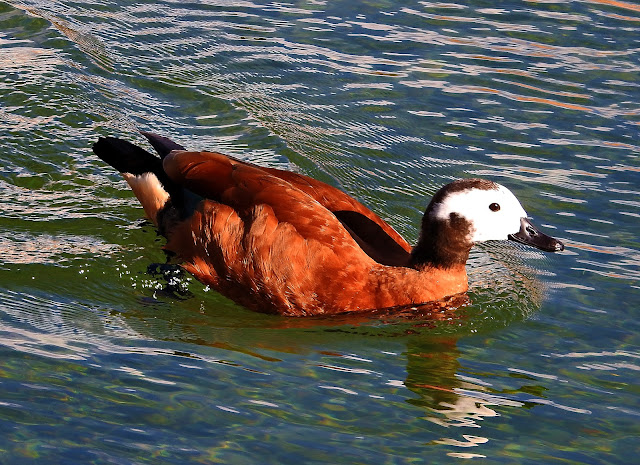
9-12-2021 CITY OF ARTS AND SCIENCES, VALENCIA - SOUTH AFRICAN SHELDUCK (MALE) (Tadorna cana)


9-12-2021 CITY OF ARTS AND SCIENCES, VALENCIA - SOUTH AFRICAN SHELDUCK (FEMALE) (Tadorna cana)


9-12-2021 CITY OF ARTS AND SCIENCES, VALENCIA - COMMON BOTTLENOSE DOLPHIN (Tursiops truncatus)


The common bottlenose dolphin or Atlantic bottlenose dolphin (Tursiops truncatus) is a wide-ranging marine mammal of the family Delphinidae. The common bottlenose dolphin is a very familiar dolphin due to the wide exposure it gets in captivity in marine parks and dolphinariums, and in movies and television programs. It is the largest species of the beaked dolphins. It inhabits temperate and tropical oceans throughout the world, and is absent only from polar waters. While formerly known simply as the bottlenose dolphin, this term is now applied to the genus Tursiops as a whole. As considerable genetic variation has been described within this species, even between neighboring populations, many experts think additional species may be recognized.

9-12-2021 CITY OF ARTS AND SCIENCES, VALENCIA - EURASIAN GREAT CORMORANT (Phalacrocorax carbo)


9-12-2021 CITY OF ARTS AND SCIENCES, VALENCIA - BAY NETTLE (Chrysaora chesapeakei)


CARPET MOTH (Catarhoe basochesiata)


17-12-2021 MONTE CORONA, VALENCIA - GEM MOTH (Orthonama obstipata)