The osprey (Pandion haliaetus), /ˈɒspri, -preɪ/,[2] also called sea hawk, river hawk, and fish hawk, is a diurnal, fish-eating bird of prey with a cosmopolitan range. It is a large raptor, reaching more than 60 cm (24 in) in length and 180 cm (71 in) across the wings. It is brown on the upperparts and predominantly greyish on the head and underparts.
The osprey tolerates a wide variety of habitats, nesting in any location near a body of water providing an adequate food supply. It is found on all continents except Antarctica, although in South America it occurs only as a non-breeding migrant.
As its other common names suggest, the osprey's diet consists almost exclusively of fish. It possesses specialised physical characteristics and unique behaviour in hunting its prey. Its unique characteristics classify it in its own taxonomic genus, Pandion, and family, Pandionidae.
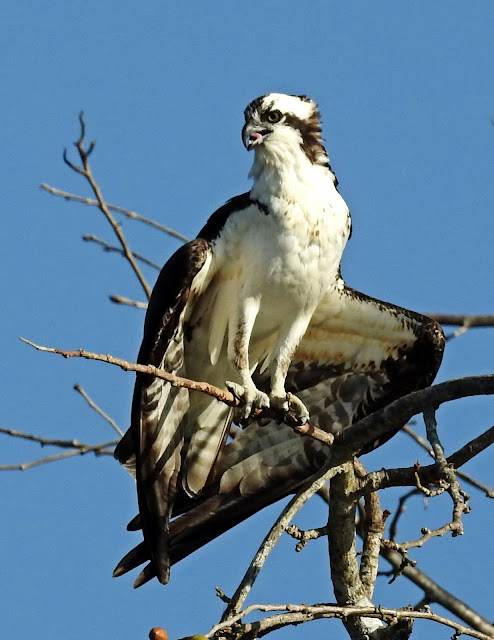
The osprey is the second most widely distributed raptor species, after the peregrine falcon, and is one of only six land-birds with a worldwide distribution. It is found in temperate and tropical regions of all continents, except Antarctica. In North America it breeds from Alaska and Newfoundland south to the Gulf Coast and Florida, wintering further south from the southern United States through to Argentina. It is found in summer throughout Europe north into Ireland, Scandinavia, Finland and Great Britain though not Iceland, and winters in North Africa. In Australia it is mainly sedentary and found patchily around the coastline, though it is a non-breeding visitor to eastern Victoria and Tasmania.
There is a 1,000 km (620 mi) gap, corresponding with the coast of the Nullarbor Plain, between its westernmost breeding site in South Australia and the nearest breeding sites to the west in Western Australia. In the islands of the Pacific it is found in the Bismarck Islands, Solomon Islands and New Caledonia, and fossil remains of adults and juveniles have been found in Tonga, where it probably was wiped out by arriving humans. It is possible it may once have ranged across Vanuatu and Fiji as well. It is an uncommon to fairly common winter visitor to all parts of South Asia, and Southeast Asia from Myanmar through to Indochina and southern China, Indonesia, Malaysia and the Philippines.

The osprey is piscivorous, with fish making up 99% of its diet. It typically takes live fish weighing 150–300 g (5.3–10.6 oz) and about 25–35 cm (9.8–13.8 in) in length, but virtually any type of fish from 50 g (1.8 oz) to 2 kg (4.4 lb) can be taken.[22] Even larger 2.8 kg (6.2 lb) northern pike (Esox lucius) has been taken in Russia. The species rarely scavenges dead or dying fish.
Characteristically its tongue often pokes out whilst swallowing food.
Ospreys have vision that is well adapted to detecting underwater objects from the air. Prey is first sighted when the osprey is 10–40 m (33–131 ft) above the water, after which the bird hovers momentarily and then plunges feet first into the water. They catch fish by diving into a body of water, oftentimes completely submerging their entire bodies. As an osprey dives it adjusts the angle of its flight to account for the distortion of the fish's image caused by refraction. Ospreys will typically eat on a nearby perch but have also been known to carry fish for longer distances.
Occasionally, the osprey may prey on rodents, rabbits, hares, other mammals, snakes, turtles, frogs, birds, salamanders, conchs and crustaceans. Reports of ospreys feeding on carrion are rare. They have been observed eating dead white-tailed deer and Virginia opossum.

The osprey breeds near freshwater lakes and rivers, and sometimes on coastal brackish waters. Rocky outcrops just offshore are used in Rottnest Island off the coast of Western Australia, where there are 14 or so similar nesting sites of which five to seven are used in any one year. Many are renovated each season, and some have been used for 70 years. The nest is a large heap of sticks, driftwood, turf or seaweed built in forks of trees, rocky outcrops, utility poles, artificial platforms or offshore islets. As wide as 2 meters and weighing about 135 kg (298 lb), large nests on utility poles may be fire hazards and have caused power outages.
Generally, ospreys reach sexual maturity and begin breeding around the age of three to four, though in some regions with high osprey densities, such as Chesapeake Bay in the United States, they may not start breeding until five to seven years old, and there may be a shortage of suitable tall structures. If there are no nesting sites available, young ospreys may be forced to delay breeding. To ease this problem, posts are sometimes erected to provide more sites suitable for nest building. In some regions ospreys prefer transmission towers as nesting sites, e.g. in eastern Germany.

Ospreys usually mate for life. Rarely, polyandry has been recorded. The breeding season varies according to latitude; spring (September–October) in southern Australia, April to July in northern Australia and winter (June–August) in southern Queensland. In spring the pair begins a five-month period of partnership to raise their young. The female lays two to four eggs within a month, and relies on the size of the nest to conserve heat. The eggs are whitish with bold splotches of reddish-brown and are about 6.2 cm × 4.5 cm (2.4 in × 1.8 in) and weigh about 65 g (2.3 oz). The eggs are incubated for about 35–43 days to hatching.

The newly hatched chicks weigh only 50–60 g (1.8–2.1 oz), but fledge in 8–10 weeks. A study on Kangaroo Island, South Australia, had an average time between hatching and fledging of 69 days. The same study found an average of 0.66 young fledged per year per occupied territory, and 0.92 young fledged per year per active nest. Some 22% of surviving young either remained on the island or returned at maturity to join the breeding population. When food is scarce, the first chicks to hatch are most likely to survive. The typical lifespan is 7–10 years, though rarely individuals can grow to as old as 20–25 years.

The oldest European wild osprey on record lived to be over thirty years of age. In North America, great horned owls (Bubo virginianus), golden eagles (Aquila chrysaetos), and bald eagles (Haliaeetus leucocephalus) are the only major predators of ospreys, capable of taking both nestlings and adults. However, kleptoparasitism by bald eagles, where the larger raptor steals the osprey's catch, is more common than predation. The white-tailed eagle (Haliaeetus albicilla), which is very similar to the bald eagle, may harass or prey on the osprey in Eurasia. Raccoons (Procyon lotor) can be a serious threat to nestlings or eggs if they can access the nest. Endoparasitic trematodes (Scaphanocephalus expansus and Neodiplostomum spp.) have been recorded in wild ospreys.
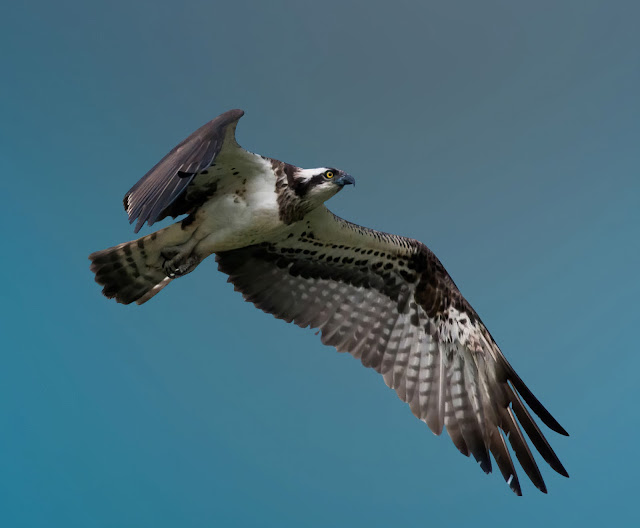%2010-gigapixel-scale-1_4x.jpg)
European breeders winter in Africa. American and Canadian breeders winter in South America, although some stay in the southernmost U.S. states such as Florida and California. Some ospreys from Florida migrate to South America. Australasian ospreys tend not to migrate.
Studies of Swedish ospreys showed that females tend to migrate to Africa earlier than males. More stopovers are made during their autumn migration. The variation of timing and duration in autumn was more variable than in spring. Although migrating predominantly during the day, they sometimes fly in the dark hours particularly in crossings over water and cover on average 260–280 km (160–170 mi) per day with a maximum of 431 km (268 mi) per day. European birds may also winter in South Asia, as indicated by an osprey tagged in Norway being monitored in western India. In the Mediterranean, ospreys show partial migratory behaviour with some individuals remaining resident, whilst others undertake relatively short migration trips.
%20(COURTESY%20MRS%20VALERIE%20FISHER)%2020.jpg)
%20(COURTESY%20MRS%20VALERIE%20FISHER)%2021.jpg)


%2020.jpg)


%2020.jpg)
%2020.jpg)

%2020.jpg)
%2021.jpg)
%2022.jpg)
%2020.jpg)
%2010.jpg)


%2021.jpg)


%2010-gigapixel-scale-1_4x.jpg)


%2020.jpg)
%2026.jpg)
%2021.jpg)
%2022.jpg)
%2025.jpg)
%2023.jpg)

%2030.jpg)
%2020.jpg)
%2021.jpg)
%2022.jpg)